TOPIC 9.5 · STUDY
Specific Heat and Thermal Conductivity
Specific heat c is intrinsic to a material while heat capacity mc belongs to a particular sample. Energy transfer for a temperature change is Q = m c Delta T. Steady conduction through a slab is k A Delta T / L, with series L/k values adding and parallel rates adding at the same Delta T.
9.5.A
Specific heat and conductivity
When a sample of mass $m$ and specific heat $c$ changes temperature by $\Delta T$, the energy transferred as heat is $$Q=mc\Delta T.$$ Specific heat $c$ is a property of the material, not of the sample size. Heat capacity is the product $mc$: it belongs to that particular piece of matter. Doubling the mass at fixed $c$ doubles the heat capacity and therefore doubles $Q$ for the same $\Delta T$, but $c$ itself does not change.
Example: a $0.40\,\mathrm{kg}$ sample with $c=500\,\mathrm{J/(kg\cdot K)}$ warmed by $20\,\mathrm{K}$ needs $$Q=(0.40)(500)(20)=4.00\times 10^{3}\,\mathrm{J}.$$ If the mass is doubled to $0.80\,\mathrm{kg}$ at the same $c$, the same $20\,\mathrm{K}$ rise needs twice the energy, $8.00\times 10^{3}\,\mathrm{J}$, while $c$ is unchanged.
If two samples absorb the same $Q$ and have the same product $mc$, they have the same $\Delta T$ because $\Delta T=Q/(mc)$. A sample with $3$ times the mass and $2$ times the specific heat has heat capacity $6mc$, so the same $Q$ changes its temperature by $1/6$ as much.
With constant heating power $P$, $$P=mc\,\frac{dT}{dt}.$$ On a graph of temperature versus time at fixed $P$, the slope is $dT/dt=P/(mc)$. A smaller slope means a larger heat capacity. At equal mass, the sample with the gentler slope has the larger specific heat.
Thermal conduction through a slab of conductivity $k$, cross-sectional area $A$, and thickness $L$ that spans a temperature difference $\Delta T=T_{\mathrm{H}}-T_{\mathrm{C}}$ has steady rate $$\frac{\Delta Q}{\Delta t}=\frac{kA\Delta T}{L}.$$ Energy flows from the hotter face toward the colder face.
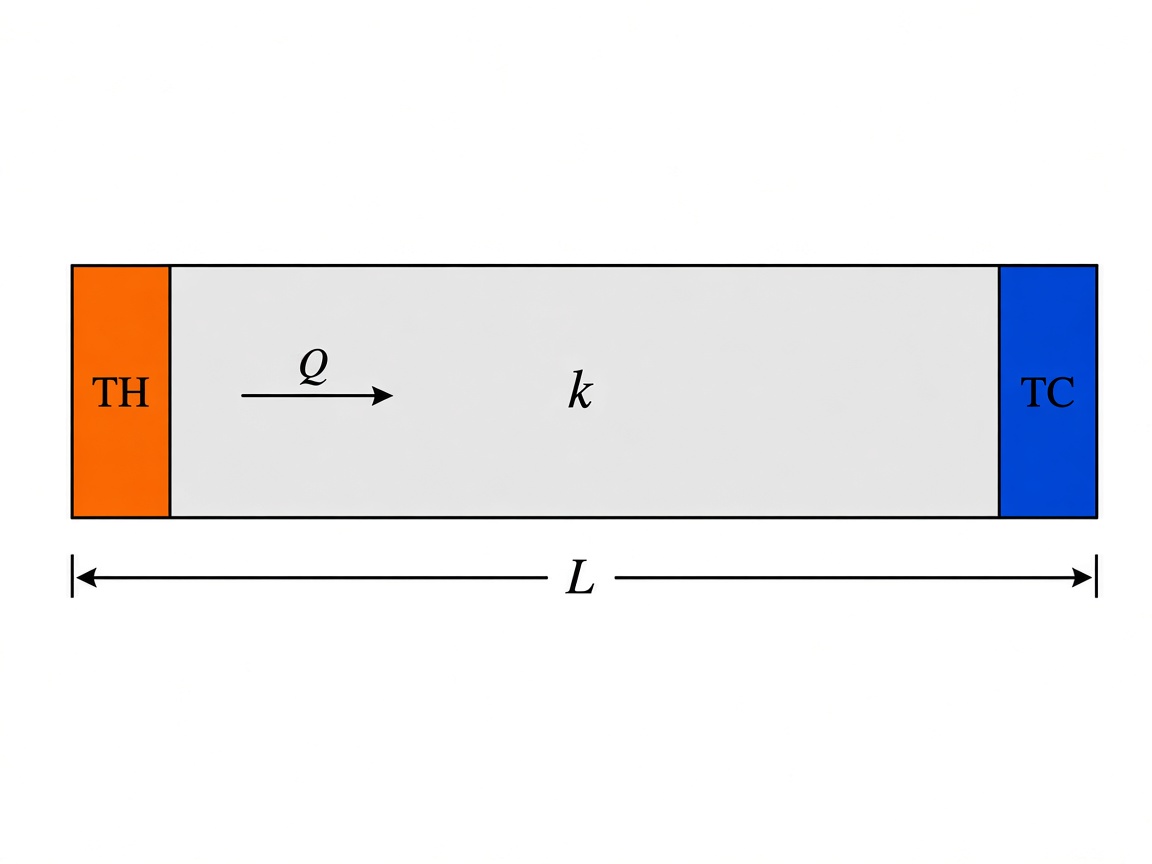
In steady state, the conduction rate is k A Delta T / L. Energy flows from the hot face TH toward the cold face TC.
Example: $k=200\,\mathrm{W/(m\cdot K)}$, $A=0.020\,\mathrm{m^{2}}$, $L=0.10\,\mathrm{m}$, and $\Delta T=30\,\mathrm{K}$ give $$\frac{\Delta Q}{\Delta t}=\frac{(200)(0.020)(30)}{0.10}=1.20\times 10^{3}\,\mathrm{W}.$$ Doubling both $A$ and $L$ leaves the rate unchanged because $A$ and $L$ cancel in the same ratio. The rate is proportional to $k$ and to $\Delta T$, and inversely proportional to $L$.
Series slabs: in steady state the conduction rate is the same through each slab, and the $L/k$ values add. Two slabs, each with $L=0.050\,\mathrm{m}$ and $A=0.020\,\mathrm{m^{2}}$, with $k=50\,\mathrm{W/(m\cdot K)}$ and $k=200\,\mathrm{W/(m\cdot K)}$, spanning a $40\,\mathrm{K}$ total difference, have $$\frac{L}{k}\ \mathrm{sum}=\frac{0.050}{50}+\frac{0.050}{200}=0.0010+0.00025=0.00125\,\mathrm{m^{2}\cdot K/W}.$$ The rate is $$\frac{\Delta Q}{\Delta t}=\frac{A\Delta T}{\sum(L/k)}=\frac{(0.020)(40)}{0.00125}=640\,\mathrm{W}.$$ Most of the temperature drop is across the lower-$k$ slab because that slab has the larger $L/k$.
Parallel slabs between the same two temperatures each have the same $\Delta T$, and the rates add. For two identical slabs, each with conductivity $k$, area $A$, and thickness $L$, the series rate is $kA\Delta T/(2L)$ while the parallel rate is $2(kA\Delta T/L)$. The parallel rate is therefore $4$ times the series rate: parallel doubles the conducting area while series doubles the effective thickness.
Calorimeter example (insulated, energy conservation): $0.20\,\mathrm{kg}$ of metal with $c=400\,\mathrm{J/(kg\cdot K)}$ at $100^{\circ}\mathrm{C}$ is placed in $0.50\,\mathrm{kg}$ of water with $c=4000\,\mathrm{J/(kg\cdot K)}$ at $20^{\circ}\mathrm{C}$. No energy leaves the system, so $$m_{\mathrm{m}}c_{\mathrm{m}}(T_{\mathrm{m}}-T_{f})=m_{\mathrm{w}}c_{\mathrm{w}}(T_{f}-T_{\mathrm{w}}),$$ which rearranges to $$T_{f}=\frac{m_{\mathrm{m}}c_{\mathrm{m}}T_{\mathrm{m}}+m_{\mathrm{w}}c_{\mathrm{w}}T_{\mathrm{w}}}{m_{\mathrm{m}}c_{\mathrm{m}}+m_{\mathrm{w}}c_{\mathrm{w}}}.$$ Check the arithmetic: $(0.20)(400)(100)+(0.50)(4000)(20)=8000+40000=48000$. Denominator $80+2000=2080$. Then $T_{f}=48000/2080=23.1^{\circ}\mathrm{C}$.
Key points
- Energy for a temperature change: $Q=mc\Delta T$; $c$ is intrinsic to the material, while $mc$ is the sample's heat capacity.
- Equal $Q$ and equal $mc$ mean equal $\Delta T$; larger heat capacity means a smaller temperature change for the same energy.
- Constant power: $P=mc\,dT/dt$; a smaller slope on a $T$-versus-time graph means larger heat capacity.
- Steady conduction through a slab: $\Delta Q/\Delta t=kA\Delta T/L$; rate scales with $k$ and $\Delta T$, and as $1/L$.
- Series slabs share one rate; the $L/k$ values add, and most of $\Delta T$ falls across the larger $L/k$ (usually lower $k$).
- Parallel slabs share the same $\Delta T$; rates add.
- Two identical slabs: parallel rate is $4$ times series rate (double area versus double thickness).
- Insulated calorimeter: energy lost by the hot object equals energy gained by the cold object until a common $T_{f}$.
Specific heat describes the material; heat capacity $mc$ describes the particular sample.