TOPIC 9.6 · STUDY
Entropy and the Second Law of Thermodynamics
Entropy is a state function for a system. An isolated system never loses entropy; irreversible processes raise it, while reversible ones leave it unchanged. A closed system can lose entropy when heat leaves, but the isolated total of system plus surroundings does not decrease. Spreading of energy raises entropy even when energy itself is conserved.
9.6.A
Entropy and the second law
Entropy is a property of the macroscopic state of a system. If two processes take a system from the same initial state to the same final state, the entropy change of that system is the same for both paths, whether the path was reversible or irreversible. Irreversibility shows up in the entropy of a larger isolated combination that includes everything involved, not as a path-dependent change of the system's own entropy between fixed endpoints.
An isolated system exchanges neither energy nor matter with its surroundings. For any isolated system the second law says the total entropy never decreases. Entropy stays constant only when every process inside is reversible. Any irreversible process inside an isolated system increases the total entropy.
A closed system can exchange energy with the surroundings but not matter. Its entropy can decrease. A refrigerator that pumps heat out of its cold interior is an example: the entropy of that closed interior can fall. The second law does not forbid that local decrease. It applies to the isolated combination of the refrigerator plus the kitchen air and coils that receive the rejected energy. That total entropy does not decrease.
Energy conservation alone does not freeze entropy. Place a hot metal block in cold water inside a sealed, insulated cooler. Treating the cooler and its contents as one isolated system, energy is conserved. Thermal energy that started concentrated in the block spreads through the water. That irreversible spreading increases the entropy of the isolated cooler until the block and water reach a common temperature.
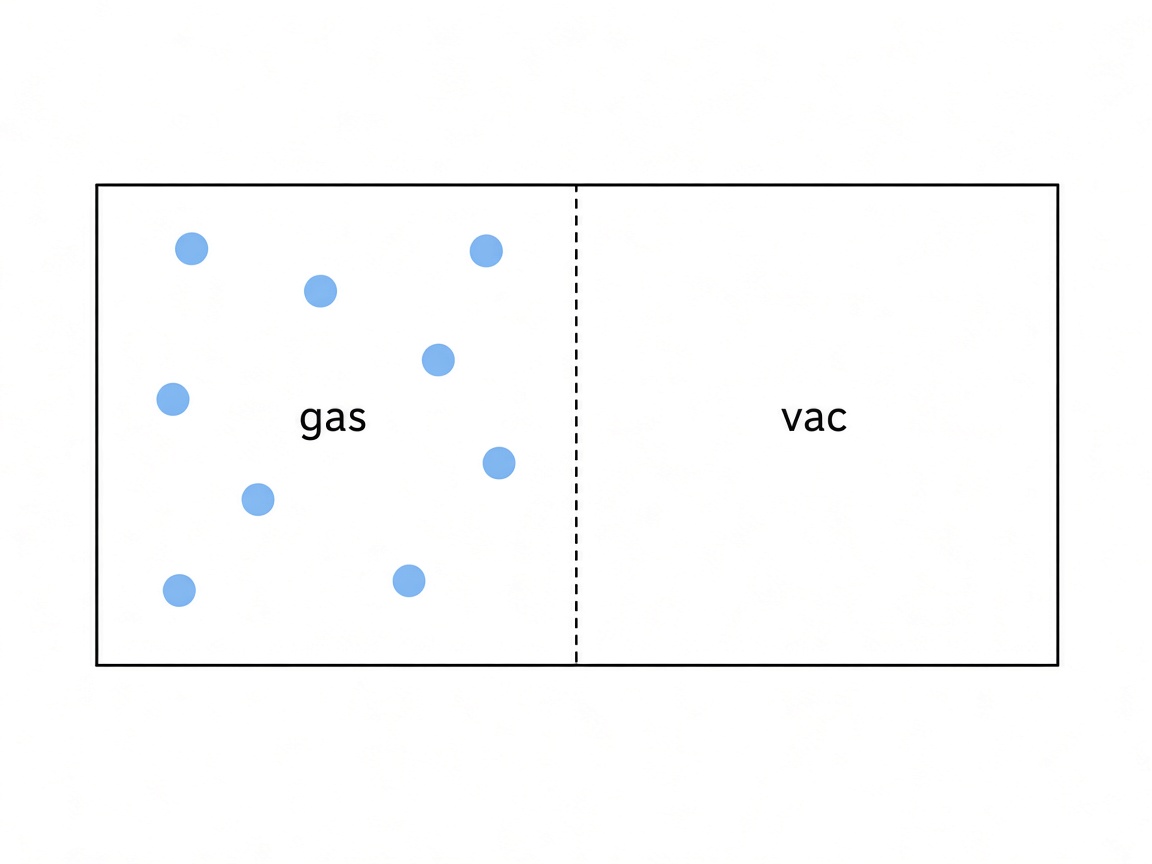
If the partition is removed, the gas expands freely into the vacuum. The box is isolated, and this irreversible spreading increases the entropy.
Free expansion of a gas into vacuum inside an insulated box is a clean illustration. No energy or matter crosses the outer wall, so the box is isolated and $Q$ at that wall is zero. The expansion is still irreversible: the gas settles into a larger volume. The entropy of the box increases because the same energy now occupies more space.
Thermal equilibrium of an isolated system is the maximum-entropy state consistent with the energy and other constraints. Once two blocks in an isolated box share one temperature, a spontaneous return to a hot region and a cold region would decrease the entropy of the box. That does not happen.
Higher entropy means the energy is more spread out and less available to do useful work. After an isolated irreversible mixing or free expansion has finished, waiting longer does not create a new store of extractable work from that completed dispersal. You cannot harvest more useful work merely by waiting after the irreversible spreading is done.
A crystal that forms from solution, or a cup of hot tea that cools on a table, can lose entropy while heat leaves it. Those objects are not isolated. The surroundings that receive the heat gain at least as much entropy, so the entropy of an appropriate isolated combination of system plus surroundings does not decrease.
Key points
- Entropy is a state function: the same initial and final macroscopic states give the same entropy change for that system on any path.
- An isolated system exchanges neither energy nor matter; its entropy never decreases and rises for irreversible processes.
- A closed system can exchange energy; its entropy can fall when heat leaves, as in a refrigerator interior.
- The second law constrains the isolated total of system plus surroundings, which does not decrease.
- Energy can be conserved while entropy still increases when thermal energy spreads, as in a hot block in cold water inside an insulated cooler.
- Free expansion into vacuum in an insulated box has $Q=0$ at the outer wall yet raises entropy because the energy occupies a larger volume.
- Equilibrium of an isolated system is the maximum-entropy state; a spontaneous return to hot and cold regions does not occur.
- Higher entropy means energy is more dispersed and less available for useful work.
The second law limits the entropy of an isolated system; a closed system that loses heat can lose entropy.