Entropy and the Second Law of Thermodynamics FRQ Practice

Responses receive AI feedback against a rubric after submission. Scores are practice estimates.

Question 1 of 5

A sealed aquarium heater runs for several minutes inside a closed, insulated aquarium (water plus air plus heater treated as one system). The water warms and then the heater is switched off. (a) While the heater runs, organized electrical energy becomes thermal energy. Explain qualitatively what happens to the entropy of this isolated aquarium system. (b) After the heater is off and the water temperature is uniform, has the system reached maximum entropy for its constraints? Justify. (c) Could waiting longer cause the aquarium’s entropy to decrease back toward its pre-heating value without interaction with the outside? Explain.
Question 2 of 5

A cup of hot cocoa cools on a table in a closed kitchen. (a) Taking only the cocoa as the system, state whether its entropy increases or decreases and why. (b) Taking cocoa plus kitchen air as an isolated combination, state whether that total entropy increases or decreases and why. (c) Explain how the two answers can both be true without contradicting the second law.

Question 3 of 5

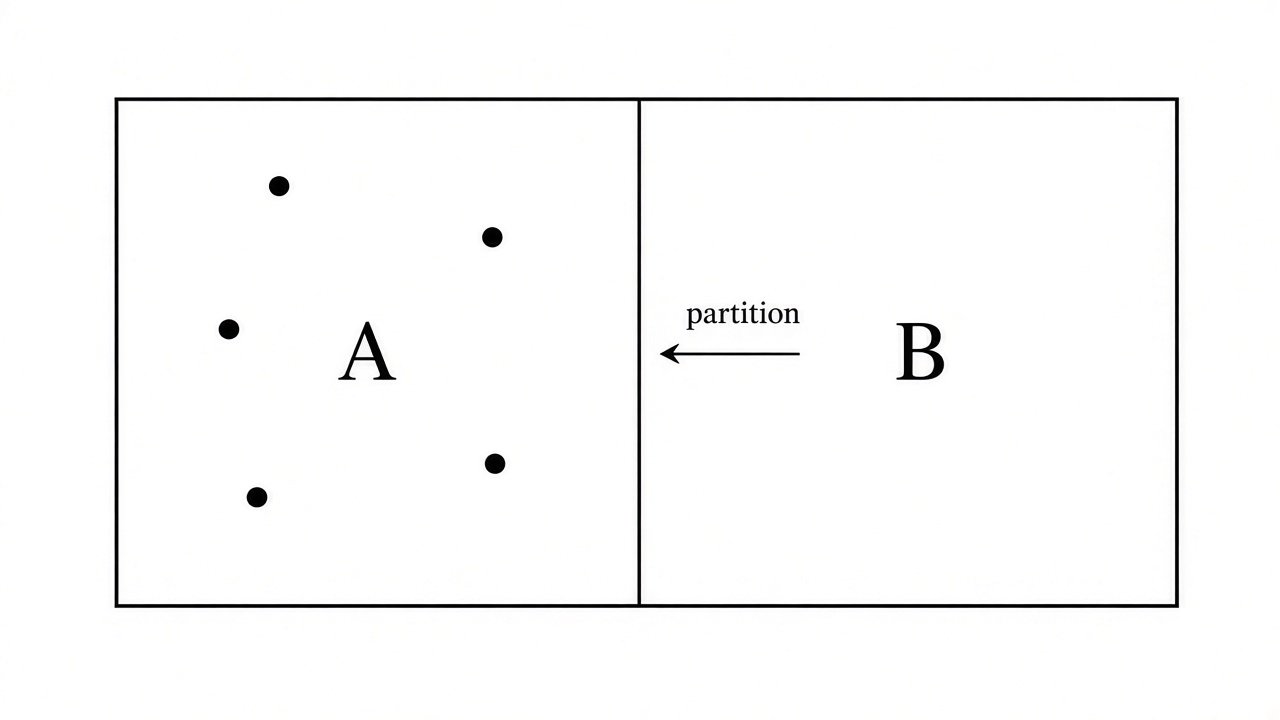
An insulated box is divided into chambers A and B by a partition. Chamber A holds gas; chamber B is vacuum. The partition is removed and the gas fills both chambers. (a) Explain why this free expansion increases the entropy of the box even though no heat is added through the outer walls. (b) Relate your answer to energy becoming more spread out. (c) If the same initial and final gas states were connected instead by a slow reversible path that required carefully controlled heat exchange with a reservoir, would $\Delta S$ of the gas alone be different from the free-expansion value? Justify.

A sealed box divided into chamber A with gas and empty chamber B, separated by a removable partition.

Question 4 of 5

A laboratory freezer removes heat from its interior while dumping more heat into the room. (a) Identify the interior as isolated or closed during normal operation with the door shut, and justify. (b) Can the interior’s entropy decrease? Justify with the energy transfer across its boundary. (c) Write one clear sentence stating what must be true of the entropy change of the room (including the warm coils) relative to the interior so the second law is satisfied for freezer-plus-room.

Question 5 of 5

Two metal blocks of equal heat capacity are placed in contact inside an insulated sack. Initially one is hot and one is cold. (a) Describe the spontaneous direction of heat flow and the final equilibrium condition. (b) Explain why the sack’s total entropy increases during the approach to equilibrium even though energy is conserved. (c) A student proposes reconnecting a tiny heat engine between the blocks “to extract work forever after they equalize.” Explain why that proposal fails using entropy or energy-dispersal language.