Entropy and the Second Law of Thermodynamics MCQ Practice

Question 1 of 10

A rigid, thermally insulated box is divided into two equal chambers by a removable partition. Chamber A holds an ideal gas. Chamber B is evacuated. The partition is pulled out and the gas fills both chambers; then the gas settles and no further macroscopic changes occur. Treating the entire box as the system, which statement is correct?
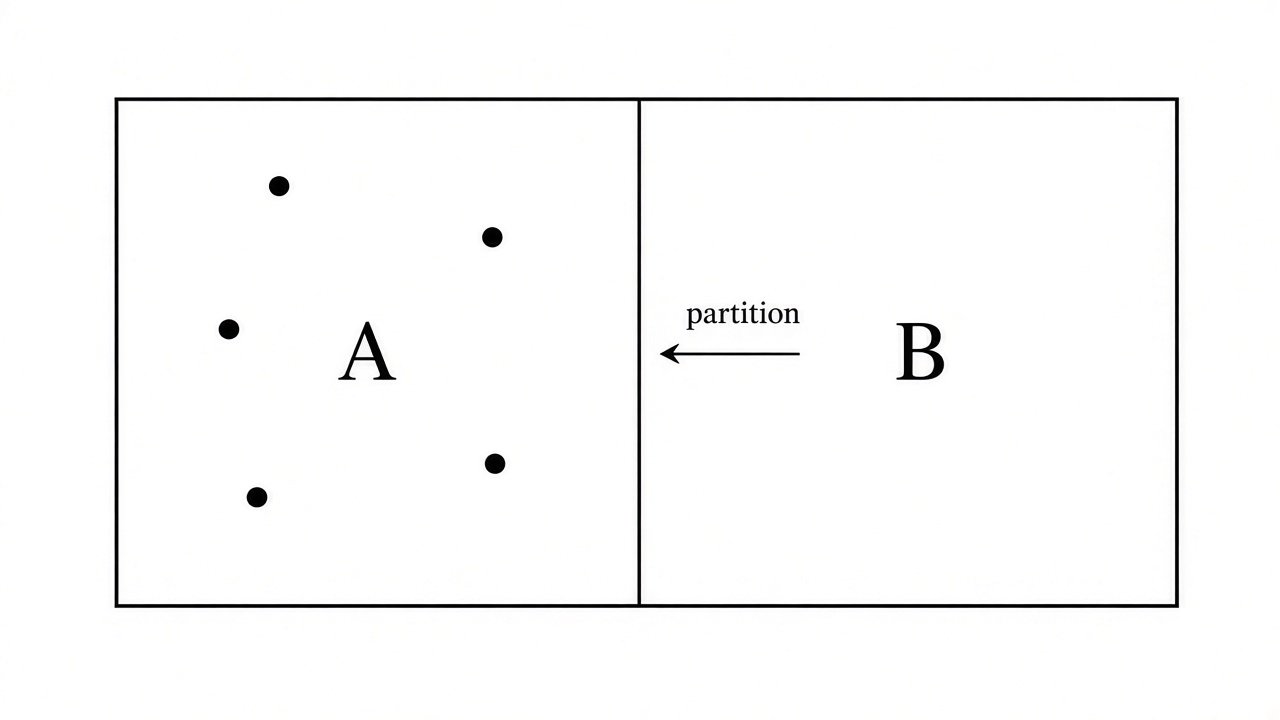
A sealed box divided into chamber A with gas and empty chamber B, separated by a removable partition.
  1. A. The process is reversible, so the entropy of the box is unchanged.
  2. B. The box is isolated, so its entropy must decrease as the gas expands.
  3. C. The box is isolated and the expansion is irreversible, so the entropy of the box increases.
  4. D. Entropy is a state function, so the entropy of the box cannot change unless work is done on the surroundings.

Question 2 of 10

Two identical isolated samples of the same gas start in the same initial macroscopic state and end in the same final macroscopic state. Sample X is taken between those states by a slow, reversible sequence of processes. Sample Y is taken between the same states by a fast, irreversible sequence. How do the entropy changes of the two samples compare?

  1. A. $\Delta S_X > \Delta S_Y$, because irreversible processes create more entropy inside the system.
  2. B. $\Delta S_X < \Delta S_Y$, because only irreversible processes change entropy.
  3. C. $\Delta S_X = 0$ and $\Delta S_Y > 0$, because entropy is constant for any process of an isolated sample.
  4. D. $\Delta S_X = \Delta S_Y$, because entropy is a state function and both samples share the same initial and final states.

Question 3 of 10

A student says that when a hot metal block is placed in cold water inside a sealed, insulated cooler, “energy is conserved, so nothing about entropy can change.” Which response best corrects the claim while staying qualitative?

  1. A. Energy is conserved, but initially localized thermal energy spreads; the cooler’s total entropy increases until the block and water reach equilibrium.
  2. B. Energy is not conserved in the cooler, and that violation is what raises entropy.
  3. C. Entropy decreases because heat flows spontaneously from hot to cold.
  4. D. Entropy is unchanged because the cooler is isolated and all processes inside it are reversible.

Question 4 of 10

A kitchen refrigerator runs steadily with its door closed. Take the cold interior and the food inside as the system. Energy leaves that system as heat is pumped out. Which statement is consistent with the second law?

  1. A. The system’s entropy can decrease; the kitchen air and coils that receive the rejected heat gain at least as much entropy.
  2. B. The system’s entropy must increase because any working device increases entropy.
  3. C. The system’s entropy is constant because a refrigerator cycle is reversible.
  4. D. The second law forbids any decrease of entropy in any system that exchanges energy.

Question 5 of 10

The table lists qualitative entropy changes claimed by a student for three processes. For each row, “system” means only the named object; “surroundings” means everything else; “isolated total” means system plus surroundings treated as one isolated combination.

Process System $\Delta S$ Surroundings $\Delta S$ Isolated total $\Delta S$
Hot coffee cools in a closed thermos that exchanges no energy decreases unchanged decreases
Ice melts while absorbing heat from a warmer room increases decreases decreases
Ideal gas expands irreversibly into vacuum inside a sealed insulated box increases unchanged increases

Which row is consistent with the second law and with a correct choice of system boundary?

  1. A. Only the coffee row
  2. B. Only the ice row
  3. C. Only the free-expansion row
  4. D. The ice row and the free-expansion row, but not the coffee row

Question 6 of 10

A closed container of gas and a movable piston undergoes a cyclic process that returns the gas to its original macroscopic state. During one irreversible segment of the cycle, friction dissipates organized mechanical energy as thermal energy. Compared with a fully reversible cycle between the same turning points, what must be true of the entropy of the gas alone after a complete cycle?

  1. A. It is higher after the irreversible cycle because friction always raises the gas’s entropy.
  2. B. It is the same after either cycle, because entropy is a state function and the initial and final states match.
  3. C. It is lower after the irreversible cycle because some energy became unavailable to do work.
  4. D. It is undefined after an irreversible cycle.

Question 7 of 10

Crystals of a salt form spontaneously from a supersaturated solution in an open flask on a lab bench. The crystal lattice is more ordered than the dissolved ions. A student claims this spontaneous ordering violates the second law. Why is the claim incorrect?

  1. A. The second law applies only to gases, not to solutions or solids.
  2. B. Ordering never changes entropy; only temperature changes entropy.
  3. C. The crystals alone are not an isolated system; heat and interactions with the solution and surroundings allow the total entropy of an appropriate isolated combination to increase.
  4. D. Spontaneous processes always decrease entropy of every subsystem.

Question 8 of 10

A cup of hot tea sits on a table in a closed classroom. Over time the tea cools to room temperature. Treat the tea as a closed system. Which description of entropy changes is correct?

  1. A. Entropy of the tea decreases; entropy of the room air increases by at least as much; entropy of tea plus room does not decrease.
  2. B. Entropy of the tea increases because cooling is spontaneous.
  3. C. Entropy of the tea is constant because the tea remains liquid.
  4. D. Entropy of tea plus room decreases because organized thermal energy is lost.

Question 9 of 10

An isolated rigid box contains two large metal blocks in contact. Initially one block is much hotter than the other. After a long time the blocks reach a common temperature and no further macroscopic change occurs. Which statement best describes the entropy of the isolated box?

  1. A. It decreased while heat flowed, then stopped changing at equilibrium.
  2. B. It increased while heat flowed and is now at its maximum for the available energy and constraints.
  3. C. It stayed constant the whole time because the box is isolated.
  4. D. It is undefined until someone computes $Q/T$ for each block.

Question 10 of 10

After an irreversible mixing process finishes inside an isolated insulated tank, a student wants to harvest more useful work from the now-uniform warm mixture than was available from the earlier, more localized energy distribution—without any further energy entering the tank. Which response is best?

  1. A. Impossible: the higher entropy of the mixed state means more of the tank’s energy is unavailable for work than before.
  2. B. Possible: uniform mixtures always store energy in a more usable form.
  3. C. Possible: isolation freezes entropy, so work potential is unchanged.
  4. D. Impossible only because energy was not conserved; entropy is irrelevant.