Electric Charge and Electric Force MCQ Practice

Question 1 of 10

Two point charges $q_1=+3.0\times 10^{-6}\,\mathrm{C}$ and $q_2=+2.0\times 10^{-6}\,\mathrm{C}$ are fixed $0.20\,\mathrm{m}$ apart in vacuum. Take $k=8.99\times 10^{9}\,\mathrm{N\cdot m^{2}/C^{2}}$. What is the magnitude of the electrostatic force on $q_2$ due to $q_1$?

  1. A. $6.7\times 10^{-1}\,\mathrm{N}$
  2. B. $1.3\,\mathrm{N}$
  3. C. $2.7\,\mathrm{N}$
  4. D. $5.4\,\mathrm{N}$

Question 2 of 10

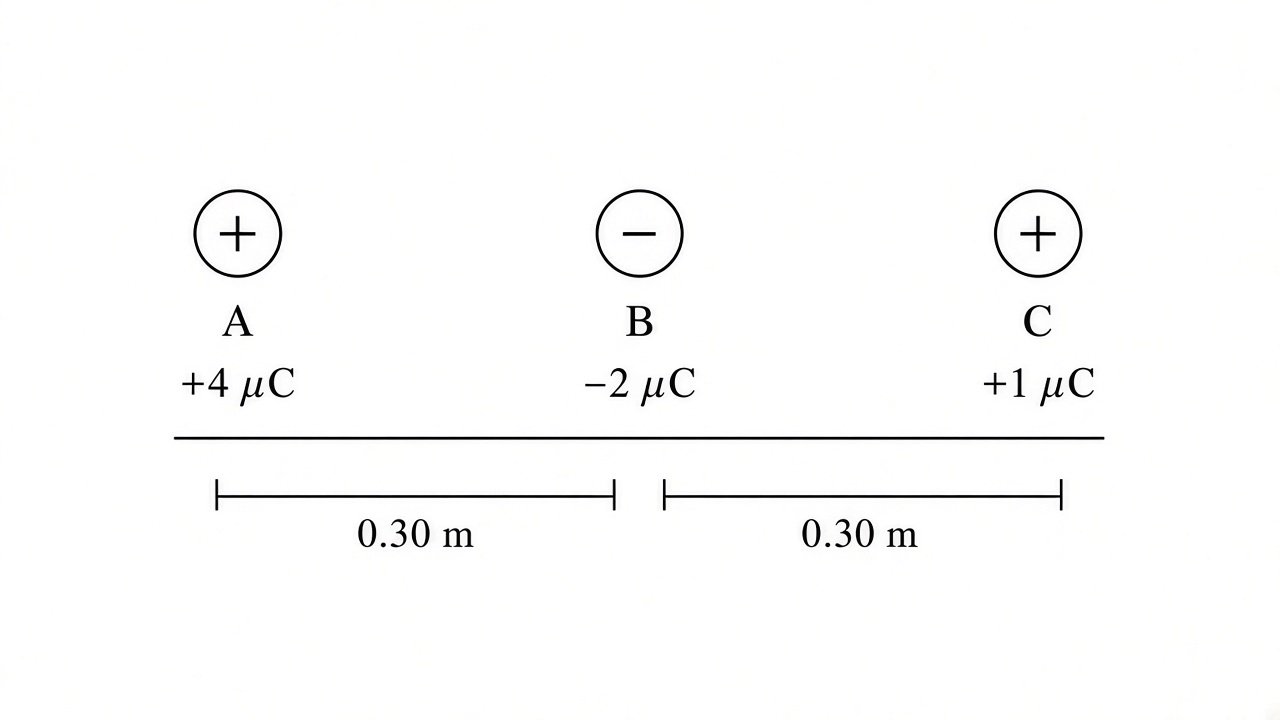
Three point charges lie on a straight line in vacuum. Charge $A$ of $+4.0\,\mu\mathrm{C}$ is at $x=0$, charge $B$ of $-2.0\,\mu\mathrm{C}$ is at $x=0.30\,\mathrm{m}$, and charge $C$ of $+1.0\,\mu\mathrm{C}$ is at $x=0.60\,\mathrm{m}$. Take $k=8.99\times 10^{9}\,\mathrm{N\cdot m^{2}/C^{2}}$. What is the net electrostatic force on charge $B$?

Three collinear point charges A, B, and C on a horizontal line with separations labeled.
  1. A. $0.60\,\mathrm{N}$ toward $A$
  2. B. $0.60\,\mathrm{N}$ toward $C$
  3. C. $1.0\,\mathrm{N}$ toward $A$
  4. D. $0.20\,\mathrm{N}$ toward $C$

Question 3 of 10

Two point charges exert an electrostatic force of magnitude $F$ on each other when separated by distance $d$. One charge is doubled and the separation is tripled. The new force magnitude is

  1. A. $\dfrac{2}{9}F$
  2. B. $\dfrac{2}{3}F$
  3. C. $\dfrac{6}{9}F$
  4. D. $6F$

Question 4 of 10

Four identical point charges $+Q$ occupy the corners of a square of side $a$ in vacuum. The magnitude of the net electrostatic force on one of the charges is

  1. A. $\dfrac{kQ^{2}}{a^{2}}\left(\sqrt{2}+\dfrac{1}{2}\right)$
  2. B. $\dfrac{kQ^{2}}{a^{2}}\left(2+\dfrac{1}{2}\right)$
  3. C. $\dfrac{2kQ^{2}}{a^{2}}$
  4. D. $\dfrac{kQ^{2}}{a^{2}}\sqrt{2}$

Question 5 of 10

Two protons are separated by distance $r$ in free space. Let $F_E$ be the magnitude of the electrostatic force and $F_G$ the magnitude of the gravitational force between them. Using $k=8.99\times 10^{9}\,\mathrm{N\cdot m^{2}/C^{2}}$, $G=6.67\times 10^{-11}\,\mathrm{N\cdot m^{2}/kg^{2}}$, $e=1.60\times 10^{-19}\,\mathrm{C}$, and $m_p=1.67\times 10^{-27}\,\mathrm{kg}$, the ratio $F_E/F_G$ is closest to

  1. A. $10^{16}$
  2. B. $10^{26}$
  3. C. $10^{36}$
  4. D. $10^{46}$

Question 6 of 10

A student claims that because gravity is much weaker than electrostatic force between elementary particles, gravitational forces should also be negligible between planets. Which response best addresses the claim?

  1. A. The claim is correct: electrostatic forces dominate at all scales.
  2. B. The claim is incorrect because planets are nearly electrically neutral, so net electrostatic forces nearly cancel while gravitational forces accumulate.
  3. C. The claim is incorrect because gravity increases with distance while electrostatic forces decrease.
  4. D. The claim is correct for planets but incorrect for stars.

Question 7 of 10

Two identical tiny spheres each have mass $m$ and charge $+q$. They hang in equilibrium from insulating threads of equal length so that the electrostatic repulsion holds them a fixed horizontal distance $d$ apart. If both charges are doubled while $m$ and $d$ remain the same in a new equilibrium (by adjusting thread length if needed), the ratio of the new electrostatic force to the original electrostatic force is

  1. A. $1$
  2. B. $2$
  3. C. $4$
  4. D. $8$

Question 8 of 10

In Coulomb’s law written as $F=\dfrac{1}{4\pi\varepsilon}|q_1 q_2|/r^{2}$, the quantity $\varepsilon$ is the electric permittivity of the medium. Which statement is correct?

  1. A. Larger $\varepsilon$ means a larger force between the same charges at the same separation.
  2. B. Larger $\varepsilon$ means a smaller force between the same charges at the same separation.
  3. C. $\varepsilon$ depends only on the magnitudes of $q_1$ and $q_2$.
  4. D. $\varepsilon$ is zero in free space.

Question 9 of 10

Two point charges experience force magnitude $F_0$ when separated by distance $d$ in vacuum ($\varepsilon=\varepsilon_0$). The same charges are immersed in an insulating liquid with permittivity $\varepsilon=4\varepsilon_0$, still separated by $d$. The new force magnitude is

  1. A. $F_0/4$
  2. B. $F_0/2$
  3. C. $2F_0$
  4. D. $4F_0$

Question 10 of 10

Which microscopic picture best explains why the permittivity of an insulating material differs from that of free space?

  1. A. The material spontaneously creates net charge, changing Coulomb’s constant permanently.
  2. B. An external electric field rearranges bound charges (polarization), altering the effective field that mediates the force between free charges.
  3. C. Insulators allow charge carriers to move freely, shorting out any force.
  4. D. Permittivity measures only temperature, not charge arrangement.