TOPIC 10.1 · STUDY
Electric Charge and Electric Force
Electric charge is positive or negative. Coulomb's law gives the force between point charges; like charges repel and opposite charges attract along the line joining them. Permittivity reduces the force in a medium, and electrostatic forces between protons dwarf gravity.
10.1.A
Electric charge and Coulomb's law
Electric charge is a signed scalar: a body can carry positive charge or negative charge. Like charges repel; opposite charges attract. The force on each charge lies along the line joining the two charges.
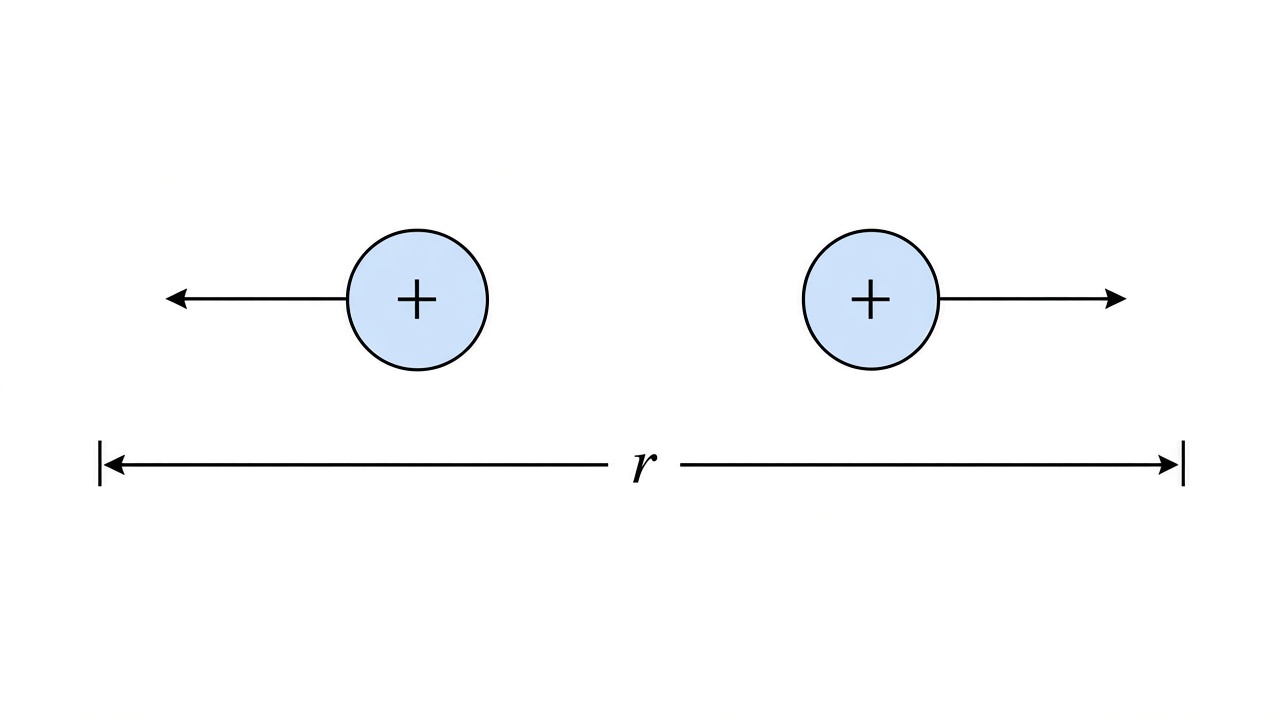
Like charges repel. Each force lies along the line joining the charges, and the two forces are equal in magnitude and opposite in direction.
Coulomb's law gives the magnitude of the electrostatic force between two point charges: $$F=k\frac{|q_1 q_2|}{r^2},$$ with $k=9.0\times 10^{9}\,\mathrm{N\cdot m^{2}/C^{2}}$. Example: both charges $2.0\times 10^{-6}\,\mathrm{C}$ and $r=0.10\,\mathrm{m}$ give $|q_1 q_2|=4.0\times 10^{-12}\,\mathrm{C^{2}}$ and $r^{2}=0.010\,\mathrm{m^{2}}$, so $$F=(9.0\times 10^{9})(4.0\times 10^{-12})/(0.010)=3.6\,\mathrm{N}.$$
Newton's third law still applies: the forces on the two charges are equal in magnitude and opposite in direction, even if the charge magnitudes differ. Each force is along the line joining the charges.
Doubling one charge doubles $F$, so the example force becomes $7.2\,\mathrm{N}$. Tripling $r$ multiplies $F$ by $1/9$, giving $0.40\,\mathrm{N}$.
The same law in a medium is $F=|q_1 q_2|/(4\pi\epsilon r^2)$, with $k=1/(4\pi\epsilon_0)$ and $\epsilon_0=8.85\times 10^{-12}\,\mathrm{C^{2}/(N\cdot m^{2})}$. A larger permittivity reduces the force. If $\epsilon=2\epsilon_0$, the force is half the vacuum value. Polarization of an insulator produces that reduction.
The electrostatic force between two protons is vastly larger than their gravitational force, on the order of $10^{36}$ times, because $k e^{2}$ greatly exceeds $G m_{p}^{2}$. Here $e=1.60\times 10^{-19}\,\mathrm{C}$.
Neutral macroscopic objects have canceling positive and negative charges, so the net electrostatic force between planets can be negligible. Gravity can dominate between planets even though it is negligible between protons.
Key points
- Charge is positive or negative; like charges repel and opposite charges attract.
- Coulomb's law: $F=k|q_1 q_2|/r^2$ with $k=9.0\times 10^{9}\,\mathrm{N\cdot m^{2}/C^{2}}$.
- Forces on the two charges are equal in magnitude and opposite in direction, even if the charges differ.
- Doubling one charge doubles $F$; tripling $r$ multiplies $F$ by $1/9$.
- In a medium, larger $\epsilon$ reduces $F$; if $\epsilon=2\epsilon_0$, $F$ is half the vacuum value.
- Electrostatic force between protons is about $10^{36}$ times their gravitational force.
- Neutral macroscopic bodies can let gravity dominate despite tiny proton-scale gravity.
Coulomb forces are equal-and-opposite pairs along the line joining the charges.