TOPIC 10.2 · STUDY
Conservation of Electric Charge and the Process of Charging
Net charge of an isolated system is conserved and comes in units of the elementary charge. Contact and induction move electrons between objects; identical conductors that touch share the total charge equally.
10.2.A
Conservation and charging
The net charge of an isolated system is conserved. Rubbing a rod with fur moves electrons from one object to the other; it does not create charge. The elementary charge is $e=1.60\times 10^{-19}\,\mathrm{C}$. If the rod gains $-4.80\times 10^{-19}\,\mathrm{C}$, that is 3 electrons onto the rod, and the fur's net charge becomes $+4.80\times 10^{-19}\,\mathrm{C}$.
Charge is quantized in units of $e$. A reported transfer of $2.5\times 10^{-19}\,\mathrm{C}$ is not an integer multiple of $e$ ($2.5/1.60=1.56$), so it cannot be a count of electrons.
In metals the mobile carriers are electrons. Protons stay in the nuclei.
Identical conducting spheres that touch share the total charge equally. Example: spheres with $+6.0\,\mu\mathrm{C}$ and $-2.0\,\mu\mathrm{C}$ become $+2.0\,\mu\mathrm{C}$ each. The total $+4.0\,\mu\mathrm{C}$ is unchanged. Charge flows until the two touching conductors are at the same potential.
Charging by contact: a negative rod touched to a neutral conductor gives the conductor some electrons, so both end negative.
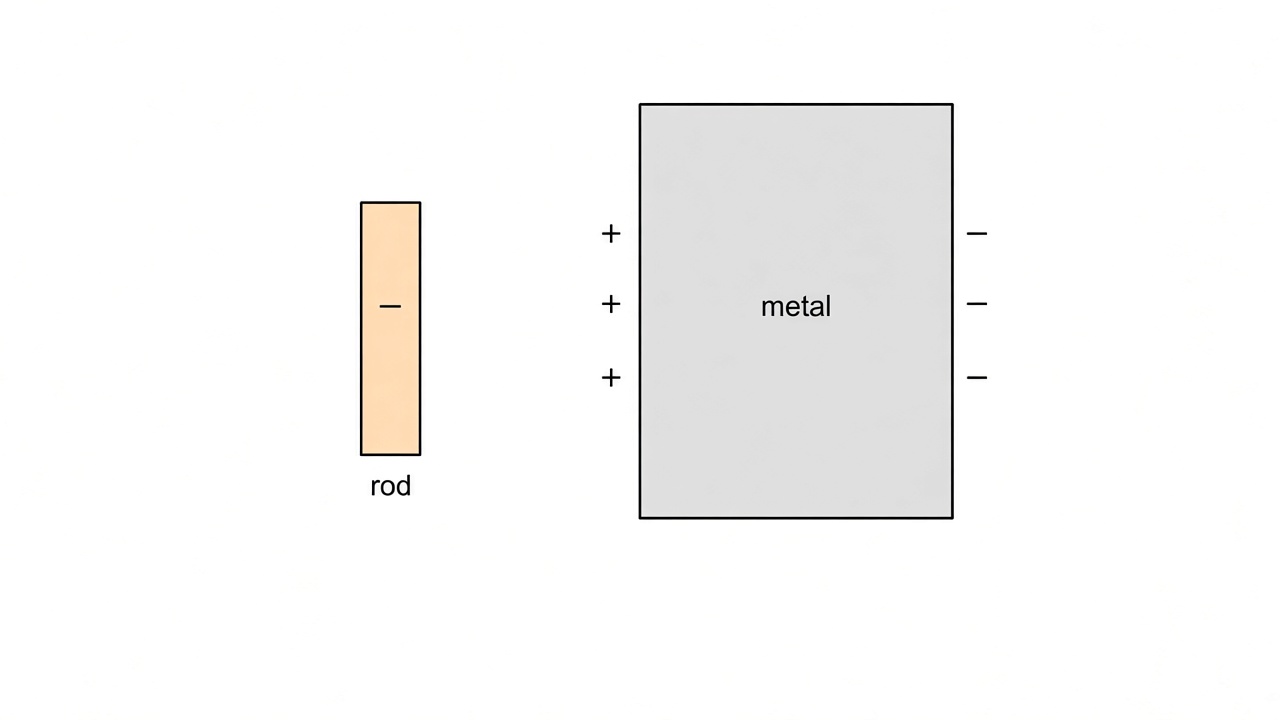
The rod does not touch the metal. It separates existing charges: the near face becomes positive and the far face becomes negative. The metal's net charge is still zero.
Induction without grounding only separates charge; the conductor's net charge stays zero. The figure shows that step.
Charging by induction: hold a negative rod near a neutral conductor, ground the far side so electrons leave, remove the ground, then remove the rod. The conductor is left positive. A positive rod, with the same sequence, leaves the conductor negative because electrons flow in from ground.
Grounding a charged conductor connects it to Earth, a huge reservoir. Excess charge flows until the small conductor is essentially neutral.
Key points
- Net charge of an isolated system is conserved; rubbing transfers electrons and does not create charge.
- Charge is quantized in units of $e=1.60\times 10^{-19}\,\mathrm{C}$; a non-integer multiple of $e$ cannot be a count of electrons.
- In metals, electrons move; protons stay fixed in nuclei.
- Identical conductors that touch share the total charge equally; total charge is unchanged.
- Contact with a charged rod leaves both objects with the same sign of charge.
- Induction without grounding only separates charge; net charge stays zero.
- Induction with grounding can leave a conductor charged opposite in sign to the nearby rod.
- Grounding connects a small conductor to Earth so excess charge flows until the conductor is essentially neutral.
Induction with grounding changes the conductor's net charge even though the rod never touches it.