TOPIC 10.3 · STUDY
Electric Fields
The electric field is the force per unit positive test charge. Point-charge fields fall as one over r squared, field vectors add by superposition, and conductors in electrostatic equilibrium have zero field inside the material with excess charge on the surface.
10.3.A
Electric fields
The electric field $\vec E$ at a point is defined by $\vec F=q\vec E$. The field points in the direction of the force on a positive test charge. A test charge must be small enough not to move the source charges that produce the field. The constant in Coulomb's law is $k=9.0\times 10^{9}\,\mathrm{N\cdot m^{2}/C^{2}}$.
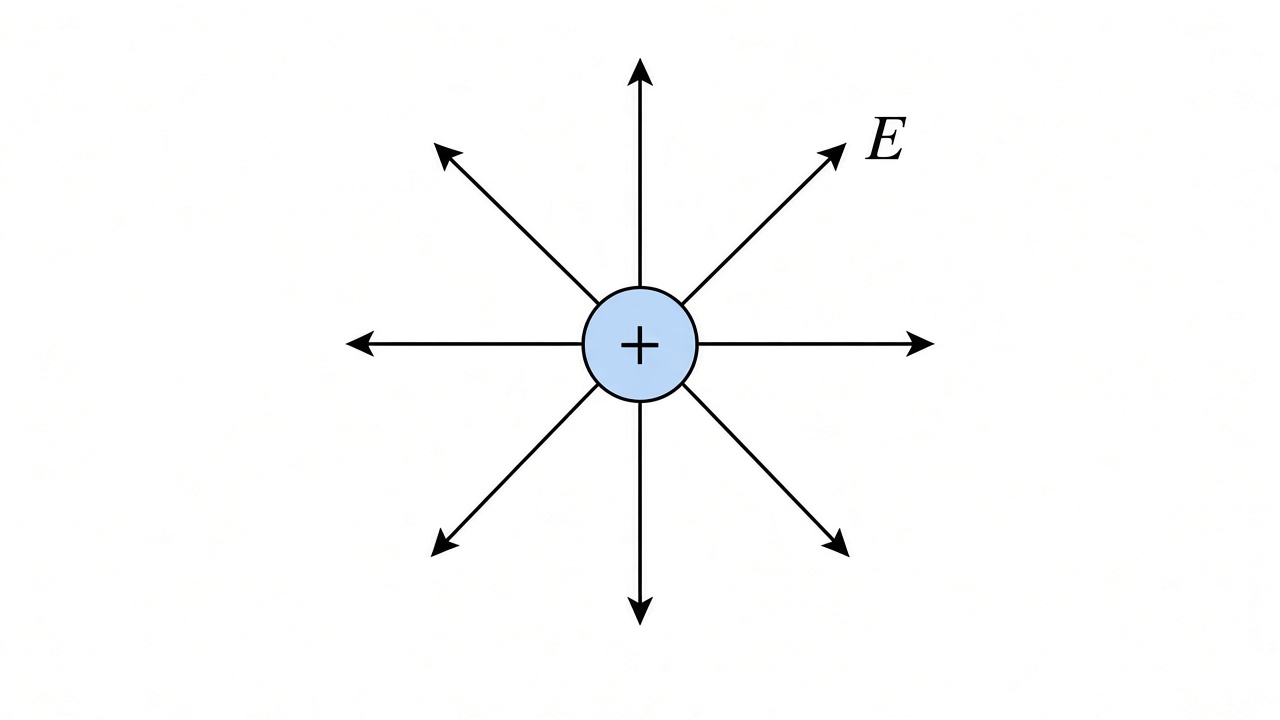
The electric field of an isolated positive point charge points away from the charge. A negative point charge would have arrows pointing inward.
For a point charge $Q$, the field magnitude at distance $r$ is $$E=k\frac{|Q|}{r^{2}}.$$ Example: $Q=+2.0\times 10^{-6}\,\mathrm{C}$ at $r=0.20\,\mathrm{m}$ gives $E=(9.0\times 10^{9})(2.0\times 10^{-6})/(0.040)=4.5\times 10^{5}\,\mathrm{N/C}$, directed away from $Q$. Doubling $r$ divides $E$ by $4$, to $1.125\times 10^{5}\,\mathrm{N/C}$.
A test charge $q=-3.0\times 10^{-9}\,\mathrm{C}$ at that same point feels $F=|q|E=1.35\times 10^{-3}\,\mathrm{N}$ toward the positive source, because a negative charge is pulled opposite the field direction.
When several sources are present, add the field vectors by superposition. Equal charges on opposite sides of a point can cancel. Between two like charges the fields oppose; a zero can lie outside the pair, nearer the smaller charge. Between opposite charges the fields point the same way and do not cancel.
For a conductor in electrostatic equilibrium, excess charge resides on the surface, $\vec E=\vec 0$ inside the conducting material, and the field just outside is perpendicular to the surface. On an irregular conductor, surface charge density is greatest at sharp points.
An isolated charged sphere of radius $R=0.10\,\mathrm{m}$ and $Q=+2.0\times 10^{-6}\,\mathrm{C}$ has $E=0$ for $r<R$. Just outside the surface, $E=kQ/R^{2}=(9.0\times 10^{9})(2.0\times 10^{-6})/(0.010)=1.8\times 10^{6}\,\mathrm{N/C}$ radially outward. Outside any spherical charge distribution the field matches a point charge $Q$ at the center.
An insulator can hold charge throughout its volume, so the interior field need not be zero. Far away, an insulator and a conductor with the same total charge look alike: both produce the same point-charge field for a given total $Q$.
An empty cavity inside a hollow conductor in a static external field has zero field in the cavity. A charge $+q$ placed in the cavity (not touching) induces $-q$ on the inner surface and $+q$ on the outer surface.
Key points
- $\vec F=q\vec E$; $\vec E$ points in the direction of the force on a positive test charge.
- Point charge: $E=k|Q|/r^{2}$ with $k=9.0\times 10^{9}\,\mathrm{N\cdot m^{2}/C^{2}}$; doubling $r$ divides $E$ by $4$.
- Add field vectors by superposition; like charges can cancel or leave a zero nearer the smaller charge.
- Conductor in electrostatic equilibrium: excess charge on the surface, $\vec E=\vec 0$ inside the material, exterior field perpendicular to the surface.
- Charged sphere: $E=0$ for $r<R$; outside, the field matches a point charge $Q$ at the center.
- An insulator can hold volume charge, so its interior field need not be zero.
- Empty cavity in a hollow conductor has zero field; $+q$ in the cavity induces $-q$ inside and $+q$ outside.
$\vec E$ is the force per unit positive test charge.