TOPIC 10.4 · STUDY
Electric Potential Energy
Electric potential energy of two point charges is U equals k q1 q2 over r, with zero at infinite separation. The sign follows the product of the charges, and for a slow move the external work equals the change in U.
10.4.A
Electric potential energy
Two point charges store electric potential energy that depends on both charges and the distance between them. The zero of $U$ is infinite separation. The Coulomb constant is $k=9.0\times 10^{9}\,\mathrm{N\cdot m^{2}/C^{2}}$.
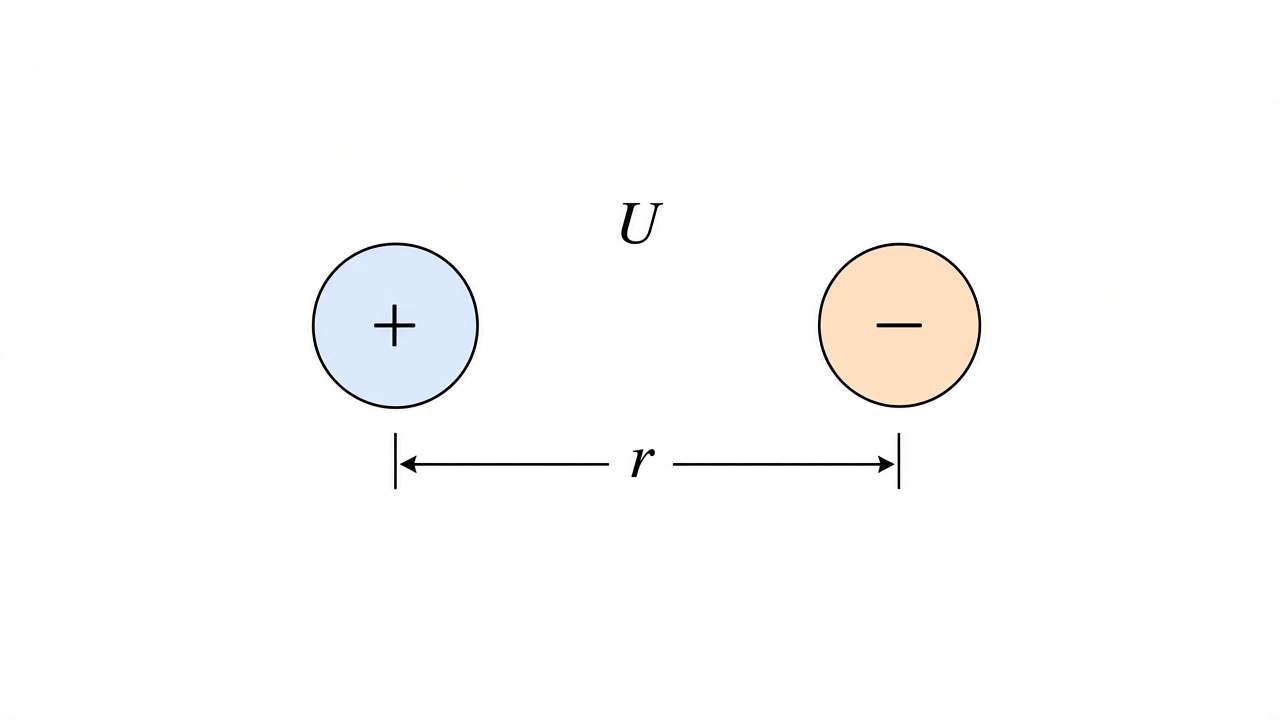
Opposite charges have negative electric potential energy relative to infinite separation. Separating them increases U toward zero.
For two point charges, $$U=k\frac{q_1 q_2}{r}.$$ The sign of $U$ follows the product $q_1 q_2$: like charges give positive $U$, and opposite charges give negative $U$.
Example: $q_1=+2.0\times 10^{-6}\,\mathrm{C}$, $q_2=-3.0\times 10^{-6}\,\mathrm{C}$, and $r=0.20\,\mathrm{m}$. The product is $q_1 q_2=-6.0\times 10^{-12}\,\mathrm{C^{2}}$, so $$U=(9.0\times 10^{9})(-6.0\times 10^{-12})/0.20=-0.27\,\mathrm{J}.$$ If $q_2$ were positive instead, the product would flip sign and $U=+0.27\,\mathrm{J}$.
Because $U$ is proportional to $1/r$, doubling $r$ halves $U$. At $r=0.40\,\mathrm{m}$ the opposite-charge example becomes $U=-0.135\,\mathrm{J}$.
For a slow move with negligible kinetic-energy change, the external agent's work is $W_{\mathrm{ext}}=\Delta U$. Separating the opposite pair from $0.20\,\mathrm{m}$ to $0.40\,\mathrm{m}$ gives $\Delta U=(-0.135)-(-0.27)=+0.135\,\mathrm{J}$, so the agent does positive work.
For a system of several point charges, $U$ is the sum over unique pairs, counting each pair once. Three charges have three pairs. There is no extra three-body term beyond those pairwise energies.
Like charges released from rest move apart: $U$ decreases and kinetic energy increases. Opposite charges are bound relative to infinity: energy must be added to separate them to infinity. Negative $U$ means lower than the zero at infinity, not that energy disappeared.
Flipping the sign of every charge leaves every product $q_i q_j$ unchanged, so the total $U$ is unchanged.
Key points
- $U=k q_1 q_2/r$ for two point charges, with zero at infinite separation.
- The sign of $U$ matches the product $q_1 q_2$: like charges positive, opposite charges negative.
- Doubling $r$ halves $U$; the opposite-charge example at $0.40\,\mathrm{m}$ is $-0.135\,\mathrm{J}$.
- For a slow move, $W_{\mathrm{ext}}=\Delta U$; separating opposite charges from $0.20\,\mathrm{m}$ to $0.40\,\mathrm{m}$ needs $+0.135\,\mathrm{J}$ of external work.
- For several point charges, sum $U$ over unique pairs only; three charges give three pairs and no three-body term.
- Like charges released from rest convert $U$ into kinetic energy as they separate.
- Opposite charges are bound relative to infinity; negative $U$ is below the zero at infinity.
- Flipping every charge sign leaves all products $q_i q_j$ and thus $U$ unchanged.
U is zero at infinite separation, and its sign matches the product of the two charges.