TOPIC 10.5 · STUDY
Electric Potential
Electric potential is a scalar set by source charges, with V = 0 at infinity for a point charge. Equipotentials are surfaces of constant V; the electric field is perpendicular to them and points from higher potential toward lower potential.
10.5.A
Electric potential
Electric potential $V$ is a scalar. For an isolated point charge, the potential at distance $r$ is $$V=k\frac{q}{r},$$ with $k=9.0\times 10^{9}\,\mathrm{N\cdot m^{2}/C^{2}}$. The zero of potential is at infinity: as $r\to\infty$, $V\to 0$.
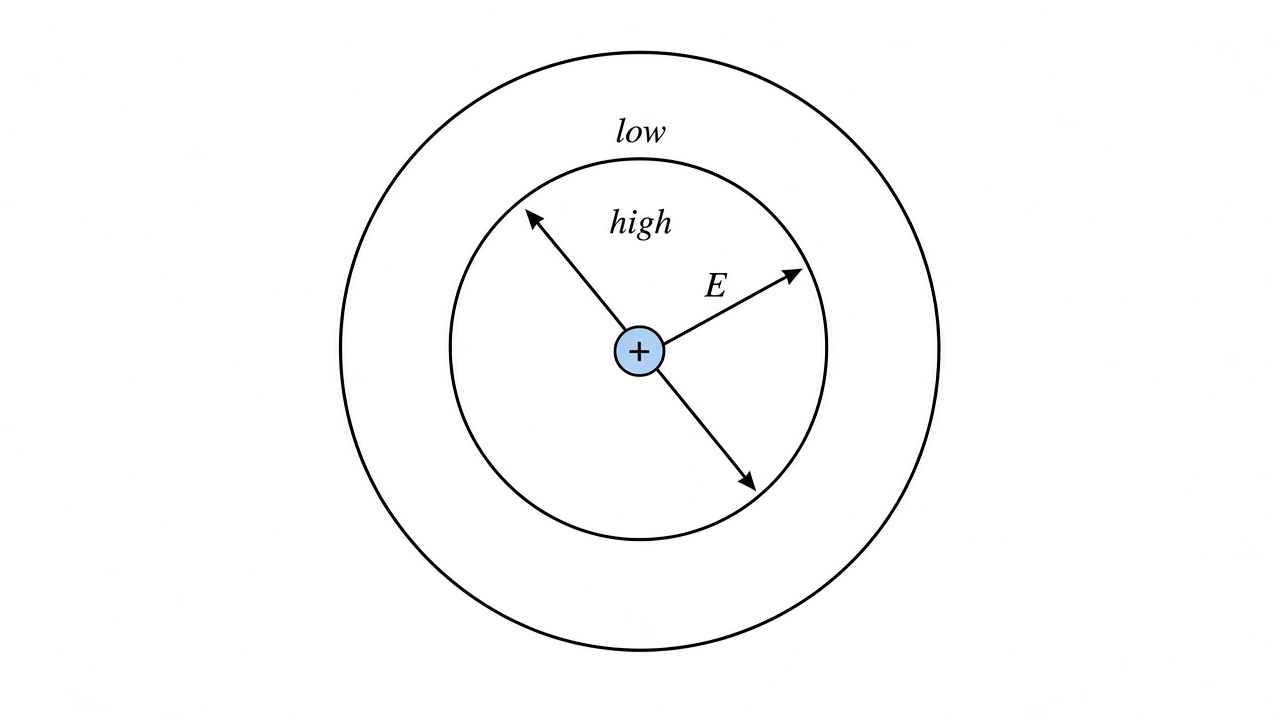
Equipotentials around an isolated positive charge are circles. The field is perpendicular to them and points from higher potential toward lower potential.
Example: a source charge $q=+3.0\times 10^{-6}\,\mathrm{C}$ at $r=0.30\,\mathrm{m}$ gives $$V=k\frac{q}{r}=(9.0\times 10^{9})(3.0\times 10^{-6})/0.30=9.0\times 10^{4}\,\mathrm{V}.$$ A negative source charge gives negative $V$ at the same distance, because $q$ is negative in $V=kq/r$.
Potentials from several point charges add as scalars: the total $V$ at a point is the algebraic sum of the individual potentials. Equal-and-opposite charges produce $V=0$ at the midpoint between them, while the electric field there is not zero. At that midpoint the field vectors from the two charges point the same way, so they add rather than cancel.
When a charge $q$ moves between two locations, the change in electric potential energy is $\Delta U=q\Delta V$. A positive test charge taken from $100\,\mathrm{V}$ to $40\,\mathrm{V}$ has $\Delta V=-60\,\mathrm{V}$ and $\Delta U=q(-60\,\mathrm{V})$, which is negative. The field does positive work on that positive charge as it moves toward lower potential. Along an equipotential, $\Delta V=0$, so $\Delta U=0$ and the field does no work.
The electric field $\vec E$ points toward decreasing $V$ and is perpendicular to equipotential lines (or surfaces). Distinct equipotentials never cross. In a uniform region the average field magnitude is $|E|=|\Delta V|/\Delta s$. Example: a potential difference of $120\,\mathrm{V}$ across $0.040\,\mathrm{m}$ gives $$E=|\Delta V|/\Delta s=120/0.040=3.0\times 10^{3}\,\mathrm{V/m}.$$ Closer spacing of the same potential step means a larger field.
A positive charge released from rest moves toward lower potential. Speeds from energy accounting belong to the next topic; here the direction of motion is enough.
Key points
- Potential $V$ is a scalar; for a point charge, $V=kq/r$ with $V=0$ at infinity and $k=9.0\times 10^{9}\,\mathrm{N\cdot m^{2}/C^{2}}$.
- A positive source gives positive $V$; a negative source gives negative $V$.
- Potentials add as scalars; equal-and-opposite charges give $V=0$ at the midpoint while $\vec E$ is not zero there.
- $\Delta U=q\Delta V$; along an equipotential $\Delta V=0$, so the field does no work.
- $\vec E$ points toward decreasing $V$ and is perpendicular to equipotentials; distinct equipotentials never cross.
- In a uniform region, $|E|=|\Delta V|/\Delta s$; closer equipotential spacing means a stronger field.
- A positive charge released from rest moves toward lower potential.
Potential is a scalar; the field points toward lower potential.