TOPIC 10.6 · STUDY
Capacitors
Capacitance is charge per volt and is a property of the device. Vacuum parallel plates give C equal to epsilon_0 A over d. Stored energy is one half C V squared. A dielectric multiplies C by kappa; whether the battery stays connected decides which other quantities change.
10.6.A
Capacitors
Capacitance $C=Q/V$ is a property of the device: for a given geometry it does not depend on how much charge is stored. Wide parallel plates with vacuum between them have a nearly uniform field between the plates when edge effects are ignored.
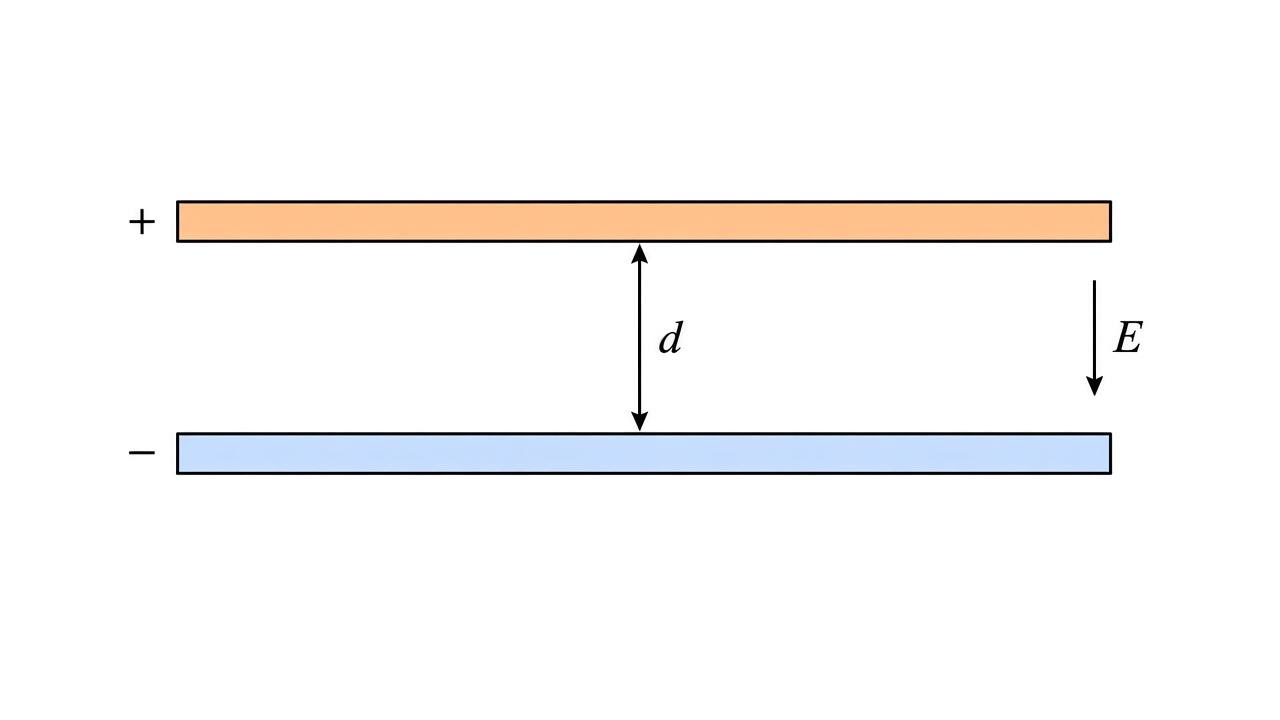
Between wide parallel plates the field is nearly uniform and points from the positive plate to the negative plate. The plate separation is d.
For vacuum parallel plates of area $A$ and separation $d$, ignoring edges, $$C=\epsilon_0 A/d.$$ Here $\epsilon_0=8.85\times 10^{-12}\,\mathrm{C^{2}/(N\cdot m^{2})}$.
Example: $A=0.020\,\mathrm{m^{2}}$, $d=1.0\times 10^{-3}\,\mathrm{m}$ give $$C=(8.85\times 10^{-12})(0.020)/(1.0\times 10^{-3})=1.77\times 10^{-10}\,\mathrm{F}.$$ Charged to $V=100\,\mathrm{V}$, the charge on each plate has magnitude $Q=CV=1.77\times 10^{-8}\,\mathrm{C}$.
The energy stored in a capacitor is $$U=\tfrac12 CV^2=\tfrac12 QV=Q^2/(2C).$$ The same example stores $$U=\tfrac12(1.77\times 10^{-10})(100)^2=8.85\times 10^{-7}\,\mathrm{J}.$$
Between the plates, away from the edges, $E=V/d$. For the example, $E=100/(1.0\times 10^{-3})=1.00\times 10^{5}\,\mathrm{V/m}$.
From $C=\epsilon_0 A/d$, doubling $d$ at fixed $A$ halves $C$. Doubling both $A$ and $d$ leaves the ratio $A/d$ unchanged, so $C$ is unchanged.
A dielectric that fills the gap multiplies $C$ by the dielectric constant $\kappa$. Polarization of the dielectric produces a field that opposes the field of the free charges on the plates.
If the battery stays connected, $V$ is fixed. Inserting a dielectric with $\kappa=4$ multiplies $C$ by $4$. Then $Q=CV$ and $U=\tfrac12 CV^2$ each also multiply by $4$.
If the battery is disconnected first, $Q$ is fixed. Inserting $\kappa=4$ still multiplies $C$ by $4$, but $V=Q/C$ and $E=V/d$ each drop to one fourth. Stored energy also drops to one fourth, because $U=Q^2/(2C)$.
Key points
- Capacitance $C=Q/V$ is a property of the device, not of the particular charge on it.
- Vacuum parallel plates, ignoring edges: $C=\epsilon_0 A/d$ with $\epsilon_0=8.85\times 10^{-12}\,\mathrm{C^{2}/(N\cdot m^{2})}$.
- Stored energy: $U=\tfrac12 CV^2=\tfrac12 QV=Q^2/(2C)$.
- Away from the edges, $E=V/d$ between the plates.
- Doubling $d$ halves $C$; doubling both $A$ and $d$ leaves $C$ unchanged.
- A gap-filling dielectric multiplies $C$ by $\kappa$; polarization opposes the free-charge field.
- Battery connected (fixed $V$), $\kappa=4$: $C$, $Q$, and $U$ each multiply by $4$.
- Battery disconnected (fixed $Q$), $\kappa=4$: $C$ multiplies by $4$; $V$, $E$, and $U$ each drop to one fourth.
Whether the battery stays connected decides which quantities stay fixed when a dielectric is inserted.