TOPIC 10.7 · STUDY
Conservation of Electric Energy
When only the electrostatic force does work, the gain in kinetic energy equals the loss in electric potential energy. Delta U = q Delta V, so a positive charge speeds up toward lower potential and a negative charge speeds up toward higher potential.
10.7.A
Conservation of electric energy
Moving a charge $q$ through a potential change $\Delta V$ changes its electric potential energy by $$\Delta U=q\Delta V.$$ If the electrostatic force is the only force doing work, kinetic energy and potential energy trade off: $$\Delta K+\Delta U=0,$$ so $\Delta K=-q\Delta V$. The total $K+U$ stays constant.
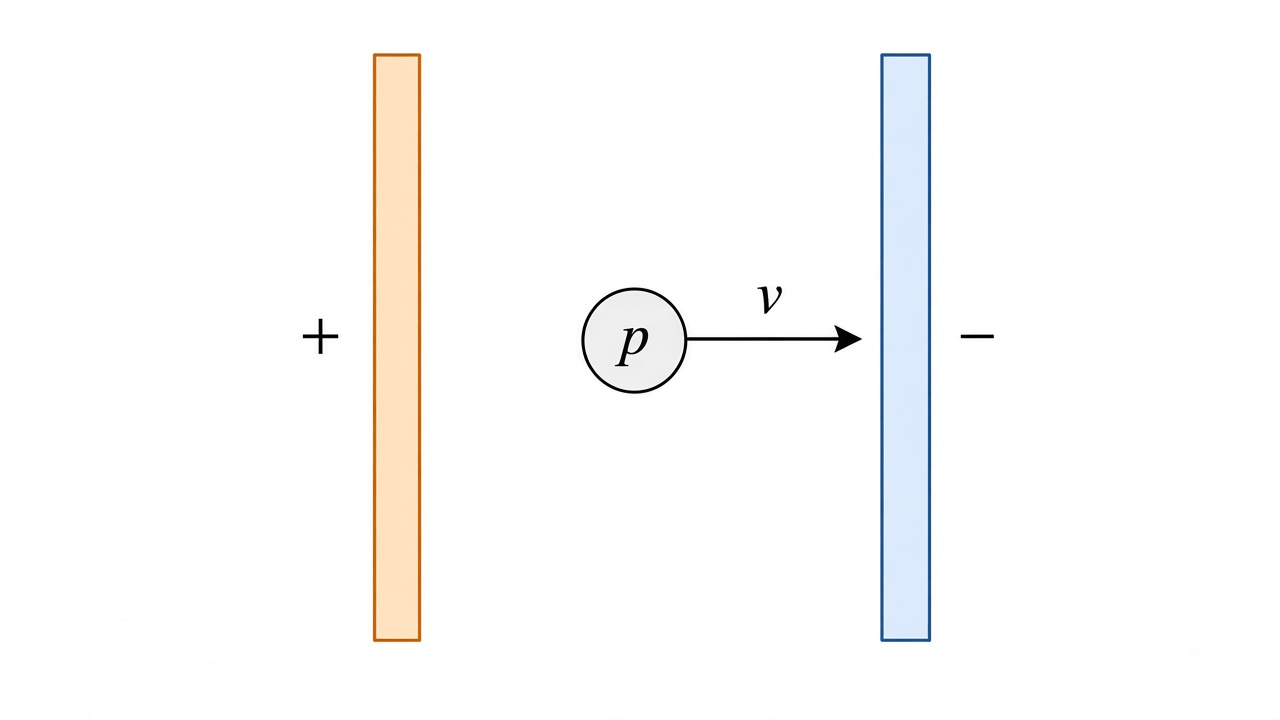
A positive particle moves toward the negative plate, which is at lower potential. Its electric potential energy decreases and its kinetic energy increases.
A proton released from rest moves toward lower potential. Use $e=1.60\times 10^{-19}\,\mathrm{C}$ and $m_{p}=1.67\times 10^{-27}\,\mathrm{kg}$. Through a drop of $200\,\mathrm{V}$ ($\Delta V=-200\,\mathrm{V}$), $$\Delta U=(1.60\times 10^{-19})(-200)=-3.20\times 10^{-17}\,\mathrm{J}.$$ Then $K=3.20\times 10^{-17}\,\mathrm{J}$ and $$v=\sqrt{\frac{2K}{m}}=\sqrt{\frac{6.40\times 10^{-17}}{1.67\times 10^{-27}}}=1.96\times 10^{5}\,\mathrm{m/s}.$$
An electron accelerates when it moves toward higher potential, the positive plate. With $m_{e}=9.11\times 10^{-31}\,\mathrm{kg}$ and $\Delta V=+200\,\mathrm{V}$ from rest, $$\Delta U=(-1.60\times 10^{-19})(200)=-3.20\times 10^{-17}\,\mathrm{J}.$$ The kinetic energy is again $3.20\times 10^{-17}\,\mathrm{J}$, but the speed is larger: $$v=\sqrt{\frac{6.40\times 10^{-17}}{9.11\times 10^{-31}}}=8.38\times 10^{6}\,\mathrm{m/s}.$$
The same $|q|$ and the same $|\Delta V|$ give the same $|\Delta K|$. The electron is much faster because its mass is smaller. At equal kinetic energy the proton has the larger momentum, because $p=\sqrt{2mK}$ and the proton mass is larger.
An alpha particle has charge $+2e$. The same $200\,\mathrm{V}$ drop from rest gives $$K=(2)(1.60\times 10^{-19})(200)=6.40\times 10^{-17}\,\mathrm{J}.$$
A negative charge that moves to lower potential gains potential energy and loses kinetic energy. Motion by itself does not decide the sign of $\Delta U$; the product $q\Delta V$ does. Doubling the accelerating potential difference from rest doubles $K$ and multiplies the final speed by $\sqrt{2}$.
Key points
- $\Delta U=q\Delta V$. The sign follows both the charge and the potential change.
- If only the electrostatic force does work, $\Delta K=-\Delta U$ and $K+U$ is constant.
- A positive charge released from rest moves toward lower potential and gains kinetic energy.
- A negative charge released from rest moves toward higher potential and gains kinetic energy.
- A proton through a $200\,\mathrm{V}$ drop from rest gains $3.20\times 10^{-17}\,\mathrm{J}$ and reaches $1.96\times 10^{5}\,\mathrm{m/s}$.
- An electron through a $200\,\mathrm{V}$ rise from rest gains the same kinetic energy and reaches $8.38\times 10^{6}\,\mathrm{m/s}$.
- Equal $|q|$ and equal $|\Delta V|$ give equal $|\Delta K|$. The smaller mass is faster; the larger mass has more momentum at that kinetic energy.
- Doubling the accelerating potential difference from rest doubles $K$ and multiplies speed by $\sqrt{2}$.
Only the electrostatic force is doing work, so the gain in kinetic energy equals the loss in electric potential energy.