TOPIC 11.1 · STUDY
Electric Current
Current is the net charge passing a cross section per time. In a metal, conventional current points opposite the electron drift.
11.1.A
Electric current
Electric current is the net charge that passes a chosen cross section of a conductor per unit time: $$I=\frac{\Delta Q}{\Delta t}.$$ Area is not needed for that definition. Example: $\Delta Q=4.0\,\mathrm{C}$ in $\Delta t=2.0\,\mathrm{s}$ gives $I=2.0\,\mathrm{A}$.
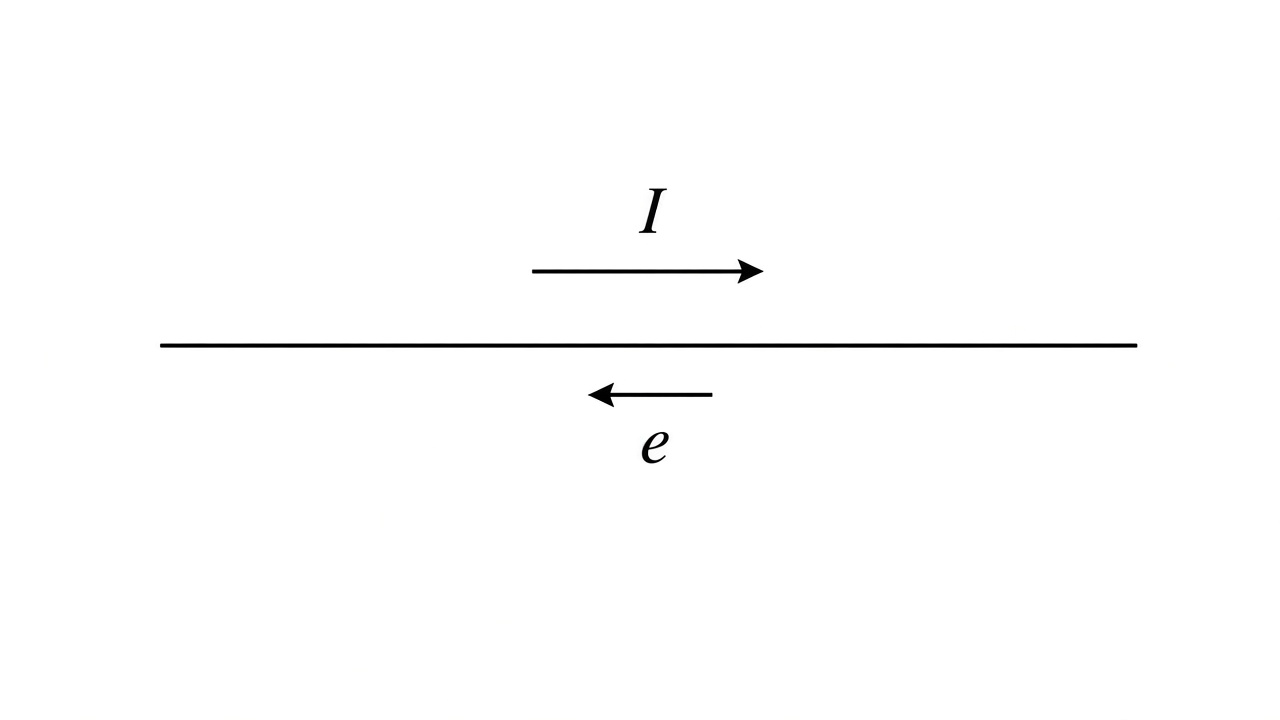
In a metal, conventional current I is the direction positive charge would move. Electrons drift the opposite way.
In a metal, conventional current points in the direction positive charge would move. Free electrons drift the opposite way, so conventional current and electron drift are opposite.
A steady current $I=2.0\,\mathrm{A}$ lasting $\Delta t=3.0\,\mathrm{s}$ transfers $Q=I\Delta t=6.0\,\mathrm{C}$. The number of elementary charges is $N=Q/e$, with $e=1.60\times 10^{-19}\,\mathrm{C}$, so $N=3.75\times 10^{19}$ electrons.
On a graph of charge $Q$ versus time $t$, current is the slope. Zero current means zero net charge per time through the cross section; electrons can still move thermally with no net flow.
An emf drives charge around a closed path. An open switch leaves no closed path, so the steady current is zero.
Negative ions drifting west add to conventional current east, the same way positive ions drifting east do. Conventional current follows the net effect of positive charge flow to the east.
Key points
- Current is net charge per time: $I=\Delta Q/\Delta t$.
- Area is not part of that definition of $I$.
- In a metal, conventional current is opposite electron drift.
- Charge transferred is $Q=I\Delta t$; $N=Q/e$ with $e=1.60\times 10^{-19}\,\mathrm{C}$.
- Current is the slope of a $Q$-versus-$t$ graph.
- Zero current means zero net charge per time; thermal motion can still occur.
- An emf needs a closed path; an open switch gives zero steady current.
- Negative ions drifting west and positive ions drifting east both contribute to conventional current east.
Conventional current is opposite electron drift in a metal.