Specific Heat and Thermal Conductivity FRQ Practice

Responses receive AI feedback against a rubric after submission. Scores are practice estimates.

Question 1 of 5

A $0.50\,\mathrm{kg}$ brass sample at $100^\circ\mathrm{C}$ is placed against a $1.00\,\mathrm{kg}$ aluminum sample at $20^\circ\mathrm{C}$ in an insulated container. Use values from the table. Neglect other heat capacities. (a) Write the equation that determines $T_f$. (b) Calculate $T_f$. (c) Calculate the energy transferred from the brass to the aluminum.

Material $c$ (J/(kg$\cdot$K)) $k$ (W/(m$\cdot$K))
Aluminum 900 205
Copper 390 400
Iron 450 80
Brass 380 110
Glass 840 1.0
Water 4180 โ€”
Wood 1700 0.12

Question 2 of 5

Two students debate specific heat. Student 1 says a larger block of wood must have a larger specific heat because it stores more thermal energy when warmed. Student 2 says specific heat depends only on the material. (a) Which student is correct? Justify using the distinction between $c$ and $mc$. (b) Using the table, calculate the energy needed to raise $0.80\,\mathrm{kg}$ of wood by $15\,\mathrm{K}$. (c) State one reason, based on atomic structure, that wood and aluminum have different specific heats.

Material $c$ (J/(kg$\cdot$K)) $k$ (W/(m$\cdot$K))
Aluminum 900 205
Copper 390 400
Iron 450 80
Brass 380 110
Glass 840 1.0
Water 4180 โ€”
Wood 1700 0.12

Question 3 of 5

An iron plate has $k=80\,\mathrm{W/(m\cdot K)}$, $A=0.020\,\mathrm{m}^{2}$, and $L=0.010\,\mathrm{m}$. The faces are held at $55^\circ\mathrm{C}$ and $25^\circ\mathrm{C}$. (a) Calculate the conductive heat-transfer rate. (b) How much thermal energy is transferred through the plate in $5.0\,\mathrm{min}$? (c) If the area is reduced to half while $\Delta T$ and $L$ stay the same, find the new rate.

Question 4 of 5

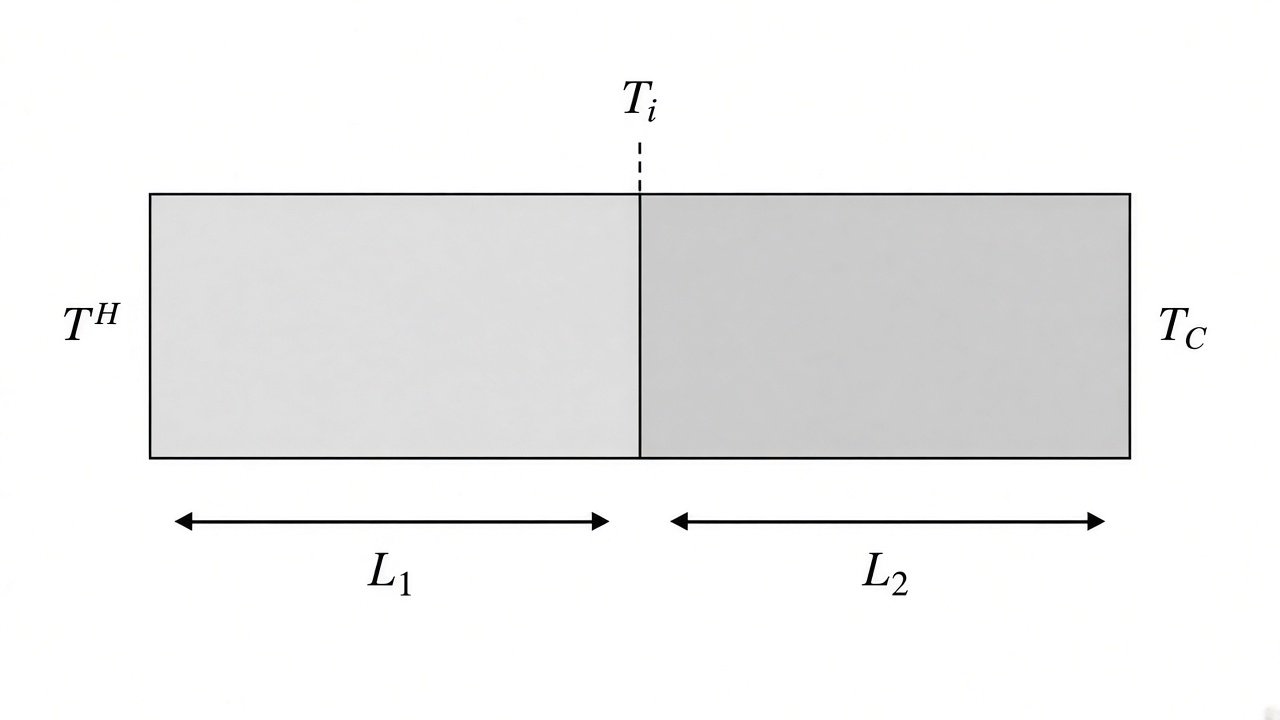
Two slabs of equal area $A=0.040\,\mathrm{m}^{2}$ and equal thickness $0.050\,\mathrm{m}$ are placed in series between reservoirs at $100^\circ\mathrm{C}$ and $20^\circ\mathrm{C}$. The hot-side slab has $k_1=50\,\mathrm{W/(m\cdot K)}$; the cold-side slab has $k_2=200\,\mathrm{W/(m\cdot K)}$. (a) Calculate the steady heat-transfer rate. (b) Calculate the interface temperature. (c) Explain why most of the temperature drop occurs across the hot-side slab.

Two slabs of equal thickness in series, with interface temperature T_i between T_H and T_C.

Question 5 of 5

A single slab has conduction rate $R_0=kA\Delta T/L$. A second identical slab is added. (a) If the two slabs are placed in parallel between the same temperatures, find the total rate in terms of $R_0$. (b) If instead they are stacked in series between the same temperatures, find the total rate in terms of $R_0$. (c) A student claims series and parallel must give the same rate because the material is unchanged. Identify the error using how $A$ and $L$ enter the conduction equation.