Specific Heat and Thermal Conductivity FRQ Practice

Responses receive AI feedback against a rubric after submission. Scores are practice estimates.

Question 1 of 5

A $0.400\,\mathrm{kg}$ copper block initially at $90.0^\circ\mathrm{C}$ is placed into $0.200\,\mathrm{kg}$ of water at $20.0^\circ\mathrm{C}$ in an insulated calorimeter. Use $c_{\mathrm{Cu}}=390\,\mathrm{J/(kg\cdot K)}$ and $c_{\mathrm{w}}=4180\,\mathrm{J/(kg\cdot K)}$. Neglect the calorimeter’s heat capacity. (a) Write the energy-conservation equation that determines the equilibrium temperature $T_f$. (b) Calculate $T_f$. (c) Calculate the thermal energy absorbed by the water.

Material $c$ (J/(kg$\cdot$K)) $k$ (W/(m$\cdot$K))
Aluminum 900 205
Copper 390 400
Iron 450 80
Brass 380 110
Glass 840 1.0
Water 4180 —
Wood 1700 0.12

Question 2 of 5

A laboratory reports that a metal sample of mass $2.0\,\mathrm{kg}$ requires $2.7\times 10^{4}\,\mathrm{J}$ to raise its temperature by $30\,\mathrm{K}$. (a) Calculate the specific heat of the sample. (b) Identify the metal using the table. (c) Explain whether cutting the sample into two equal pieces changes the specific heat, and whether it changes the energy needed to raise one piece by $30\,\mathrm{K}$.

Material $c$ (J/(kg$\cdot$K)) $k$ (W/(m$\cdot$K))
Aluminum 900 205
Copper 390 400
Iron 450 80
Brass 380 110
Glass 840 1.0
Water 4180 —
Wood 1700 0.12

Question 3 of 5

A copper bar has cross-sectional area $A=2.0\times 10^{-3}\,\mathrm{m}^{2}$ and length $L=0.40\,\mathrm{m}$. The ends are held at $T_H=80^\circ\mathrm{C}$ and $T_C=20^\circ\mathrm{C}$. Use $k=400\,\mathrm{W/(m\cdot K)}$. (a) Calculate the steady conductive heat-transfer rate. (b) If $L$ is reduced to $0.20\,\mathrm{m}$ with all other quantities unchanged, determine the new rate. (c) State what the larger rate implies about how thickness affects conduction.

Question 4 of 5

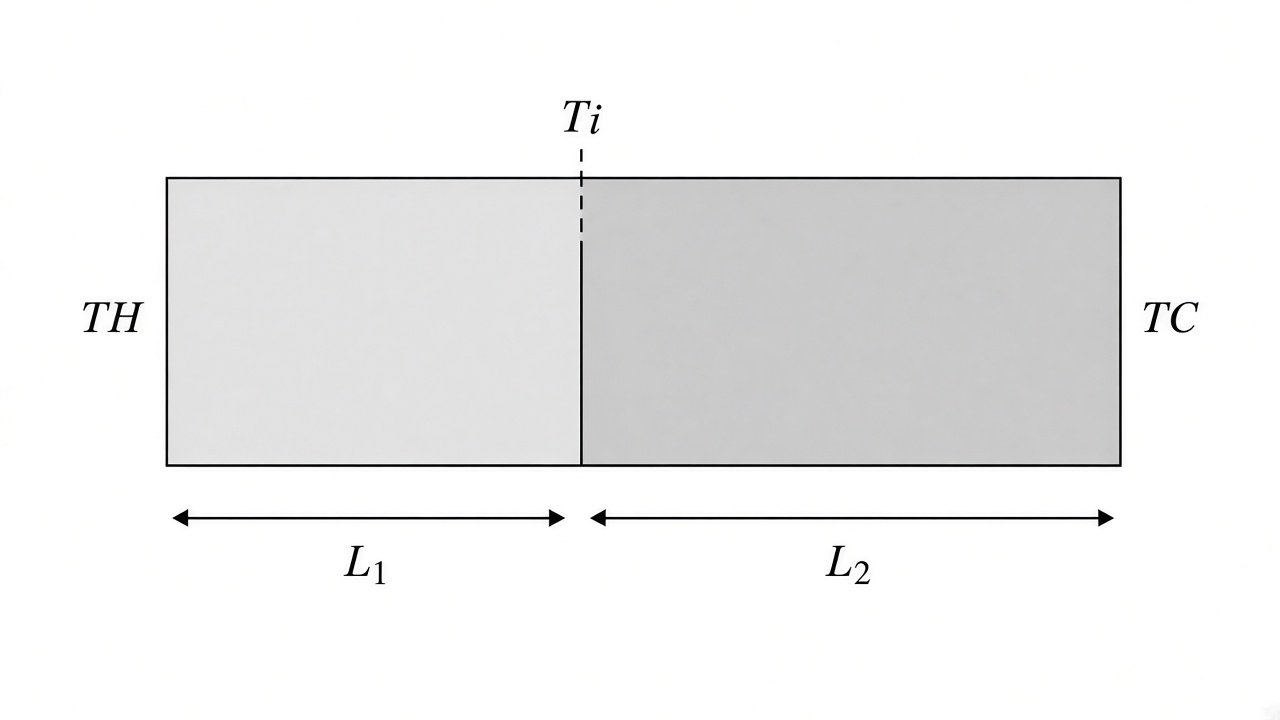
Two slabs of equal area $A=0.010\,\mathrm{m}^{2}$ are arranged in series as in the figure. Slab 1 (hot side) has $L_1=0.10\,\mathrm{m}$ and $k_1=100\,\mathrm{W/(m\cdot K)}$. Slab 2 (cold side) has $L_2=0.20\,\mathrm{m}$ and $k_2=200\,\mathrm{W/(m\cdot K)}$. The outer temperatures are $T_H=100^\circ\mathrm{C}$ and $T_C=40^\circ\mathrm{C}$. (a) Show that $L_1/k_1+L_2/k_2=0.0020\,\mathrm{m}^{2}\cdot\mathrm{K/W}$. (b) Calculate the steady heat-transfer rate. (c) Calculate the interface temperature $T_i$.

Two slabs in series between T_H and T_C with thicknesses L_1 and L_2 and interface temperature T_i.

Question 5 of 5

Two identical slabs can be arranged either in series or in parallel between the same reservoirs at temperatures differing by $\Delta T$. Each slab has conductivity $k$, area $A$, and thickness $L$. (a) Find the series heat-transfer rate in terms of $k$, $A$, $L$, and $\Delta T$. (b) Find the parallel heat-transfer rate in the same symbols. (c) Determine the ratio $R_{\mathrm{parallel}}/R_{\mathrm{series}}$ and state which arrangement transfers energy faster.