TOPIC 11.5 · STUDY
Compound Direct Current (DC) Circuits
Series resistors add. Parallel resistors add as reciprocals. A battery's internal resistance lowers the terminal voltage when current flows.
11.5.A
Series and parallel networks
Series resistors carry the same current and add: $R_{\mathrm{s}}=R_1+R_2+\cdots$. Parallel resistors share the same potential difference and add as reciprocals: $$\frac{1}{R_{\mathrm{p}}}=\frac{1}{R_1}+\frac{1}{R_2}+\cdots.$$
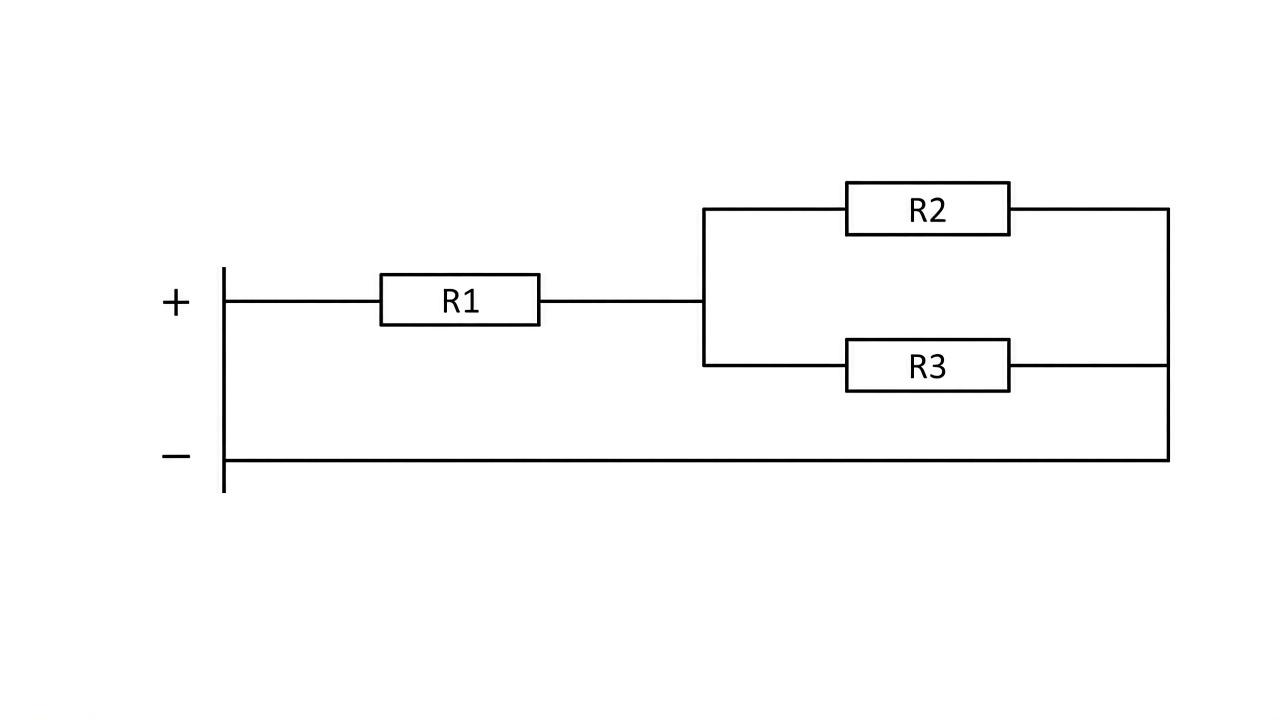
R1 is in series with the parallel combination of R2 and R3. The parallel branches have the same potential difference.
Ideal $18\,\mathrm{V}$ battery. $R_1=4.0\,\Omega$ is in series with $R_2=12\,\Omega$ parallel to $R_3=6.0\,\Omega$. The parallel equivalent is $4.0\,\Omega$ because $$\frac{1}{12}+\frac{1}{6}=\frac{1}{4}.$$ Total resistance is $R_{\mathrm{tot}}=4.0+4.0=8.0\,\Omega$. Battery current is $I=18/8=2.25\,\mathrm{A}$.
The parallel section has $V_{\mathrm{p}}=I R_{\mathrm{p}}=(2.25)(4.0)=9.0\,\mathrm{V}$. The $12\,\Omega$ branch carries $I_2=9.0/12=0.75\,\mathrm{A}$ and the $6.0\,\Omega$ branch carries $I_3=9.0/6.0=1.50\,\mathrm{A}$. Check: $0.75+1.50=2.25\,\mathrm{A}$, matching the series current through $R_1$.
Series resistances add. Opening one parallel branch removes that path, raises the equivalent resistance of the network, and changes the currents in the remaining elements.
A real battery has emf $\mathcal{E}$ and internal resistance $r$. Terminal voltage is $$V_{\mathrm{t}}=\mathcal{E}-Ir$$ when current $I$ flows out of the positive terminal. Example: $\mathcal{E}=12\,\mathrm{V}$, $r=2.0\,\Omega$, external $R=4.0\,\Omega$. Then $I=\mathcal{E}/(r+R)=12/6.0=2.0\,\mathrm{A}$ and $V_{\mathrm{t}}=12-(2.0)(2.0)=8.0\,\mathrm{V}$.
An ideal ammeter has nearly zero resistance and is placed in series with the element whose current is measured. An ideal voltmeter has nearly infinite resistance and is placed in parallel with the element whose potential difference is measured. A real meter changes the circuit it measures.
Key points
- Series: same current; $R_{\mathrm{s}}=R_1+R_2+\cdots$.
- Parallel: same potential difference; $1/R_{\mathrm{p}}=1/R_1+1/R_2+\cdots$.
- Example: $18\,\mathrm{V}$, $R_1=4.0\,\Omega$ with $12\,\Omega\parallel 6.0\,\Omega$ gives $R_{\mathrm{p}}=4.0\,\Omega$, $R_{\mathrm{tot}}=8.0\,\Omega$, $I=2.25\,\mathrm{A}$.
- Parallel section at $9.0\,\mathrm{V}$: $0.75\,\mathrm{A}$ in $12\,\Omega$ and $1.50\,\mathrm{A}$ in $6.0\,\Omega$.
- Opening a parallel branch raises equivalent resistance and changes currents.
- Terminal voltage: $V_{\mathrm{t}}=\mathcal{E}-Ir$; example $12\,\mathrm{V}$, $r=2.0\,\Omega$, $R=4.0\,\Omega$ gives $I=2.0\,\mathrm{A}$ and $V_{\mathrm{t}}=8.0\,\mathrm{V}$.
- Ideal ammeter: nearly zero resistance, in series. Ideal voltmeter: nearly infinite resistance, in parallel.
- A real meter changes the circuit it measures.
Terminal voltage is less than the emf whenever internal resistance carries current.