Compound Direct Current (DC) Circuits MCQ Practice

Question 1 of 10

In the figure, a 4 Ω resistor R1 is in series with parallel resistors R2 = 12 Ω and R3 = 6 Ω across an ideal 18 V battery. A switch opens the R3 branch. By what factor does the current through R2 change?
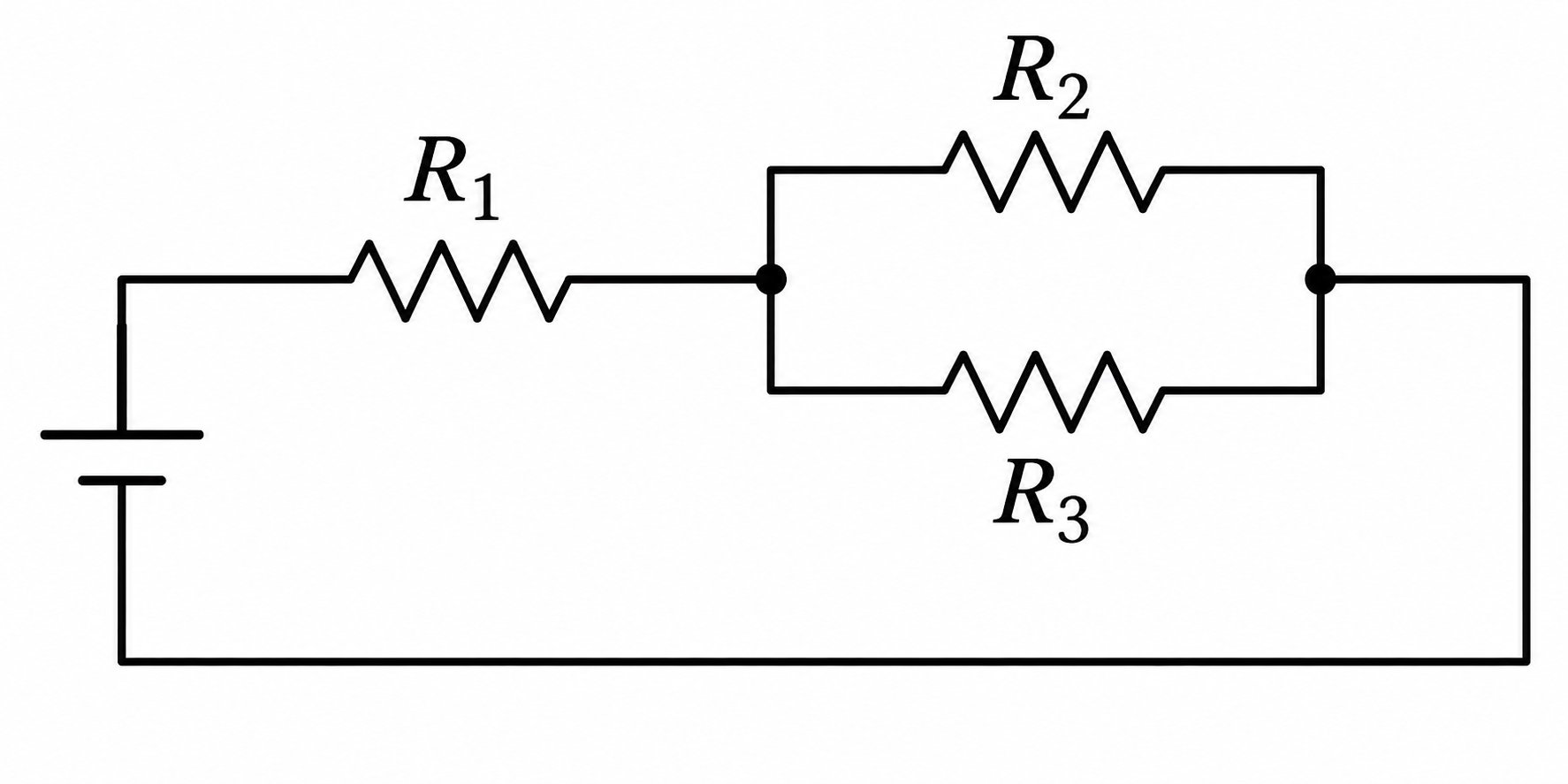
A battery and R1 in series with two parallel branches containing R2 and R3.
  1. A. It decreases to 2/3 of its original value.
  2. B. It is unchanged.
  3. C. It increases to 3/2 of its original value.
  4. D. It doubles.

Question 2 of 10

For the same 18 V circuit with R1 = 4 Ω, R2 = 12 Ω, and R3 = 6 Ω, an ideal wire is connected directly across R3. How does the power in R1 compare with its value before the wire is added?

A battery and R1 in series with two parallel branches containing R2 and R3.
  1. A. It becomes zero.
  2. B. It doubles.
  3. C. It quadruples.
  4. D. It increases ninefold.

Question 3 of 10

An ideal 12 V battery supplies a 2 Ω resistor in series with a parallel pair: a 6 Ω branch and an unknown resistor R. The battery current is 3 A. What is R?

  1. A. 2 Ω
  2. B. 3 Ω
  3. C. 4 Ω
  4. D. 12 Ω

Question 4 of 10

A battery supplies 2.0 A through a 4 Ω load and 1.0 A through a 10 Ω load. Its emf and internal resistance remain constant. What is its internal resistance?

  1. A. 1 Ω
  2. B. 2 Ω
  3. C. 3 Ω
  4. D. 4 Ω

Question 5 of 10

An ideal 12 V battery supplies a 3 Ω resistor in series with a 6 Ω resistor. A voltmeter with resistance 6 Ω is connected across the 6 Ω resistor. What does the voltmeter read?

  1. A. 4 V
  2. B. 6 V
  3. C. 8 V
  4. D. 12 V

Question 6 of 10

Three identical bulbs A, B, and C behave as fixed resistors. A is in series with B and C in parallel across an ideal battery. Bulb C is removed, leaving its branch open. What happens to the powers of A and B?

A battery and R1 in series with two parallel branches containing R2 and R3.
  1. A. Both increase.
  2. B. A increases; B decreases.
  3. C. A decreases; B increases.
  4. D. Both decrease.

Question 7 of 10

An 18 V battery has internal resistance 2 Ω. Its external circuit is R1 = 4 Ω in series with R2 = 12 Ω and R3 = 6 Ω in parallel. What is the potential difference across R3?

A battery and R1 in series with two parallel branches containing R2 and R3.
  1. A. 3.6 V
  2. B. 7.2 V
  3. C. 9.0 V
  4. D. 14.4 V

Question 8 of 10

An ideal battery supplies R1 in series with parallel resistors R2 and R3. A third resistor is added in parallel with R2 and R3. Which statement must be true for the original R2?

A battery and R1 in series with two parallel branches containing R2 and R3.
  1. A. Its voltage and power both increase.
  2. B. Its voltage and power both decrease.
  3. C. Its current is unchanged because its resistance is unchanged.
  4. D. Its power is unchanged because the battery emf is unchanged.

Question 9 of 10

A battery with emf 12 V and internal resistance 1 Ω first powers one 5 Ω resistor. A second 5 Ω resistor is connected in parallel with the first. What happens to terminal voltage and power in the original resistor?

  1. A. Both increase.
  2. B. Terminal voltage increases; power decreases.
  3. C. Both decrease.
  4. D. Terminal voltage decreases; power increases.

Question 10 of 10

Two arrangements use the same ideal battery and three identical resistors. X has one resistor in series with two in parallel; Y has two in series, with that pair in parallel with the third. Which comparison is correct?

  1. A. X has greater equivalent resistance and draws less battery current.
  2. B. X has smaller equivalent resistance and draws more battery current.
  3. C. Both have the same equivalent resistance.
  4. D. The comparison depends on battery emf.