Compound Direct Current (DC) Circuits FRQ Practice

Responses receive AI feedback against a rubric after submission. Scores are practice estimates.

Question 1 of 5

An ideal 24 V battery powers R1 = 4 Ω in series with parallel branches R2 = 12 Ω and R3 = 6 Ω. A switch in the R3 branch is initially closed and then opened. (a) Find the initial battery current and both branch currents. (b) Find the battery current after opening the switch. (c) Compare the power in R2 before and after. Explain why it changes although R2 itself is unchanged.
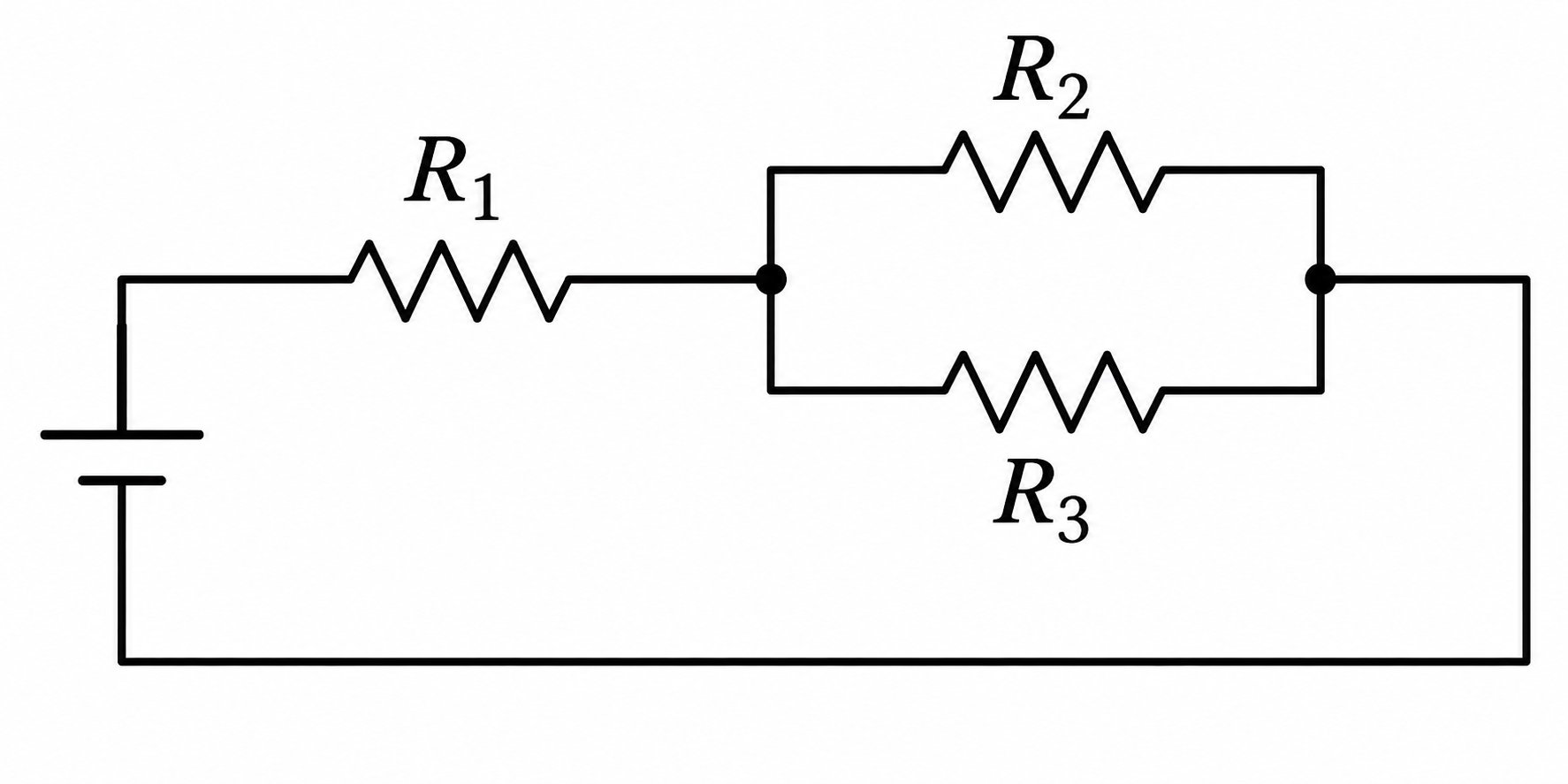
A battery and R1 in series with two parallel branches containing R2 and R3.

Question 2 of 5

A battery is tested with external loads. Measured (current, terminal voltage) pairs are (0.50 A, 11 V) and (1.50 A, 9 V). Its internal resistance is constant. The battery is then connected to R1 = 4 Ω in series with R2 = 12 Ω and R3 = 6 Ω in parallel. (a) Determine emf and internal resistance. (b) Find battery current and terminal voltage in the new circuit. (c) Find the R3 current. (d) State the intercept and slope of a terminal-voltage-versus-current graph.

A battery and R1 in series with two parallel branches containing R2 and R3.

Question 3 of 5

An ideal 12 V battery powers a 3 Ω resistor in series with a 6 Ω resistor. A voltmeter of resistance 6 Ω is placed across the 6 Ω resistor. (a) Find the reading of an ideal voltmeter in that location. (b) Find the actual voltmeter reading. (c) Find current through the original 6 Ω resistor with the actual meter connected. (d) Explain why the meter changes the quantity it measures.

Question 4 of 5

An ideal 18 V battery powers a 2 Ω resistor in series with a parallel pair: one branch is 6 Ω, the other is an unknown R. The battery current is 3 A. (a) Determine R. (b) Find current and power in each branch. (c) The unknown branch is removed. Predict whether power in the 6 Ω resistor rises or falls, then calculate its new power.

Question 5 of 5

A 12 V battery has internal resistance 1 Ω. Its external circuit is a 5 Ω resistor in series with two parallel 10 Ω resistors. A student accidentally connects an ideal ammeter across one 10 Ω resistor instead of inserting it in that branch. (a) Find battery current before the ammeter is attached. (b) Find battery current afterward. (c) State current and power in each 10 Ω resistor afterward. (d) Explain why internal resistance matters in this idealized prediction.