Compound Direct Current (DC) Circuits FRQ Practice

Responses receive AI feedback against a rubric after submission. Scores are practice estimates.

Question 1 of 5

The figure shows an ideal 18 V battery supplying R1 = 3 Ω in series with two branches: R2 = 6 Ω above and R3 = 2 Ω followed by R4 = 4 Ω below. (a) Find battery current, current in each branch, and power in R4. (b) An ideal wire is then connected across R4. Find the new battery current and power in R2. (c) Explain why power in R2 decreases even as battery current increases.
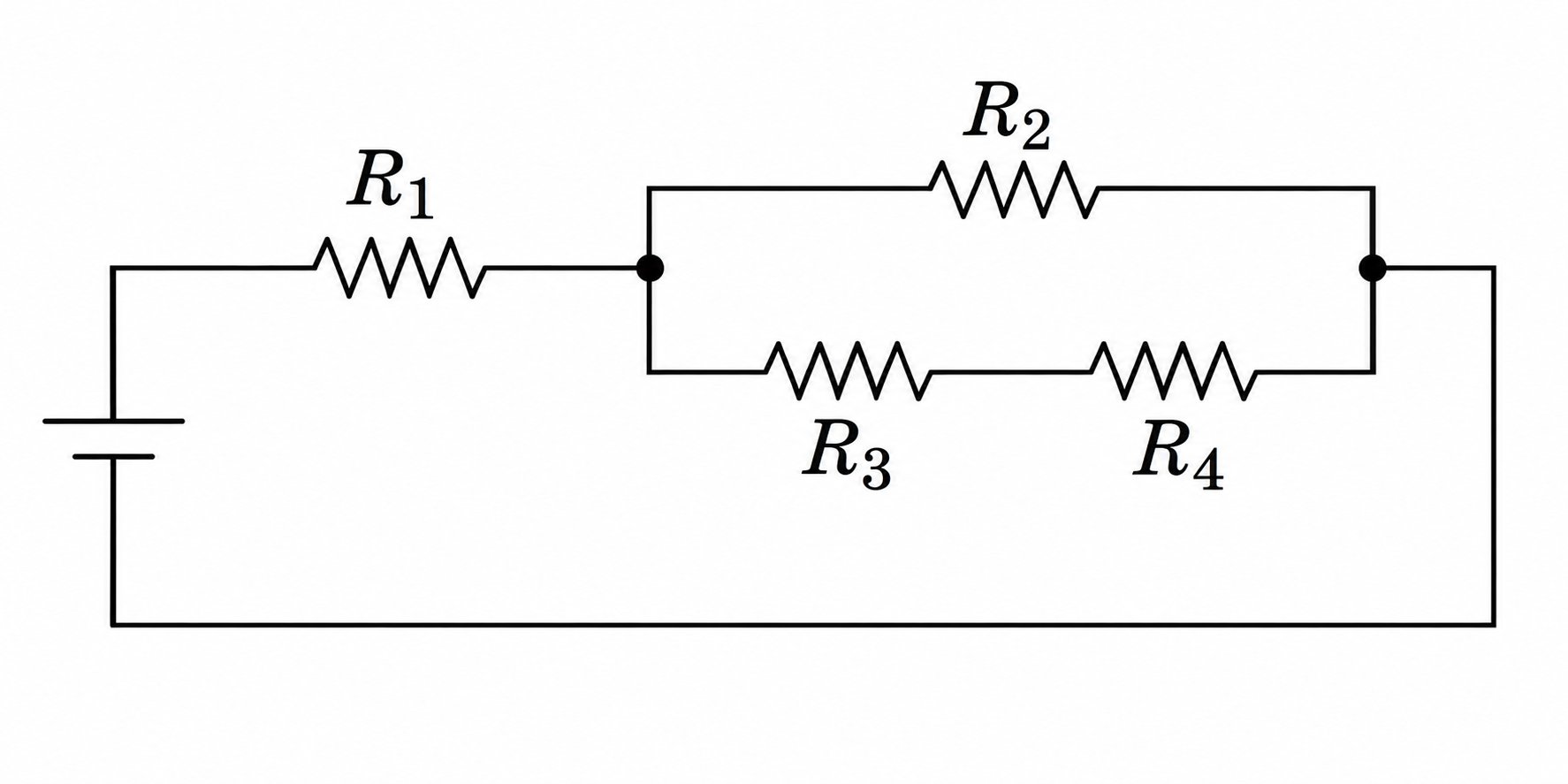
A battery and R1 in series with two parallel branches: R2 above, R3 and R4 in series below.

Question 2 of 5

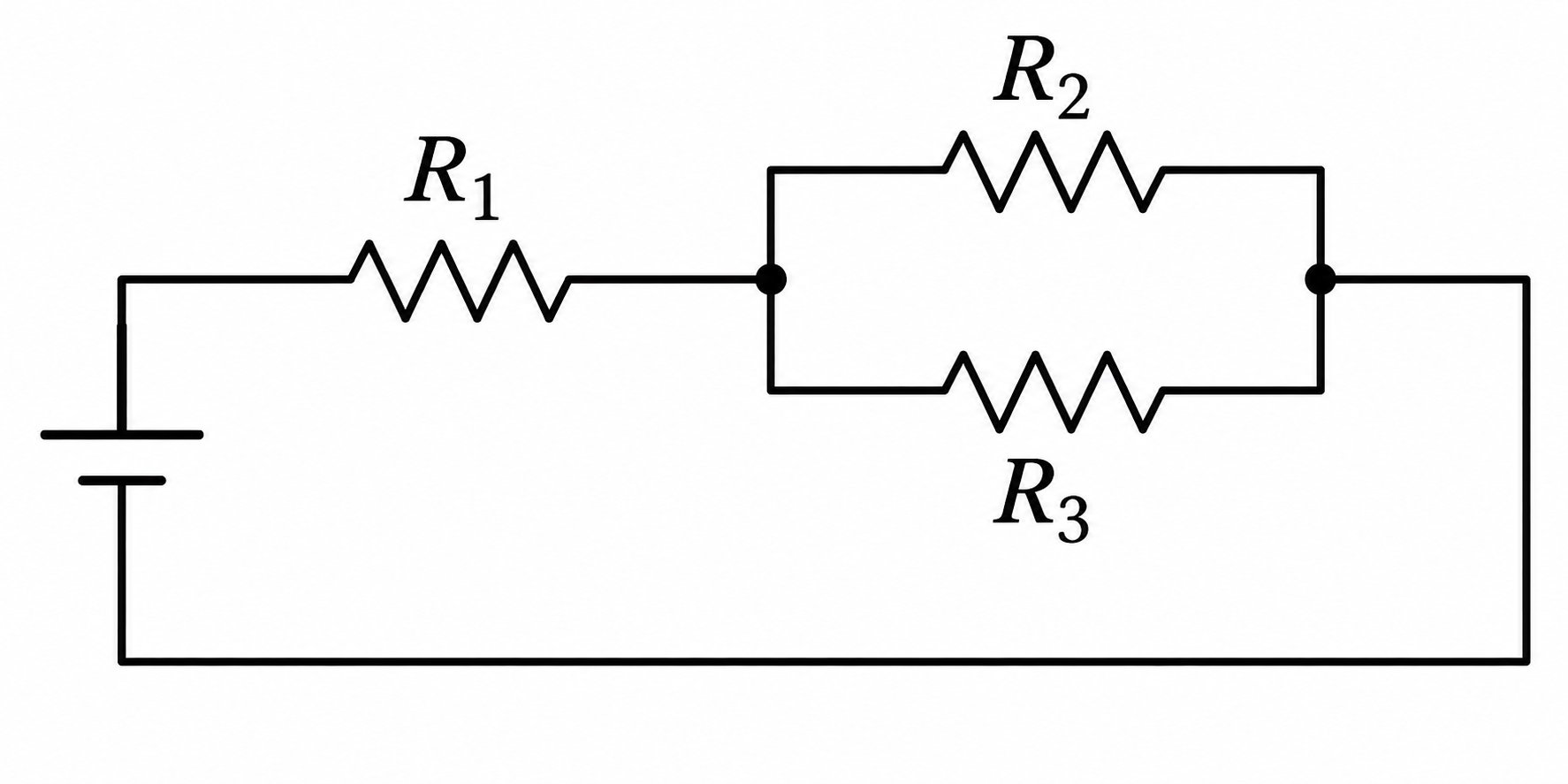
A battery's measured terminal voltages are 14 V at 1 A and 12 V at 3 A. Its internal resistance is constant. It then powers R1 = 2 Ω in series with R2 = 6 Ω and R3 = 3 Ω in parallel. (a) Find emf and internal resistance. (b) Find the total current and terminal voltage. (c) Find current in each branch. (d) Check energy conservation by comparing power supplied by the ideal emf with power dissipated internally and externally.

A battery and R1 in series with two parallel branches containing R2 and R3.

Question 3 of 5

An ideal 12 V battery supplies R1 = 2 Ω in series with R2 = 6 Ω and R3 = 3 Ω in parallel. The circuit initially works normally. Later an ideal ammeter placed in series with the battery reads 1.5 A; an ideal voltmeter reads 3 V across R1 and 9 V across the parallel section. (a) Predict all three normal currents. (b) Identify which single resistor branch has opened and justify with the measured data. (c) Predict the new current through the unbroken branch. (d) Explain why an open branch cannot be identified from a battery-current reading alone if resistor values are unknown.

A battery and R1 in series with two parallel branches containing R2 and R3.

Question 4 of 5

An ideal 12 V battery supplies R1 = 2 Ω in series with R2 = 6 Ω and R3 = 3 Ω in parallel. A real ammeter of resistance 1 Ω is inserted in series only with R3. (a) Find the current in R3 before the meter is inserted. (b) Find the meter reading afterward and the current through R2. (c) Compare battery currents before and after insertion. (d) Explain how a meter placed in one branch can change the current in another branch.

A battery and R1 in series with two parallel branches containing R2 and R3.

Question 5 of 5

A battery has emf 20 V and internal resistance 2 Ω. Its external network is an unknown series resistor R1 followed by two parallel 10 Ω resistors. While both branches are connected, an ideal voltmeter across the battery terminals reads 16 V. (a) Determine battery current and R1. (b) Find the power in either 10 Ω resistor. (c) One 10 Ω branch fails open. Find the new terminal voltage and power in the surviving 10 Ω resistor. (d) Explain why the terminal voltage and that resistor's power both rise after the failure.