TOPIC 11.6 · STUDY
Kirchhoff's Loop Rule
The loop rule says the signed potential changes around any closed path add to zero. That statement is conservation of energy for a charge that returns to its start.
11.6.A
Kirchhoff's loop rule
Kirchhoff's loop rule: the sum of signed potential changes around any closed path is zero, $$\sum \Delta V=0.$$ A charge that returns to its starting point has the same potential energy it began with, so the rule is conservation of energy.
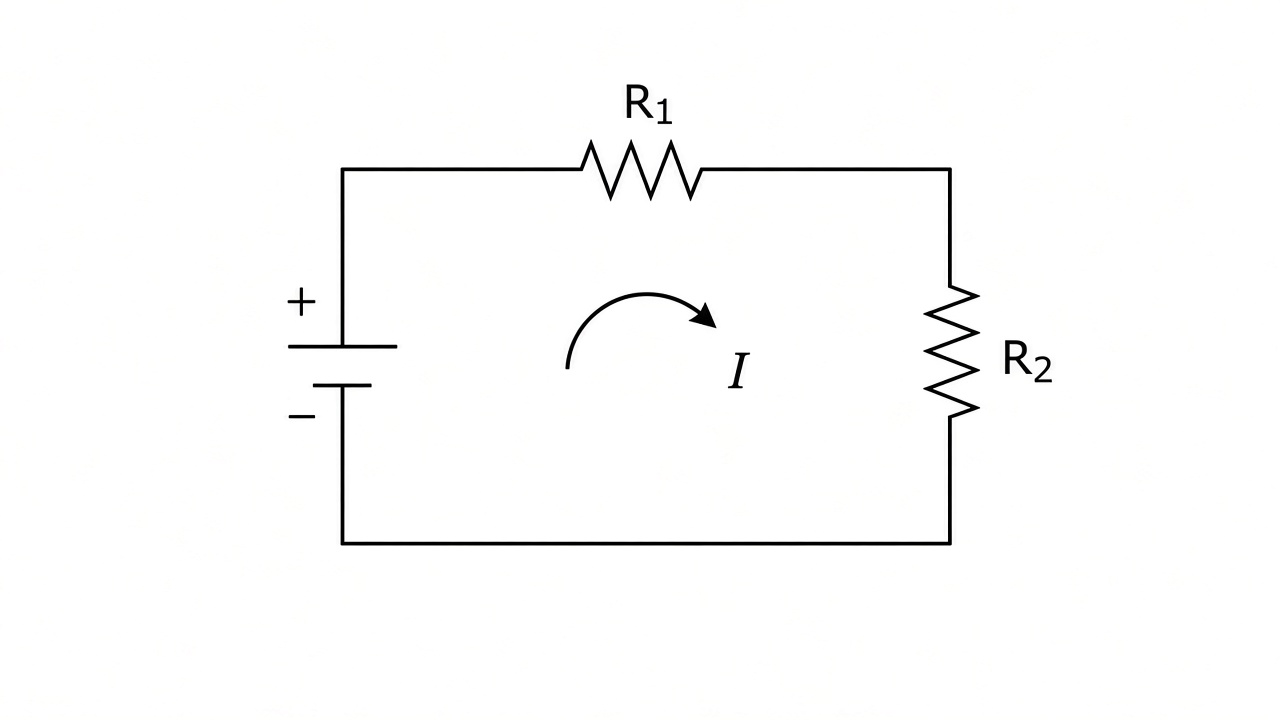
The clockwise arrow is the traversal. Potential rises from the negative terminal to the positive terminal and drops along the current through each resistor.
In the figure the long battery line is labeled $+$ on the upper side and current is clockwise, so conventional current leaves the positive terminal, passes $R_1$, then $R_2$.
Example: $\mathcal{E}=12\,\mathrm{V}$, $R_1=4.0\,\Omega$, $R_2=8.0\,\Omega$. Traversing with the current: $$+12-I(4.0)-I(8.0)=0,$$ so $12I=12$ and $I=1.0\,\mathrm{A}$. The drop across $R_1$ is $IR_1=4.0\,\mathrm{V}$ and across $R_2$ is $IR_2=8.0\,\mathrm{V}$.
Sign conventions along the chosen traversal: in the direction of the current, a resistor change is $-IR$. Against the current it is $+IR$. Crossing the battery from the negative terminal to the positive terminal is $+\mathcal{E}$.
The complete loop sum, including the battery, is zero. Summing only the resistor drops equals the emf in this single-loop case, but that partial sum is not the loop rule. The loop rule always includes every element on the path so that $\sum \Delta V=0$.
Each closed loop obeys the rule separately. Choose a traversal direction for that loop, assign signs consistently, and set the signed sum to zero.
Key points
- Loop rule: $\sum \Delta V=0$ around any closed path (conservation of energy).
- With the current: resistor change is $-IR$. Against the current: $+IR$.
- Crossing a battery from negative to positive is $+\mathcal{E}$.
- Example: $12\,\mathrm{V}$, $4.0\,\Omega$, $8.0\,\Omega$ gives $+12-4I-8I=0$, so $I=1.0\,\mathrm{A}$.
- Drops: $4.0\,\mathrm{V}$ on $R_1$ and $8.0\,\mathrm{V}$ on $R_2$.
- Include the battery in the loop sum; the full sum is zero.
- Summing only resistor drops may match the emf, but that partial sum is not the loop rule.
- Each closed loop obeys the rule separately with a consistent traversal.
Include the battery in the loop sum; the full sum is zero.