TOPIC 11.7 · STUDY
Kirchhoff's Junction Rule
At a steady-state junction, current in equals current out. The rule is conservation of charge: charge does not pile up at the junction.
11.7.A
Kirchhoff's junction rule
Kirchhoff's junction rule: at a steady-state junction, the total current into the junction equals the total current out. Equivalently, the net current into the junction is zero. The rule is conservation of charge: charge does not pile up at the junction.
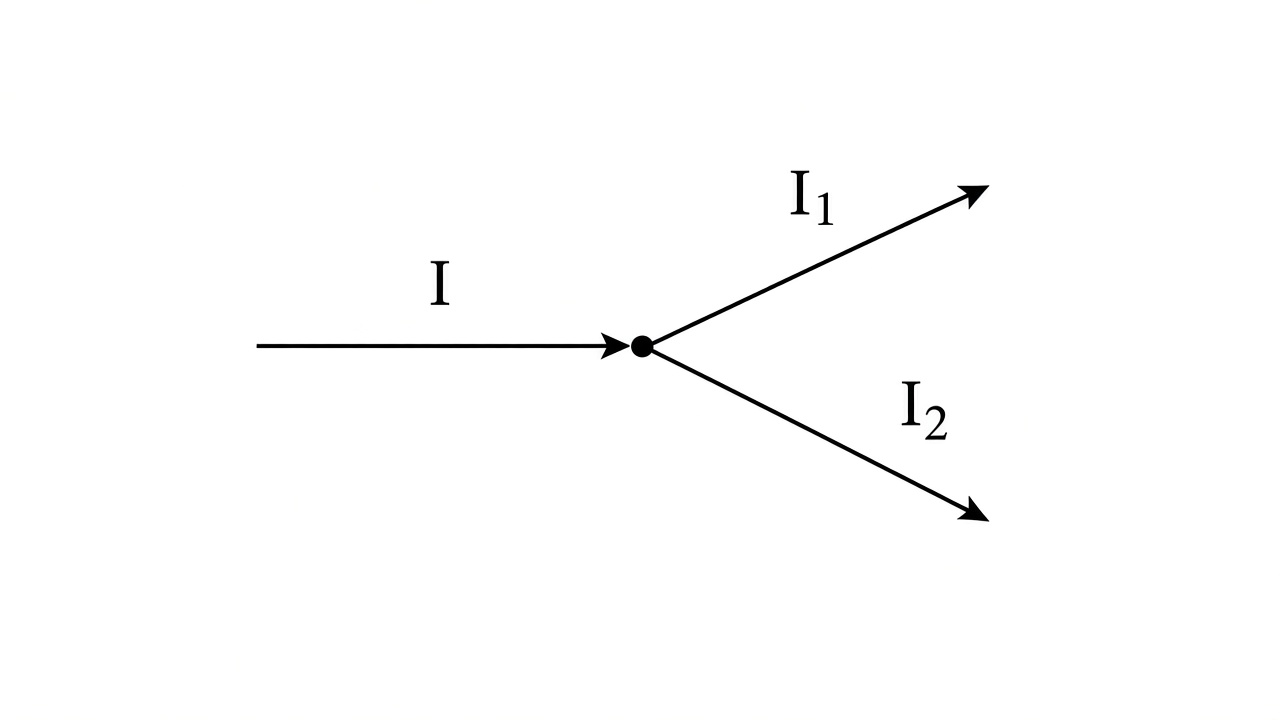
Charge is conserved at the junction, so I = I1 + I2.
Example: $5.0\,\mathrm{A}$ enters a junction and $2.0\,\mathrm{A}$ leaves on one branch, so the other branch carries $3.0\,\mathrm{A}$. With $I$ in and $I_1$, $I_2$ out, $$I=I_1+I_2.$$
Another junction: $4.0\,\mathrm{A}$ and $1.0\,\mathrm{A}$ enter, and $3.0\,\mathrm{A}$ leaves on one outgoing branch. The remaining outgoing current is $2.0\,\mathrm{A}$, because $4.0+1.0=3.0+2.0$. The net current into the junction is zero.
A supply wire feeding parallel branches carries the sum of the branch currents. That is the junction rule applied at the split: the incoming current equals the sum of the currents in the parallel paths.
The junction rule constrains currents, not potential differences. The loop rule is energy; the junction rule is charge. Both are needed for multi-loop circuits, where currents split at junctions and potential changes close around loops.
Key points
- Steady-state junction: current in equals current out; net current into the junction is zero.
- The rule is conservation of charge: charge does not accumulate at the junction.
- If $I$ enters and splits into $I_1$ and $I_2$, then $I=I_1+I_2$.
- Example: $5.0\,\mathrm{A}$ in and $2.0\,\mathrm{A}$ out on one branch leaves $3.0\,\mathrm{A}$ on the other.
- Example: $4.0\,\mathrm{A}$ and $1.0\,\mathrm{A}$ enter with $3.0\,\mathrm{A}$ out leaves $2.0\,\mathrm{A}$ on the remaining outgoing branch.
- A wire feeding parallel branches carries the sum of the branch currents.
- The junction rule constrains currents; the loop rule constrains potential changes.
- Loop rule is energy; junction rule is charge; both are needed for multi-loop circuits.
Steady current cannot accumulate charge at a junction.