TOPIC 11.8 · STUDY
Resistor-Capacitor (RC) Circuits
Series capacitors combine by reciprocals and parallel capacitors add. In a series RC loop, current is largest just after the switch closes and falls toward zero as the capacitor charges.
11.8.A
RC circuits
Parallel capacitors add: $C_{\mathrm{eq}}=C_1+C_2$. Series capacitors combine by reciprocals: $$\frac{1}{C_{\mathrm{eq}}}=\frac{1}{C_1}+\frac{1}{C_2}.$$
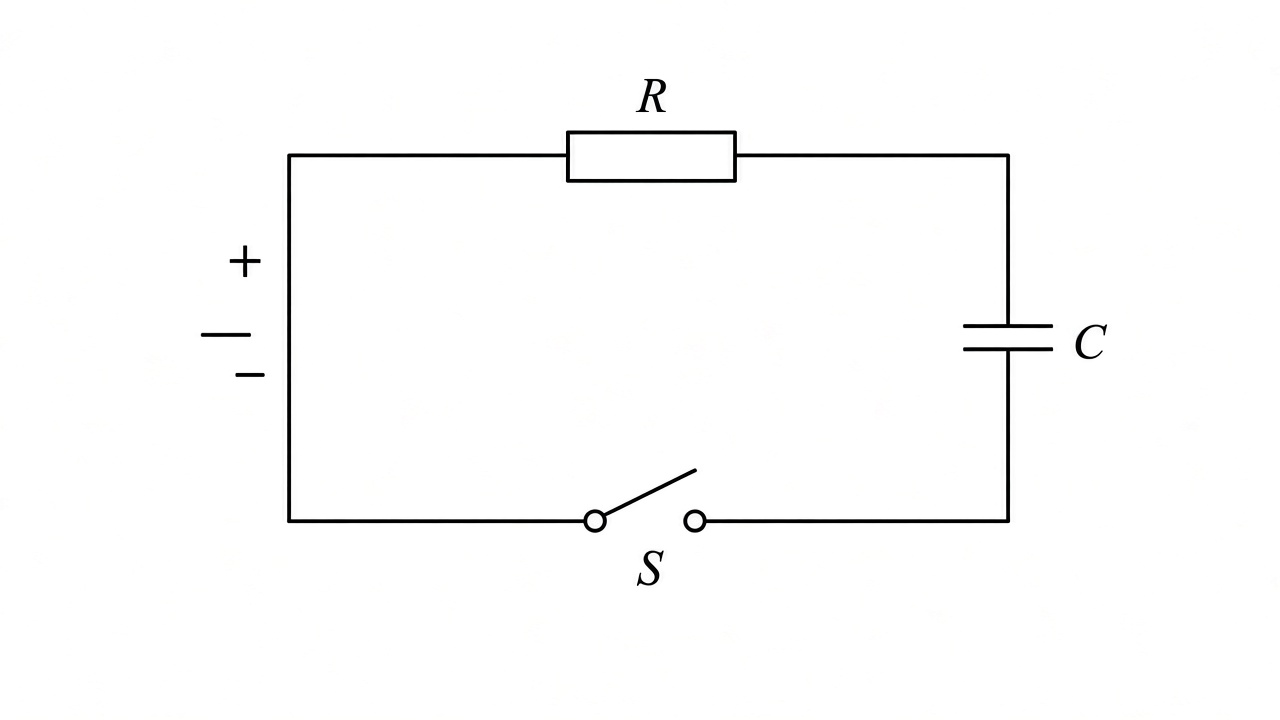
Switch S is open. Closing it connects the battery, resistor, and capacitor in one series loop.
Example: $6.0\,\mu\mathrm{F}$ and $3.0\,\mu\mathrm{F}$ in parallel give $C_{\mathrm{eq}}=9.0\,\mu\mathrm{F}$. The same two in series give $$\frac{1}{C_{\mathrm{eq}}}=\frac{1}{6.0}+\frac{1}{3.0}=\frac{1}{2.0},$$ so $C_{\mathrm{eq}}=2.0\,\mu\mathrm{F}$, which is less than the smaller capacitor.
Series capacitors carry the same charge magnitude. The parallel pair stores more charge at the same potential difference because $Q=CV$. Larger $C$ at fixed $V$ means larger $Q$.
Uncharged capacitor, $R=4.0\,\Omega$, emf $\mathcal{E}=12\,\mathrm{V}$: just after the switch closes, the capacitor behaves like a wire and $I=12/4.0=3.0\,\mathrm{A}$. After a long time the current is zero and the capacitor charge approaches $C\mathcal{E}$. With $C=5.0\,\mu\mathrm{F}$, $$Q_{\mathrm{f}}=C\mathcal{E}=(5.0\times 10^{-6})(12)=6.0\times 10^{-5}\,\mathrm{C}.$$
During charging, current starts high and falls toward zero; capacitor voltage starts at zero and rises toward the battery voltage. During discharging, the initial current is $V_0/R$, and both current and charge fall toward zero.
The time constant $\tau=RC$ measures how quickly the change proceeds. Larger $R$ or larger $C$ means a larger $\tau$ and a slower change.
Key points
- Parallel: $C_{\mathrm{eq}}=C_1+C_2$. Series: $1/C_{\mathrm{eq}}=1/C_1+1/C_2$.
- Example: $6.0\,\mu\mathrm{F}$ and $3.0\,\mu\mathrm{F}$ give $9.0\,\mu\mathrm{F}$ in parallel and $2.0\,\mu\mathrm{F}$ in series.
- Series capacitors carry the same charge magnitude; $Q=CV$ at fixed $V$ favors larger $C$.
- Just after closing on an uncharged capacitor: like a wire; example $I=12/4.0=3.0\,\mathrm{A}$.
- Long after closing: charging current is zero; $Q$ approaches $C\mathcal{E}$ (example $6.0\times 10^{-5}\,\mathrm{C}$).
- Charging: $I$ falls toward zero while capacitor voltage rises toward the battery voltage.
- Discharging: initial current is $V_0/R$; current and charge fall toward zero.
- Time constant $\tau=RC$: larger $R$ or larger $C$ means a slower change.
Right after the switch closes an uncharged capacitor acts like a wire; a long time later the charging current is zero.