TOPIC 12.1 · STUDY
Magnetic Fields
Magnetic field lines form closed loops. There are no isolated magnetic poles. Outside a bar magnet the lines leave the north end and enter the south end.
12.1.A
Magnetic fields and materials
Magnetic field lines form closed loops. There are no isolated magnetic poles, so every north pole is paired with a south pole. Outside a bar magnet the lines leave the north end and enter the south end, then continue through the magnet to close the loops.
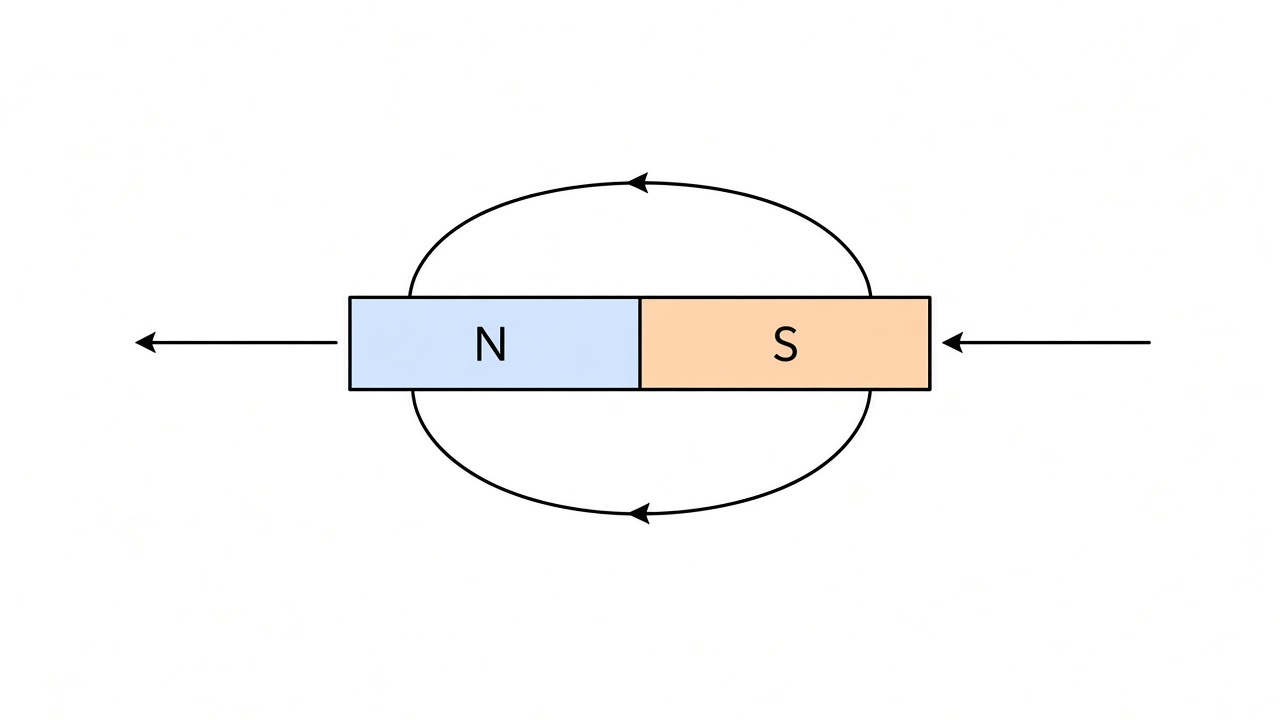
Outside the magnet the field leaves the north end and enters the south end. The lines continue as closed loops.
There are no magnetic monopoles. Breaking a bar magnet does not isolate a single pole; each piece is a smaller dipole with its own north and south ends. Like poles repel; opposite poles attract.
A compass needle aligns with the local magnetic field. The north-seeking end of the needle points toward Earth's magnetic south pole, which lies near geographic north.
Ferromagnetic materials such as iron can keep aligned domains and stay magnetized after the external field is removed. Paramagnetic materials are weakly attracted only while the field is present. Diamagnetism is a weak alignment opposite the applied field, so the sample is weakly repelled; all materials have some diamagnetism.
A magnetic dipole field gets weaker with distance. At the same distance from the dipole, the field is stronger on the axis than on the perpendicular bisector.
Vacuum permeability $\mu_0$ is a constant of free space. It appears as the constant in vacuum magnetic-field formulas. A material's permeability can differ from $\mu_0$ and can change with temperature, including near the Curie point. A soft-iron core increases the field inside a coil for the same current.
Key points
- Magnetic field lines are closed loops; there are no isolated magnetic poles.
- Outside a bar magnet, lines leave the north end and enter the south end.
- Breaking a bar magnet makes two smaller dipoles, not monopoles.
- Like poles repel; opposite poles attract.
- A compass needle aligns with the local field; its north-seeking end points toward Earth's magnetic south pole near geographic north.
- Ferromagnets can stay magnetized; paramagnets are weakly attracted only while a field is present; diamagnetism weakly opposes the applied field.
- A dipole field weakens with distance and is stronger on the axis than on the perpendicular bisector at equal distance.
- $\mu_0$ is the vacuum permeability; a material's permeability can differ from $\mu_0$ and can change near the Curie point.
- A soft-iron core increases the field inside a coil for the same current.
Field lines are closed loops, so every north pole is paired with a south pole.