TOPIC 12.2 · STUDY
Magnetism and Moving Charges
A moving charge produces a magnetic field and can feel a magnetic force. The force is largest when velocity is perpendicular to the field and is zero when velocity is parallel to the field. The force does no work, so the speed does not change.
12.2.A
Forces on moving charges
A single moving charge produces a magnetic field; a charge at rest does not. The field is largest when the position vector from the charge to the point is perpendicular to the velocity, and it is weaker far ahead on the line of motion.
Right-hand rule for the field of a positive charge: fingers along $\vec{v}$, curl toward the position vector, and the thumb gives $\vec{B}$. A negative charge reverses that direction.
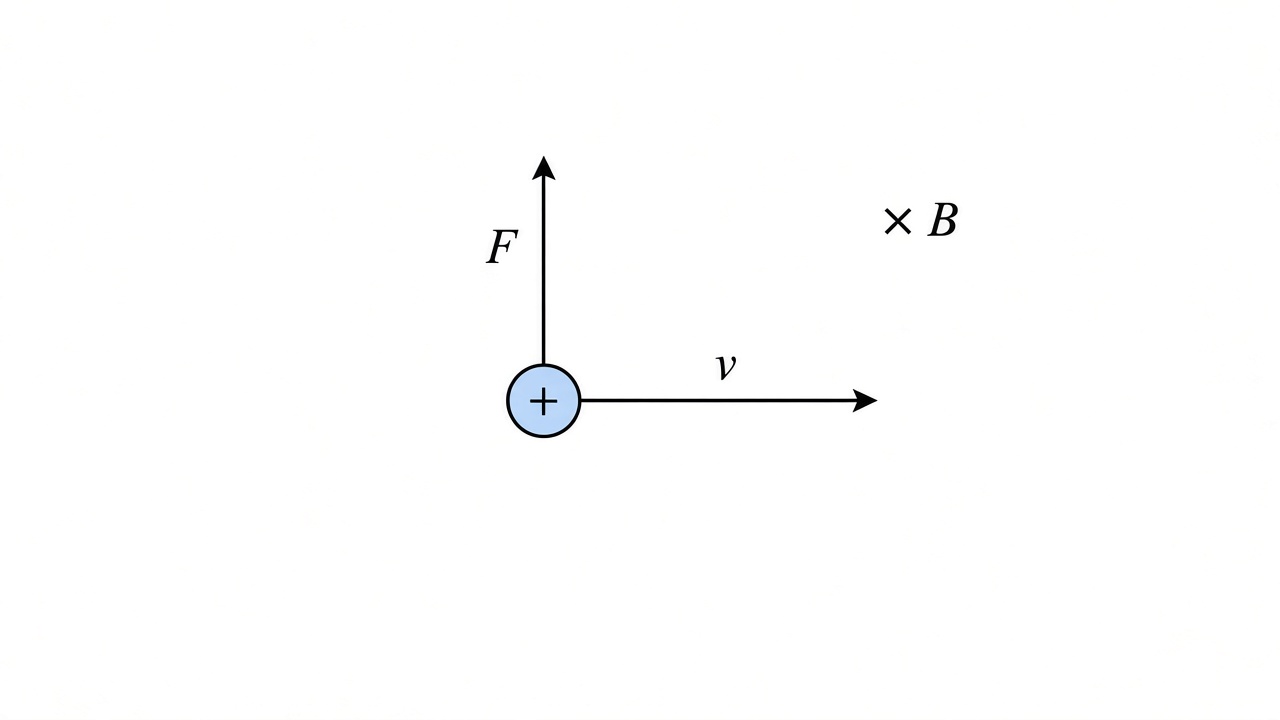
For a positive charge, v to the right and B into the page give an upward force. A negative charge would feel the opposite force.
The magnetic force magnitude is $|q|vB\sin\theta$, where $\theta$ is the angle between $\vec{v}$ and $\vec{B}$. Compute a number only when $\theta$ is $0^{\circ}$, $90^{\circ}$, or $180^{\circ}$. At $90^{\circ}$, $F=|q|vB$. At $0^{\circ}$ or $180^{\circ}$, $F=0$ even if the speed changes.
Example: a proton with $q=1.60\times 10^{-19}\,\mathrm{C}$, $v=2.0\times 10^{6}\,\mathrm{m/s}$, and $B=0.50\,\mathrm{T}$, with $\vec{v}$ perpendicular to $\vec{B}$. Then $$F=(1.60\times 10^{-19})(2.0\times 10^{6})(0.50)=1.60\times 10^{-13}\,\mathrm{N}.$$
Right-hand rule for the force on a positive charge: fingers along $\vec{v}$, curl toward $\vec{B}$, and the thumb is $\vec{F}$. The figure matches that rule. Negative charges reverse $\vec{F}$.
The force is perpendicular to $\vec{v}$, so the work is zero and kinetic energy stays constant. Speed does not change. A perpendicular field can bend the path into a circle at constant speed. Electric and magnetic forces act independently when both fields are present.
For angles other than $0^{\circ}$, $90^{\circ}$, and $180^{\circ}$, compare only qualitatively: closer to $90^{\circ}$ means a larger force.
Key points
- A moving charge produces a magnetic field; a charge at rest does not.
- Force magnitude: $F=|q|vB\sin\theta$. At $90^{\circ}$, $F=|q|vB$; at $0^{\circ}$ or $180^{\circ}$, $F=0$.
- Proton example with $v$ perpendicular to $B$: $F=1.60\times 10^{-13}\,\mathrm{N}$.
- Right-hand rule for positive $q$: fingers along $\vec{v}$, curl toward $\vec{B}$, thumb is $\vec{F}$; negative $q$ reverses $\vec{F}$.
- Magnetic force is perpendicular to $\vec{v}$, so work is zero and speed is unchanged.
- A perpendicular field can bend the path into a circle at constant speed.
- Electric and magnetic forces act independently when both fields are present.
- Away from $0^{\circ}$, $90^{\circ}$, and $180^{\circ}$, compare forces qualitatively only.
Magnetic force changes direction, not speed.