TOPIC 12.3 · STUDY
Magnetism and Current-Carrying Wires
A long straight wire produces a magnetic field that circles the wire and falls off as one over distance. A wire perpendicular to a magnetic field feels a force I L B. Parallel currents in the same direction attract.
12.3.A
Fields and forces of wires
A long straight wire produces a magnetic field that circles the wire. Use $\mu_0=4\pi\times 10^{-7}\,\mathrm{T\cdot m/A}$. The magnitude at distance $r$ from the wire is $$B=\frac{\mu_0 I}{2\pi r}.$$
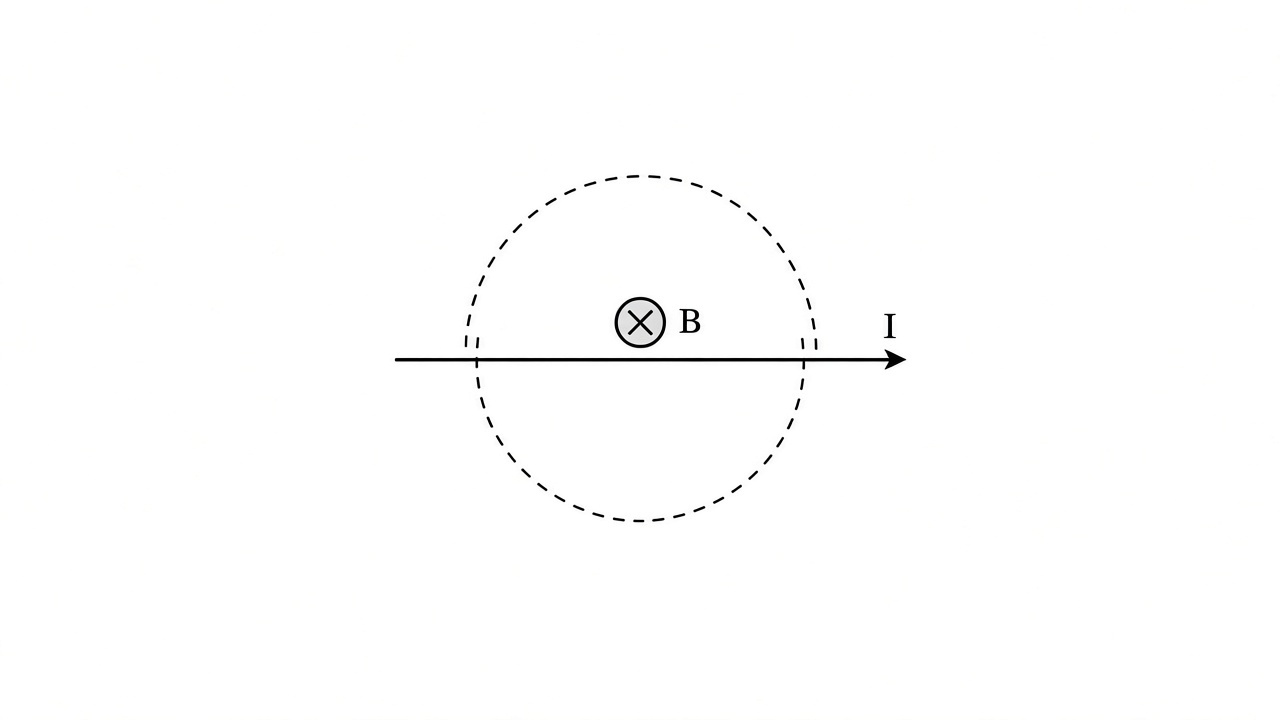
Thumb along the conventional current to the right. Above the wire the fingers curl into the page, so B is into the page.
Example: $I=10\,\mathrm{A}$ and $r=0.050\,\mathrm{m}$ give $$B=\frac{(4\pi\times 10^{-7})(10)}{2\pi(0.050)}=4.0\times 10^{-4}\,\mathrm{T}.$$ Doubling both $I$ and $r$ leaves $B$ unchanged. Tripling $r$ divides $B$ by $3$, not by $9$. The field is tangent to circles around the wire.
Equal currents in the same direction cancel at the midpoint between two parallel wires, and the wires attract. Opposite currents add at the midpoint, and the wires repel. A loop with counterclockwise current, viewed by you, has $\vec{B}$ at the center toward you.
Force on a wire: $F=ILB$ when the wire is perpendicular to $\vec{B}$, and $F=0$ when it is parallel. Example: $I=3.0\,\mathrm{A}$, $L=0.40\,\mathrm{m}$, $B=0.20\,\mathrm{T}$, perpendicular, so $$F=(3.0)(0.40)(0.20)=0.24\,\mathrm{N}.$$ Only the length inside the field counts. Right-hand rule: fingers along $I$, curl toward $\vec{B}$, thumb is the force.
Key points
- Long-wire field: $B=\mu_0 I/(2\pi r)$ with $\mu_0=4\pi\times 10^{-7}\,\mathrm{T\cdot m/A}$.
- Example $I=10\,\mathrm{A}$, $r=0.050\,\mathrm{m}$: $B=4.0\times 10^{-4}\,\mathrm{T}$.
- Doubling both $I$ and $r$ leaves $B$ unchanged; tripling $r$ divides $B$ by $3$, not by $9$.
- Same-direction parallel currents attract and cancel at the midpoint; opposite currents repel and add at the midpoint.
- A counterclockwise loop (as viewed by you) has $\vec{B}$ at the center toward you.
- Wire force: $F=ILB$ when perpendicular to $\vec{B}$; $F=0$ when parallel.
- Example $I=3.0\,\mathrm{A}$, $L=0.40\,\mathrm{m}$, $B=0.20\,\mathrm{T}$: $F=0.24\,\mathrm{N}$.
- Only the length inside the field counts; fingers along $I$, curl toward $\vec{B}$, thumb is the force.
The long-wire field depends on $1/r$, not $1/r^{2}$.