TOPIC 12.4 · STUDY
Electromagnetic Induction and Faraday's Law
An emf is induced when magnetic flux changes. The magnitude is the absolute value of the flux change over the time interval. Lenz's law says the induced current makes a field that opposes the change in flux.
12.4.A
Faraday's law and Lenz's law
Magnetic flux through a loop is $\Phi=BA\cos\theta$, where $\theta$ is the angle between $\vec{B}$ and the area vector. For a perpendicular field with $A=0.020\,\mathrm{m^{2}}$ and $B=0.40\,\mathrm{T}$, $$\Phi=(0.40)(0.020)=0.0080\,\mathrm{Wb}.$$ If $\vec{B}$ lies in the plane of the loop, the flux is zero.
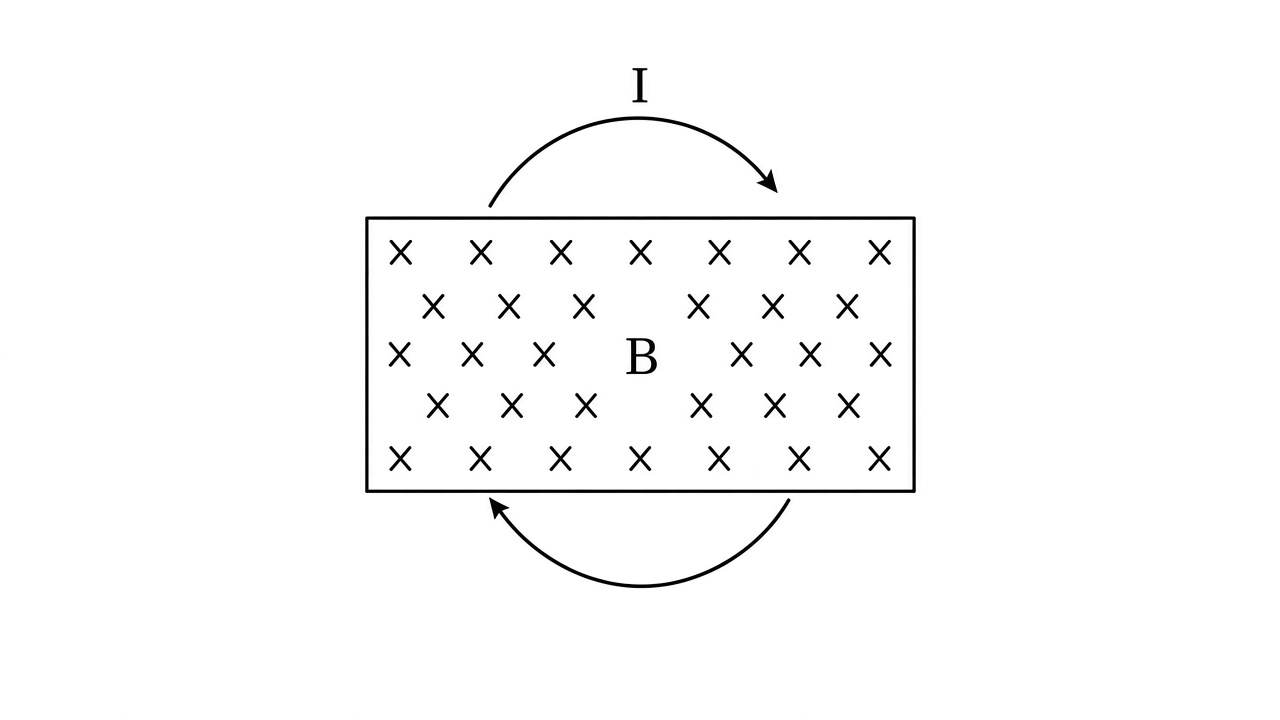
Clockwise current produces its own into-page field. That direction opposes a decrease of into-page flux.
An emf is induced when magnetic flux changes. The average emf magnitude is $|\Delta\Phi|/\Delta t$. If that $0.0080\,\mathrm{Wb}$ falls to zero in $0.020\,\mathrm{s}$, $$\mathcal{E}=\frac{0.0080}{0.020}=0.40\,\mathrm{V}.$$ A constant field through a stationary loop induces zero emf.
A rod of length $L$ moving at speed $v$ on rails in a perpendicular field has $\mathcal{E}=BLv$. Example: $B=0.50\,\mathrm{T}$, $L=0.20\,\mathrm{m}$, $v=4.0\,\mathrm{m/s}$ give $$\mathcal{E}=(0.50)(0.20)(4.0)=0.40\,\mathrm{V}.$$ If the loop resistance is $2.0\,\Omega$, the induced current is $I=\mathcal{E}/R=0.40/2.0=0.20\,\mathrm{A}$.
Lenz's law: the induced current makes a field that opposes the change in flux. Increasing into-page flux produces an out-of-page induced field and a counterclockwise current. Decreasing into-page flux produces an into-page induced field and a clockwise current, which is what the figure shows.
An approaching north pole makes the near face of the loop a north pole so the loop repels the magnet. The magnetic force on the induced current opposes the motion that causes the flux change, so an external agent must do work.
Key points
- Flux: $\Phi=BA\cos\theta$. Perpendicular example: $\Phi=0.0080\,\mathrm{Wb}$.
- Average emf magnitude: $|\Delta\Phi|/\Delta t$. That $0.0080\,\mathrm{Wb}$ to zero in $0.020\,\mathrm{s}$ gives $0.40\,\mathrm{V}$.
- A constant field through a stationary loop induces zero emf.
- Moving rod on rails: $\mathcal{E}=BLv$. Example: $0.40\,\mathrm{V}$; with $R=2.0\,\Omega$, $I=0.20\,\mathrm{A}$.
- Lenz: induced field opposes the change in flux.
- Increasing into-page flux: out-of-page induced field, counterclockwise current.
- Decreasing into-page flux: into-page induced field, clockwise current.
- An approaching north pole makes the near face a north pole; an external agent must do work against the opposing force.
A strong but unchanging field induces no emf; a weak but rapidly changing field can.