TOPIC 13.1 · STUDY
Reflection
A light ray shows the direction a narrow beam travels. The ray model works when openings are large compared with the wavelength. On a smooth surface the angle of incidence equals the angle of reflection, both measured from the normal.
13.1.A
Rays and the wave model
A geometric ray is drawn perpendicular to a wavefront and points in the direction the energy travels. It tracks a narrow beam. It does not record amplitude, and it does not predict how a wave spreads around a small opening.
The ray model is appropriate when the wavelength is negligible compared with the apertures and obstacles of interest. A wide doorway and a narrow laser beam are ray problems. Bright and dark fringes from a narrow slit, or colors from a soap film, need the wave model because those patterns come from phase differences across a wavefront.
A laser is modeled as one narrow bundle of nearly parallel rays, so the spot stays tight. A flashlight is many rays leaving over a wide range of directions, so the illuminated region is broad. Drawing a ray diagram does not disprove the wave nature of light. Rays are the useful limit of that wave when spreading can be ignored.
13.1.B
The law of reflection
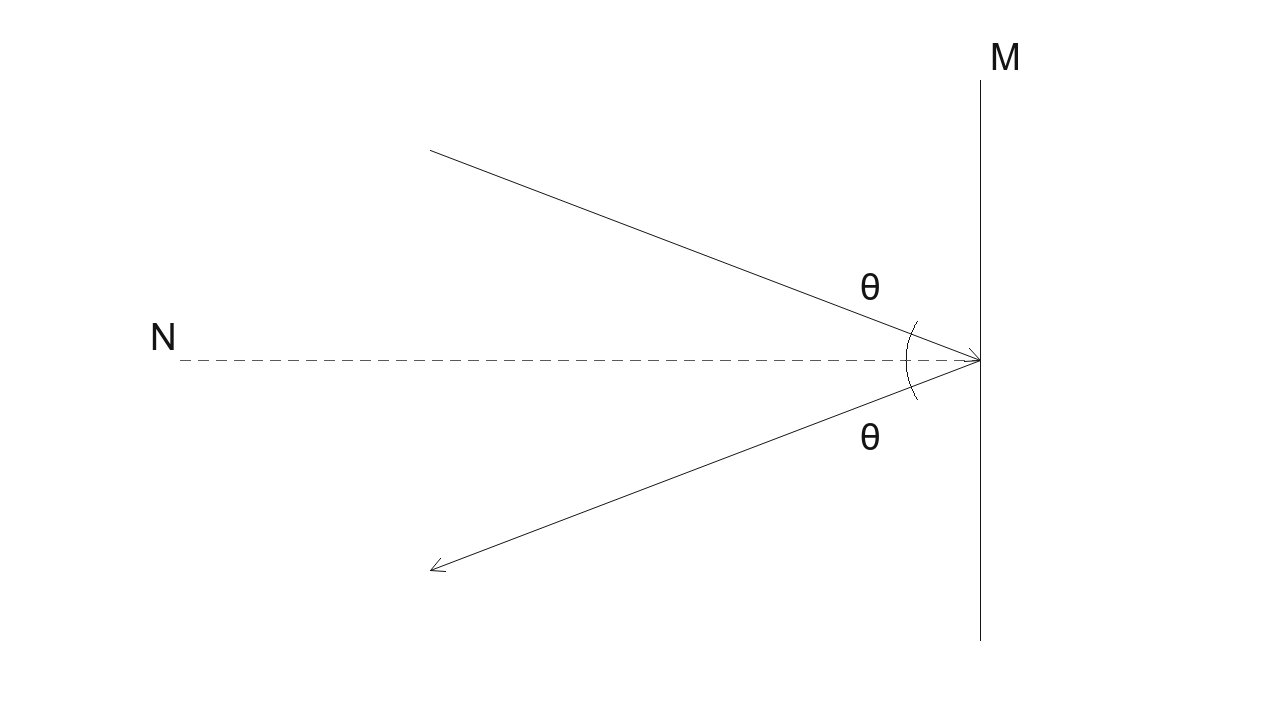
Both angles are measured from the normal. The law of reflection says those angles are equal.
The angle of incidence $\theta_i$ and the angle of reflection $\theta_r$ are measured from the normal, not from the surface. The law of reflection is $\theta_i=\theta_r$. If a ray meets a surface at $20^\circ$ to the surface, the angle with the normal is $70^\circ$, so $\theta_r=70^\circ$. The angle between the incident and reflected rays is $2\theta_i$.
Rotating a plane mirror by a small angle $\alpha$ changes the reflected beam's direction by $2\alpha$. A rotation of $8^\circ$ swings the reflected ray by $16^\circ$.
Specular reflection comes from a smooth surface whose normal is nearly the same everywhere, so the beam leaves in one direction. Sunlight glinting off a calm lake is specular. Diffuse reflection comes from a rough surface whose local normals point many ways, so light reaches many viewing directions. Matte paper looks bright off the mirror direction for that reason.
Key points
- A ray is perpendicular to the wavefront and points in the travel direction.
- Rays locate a beam when the wavelength is negligible compared with openings and obstacles.
- Fringe locations and thin-film colors need the wave model.
- Law of reflection: $\theta_i=\theta_r$, both from the normal.
- A $20^\circ$ angle with the surface means a $70^\circ$ angle with the normal.
- Turning a mirror by $\alpha$ turns the reflected ray by $2\alpha$.
- Specular reflection follows one outgoing direction. Diffuse reflection spreads over many directions.
Angles of incidence and reflection are measured from the normal. An angle quoted from the surface is the complement of that angle.