TOPIC 13.2 · STUDY
Images Formed by Mirrors
A concave mirror can form a real inverted image or a virtual upright image. A convex mirror and a plane mirror form upright virtual images for a real object. The mirror equation and the sign of the magnification tell which case it is.
13.2.A
Images formed by mirrors
Object distance $s$ is positive for a real object. Image distance $s'$ is positive for a real image and negative for a virtual image. Focal length $f$ is positive for a concave mirror and negative for a convex mirror. The mirror equation and the lateral magnification are $$\frac{1}{s}+\frac{1}{s'}=\frac{1}{f},\qquad M=-\frac{s'}{s}.$$ A positive $M$ means upright. A negative $M$ means inverted. For a spherical mirror, $f=R/2$.
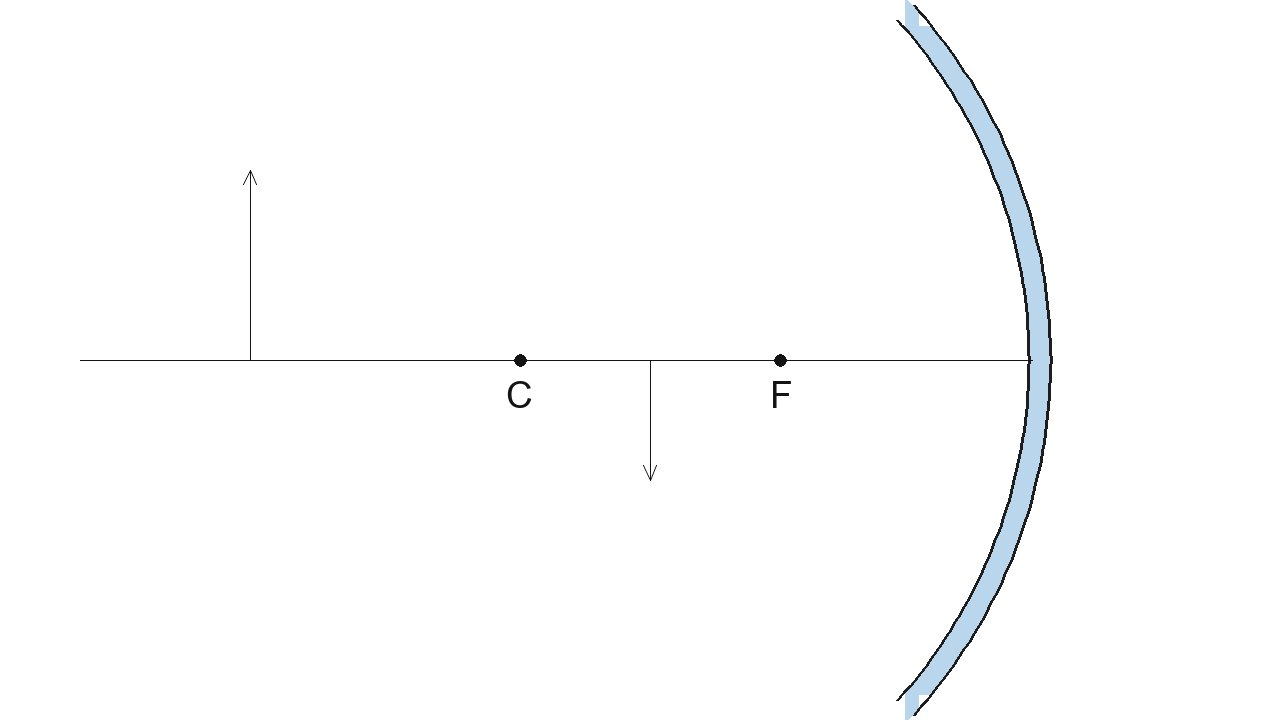
The object is beyond C. The real image is inverted and lies between C and F.
Three principal rays for a concave mirror: a ray parallel to the axis reflects through F; a ray through F reflects parallel to the axis; a ray through C reflects back on itself. An object beyond C produces an inverted, reduced real image between F and C.
Example: a concave mirror with $f=+10\,\mathrm{cm}$ and a real object at $s=30\,\mathrm{cm}$. Then $$\frac{1}{s'}=\frac{1}{10}-\frac{1}{30}=\frac{1}{15},$$ so $s'=+15\,\mathrm{cm}$ and $M=-15/30=-0.50$. The image is real, inverted, and half as tall. A $4.0\,\mathrm{cm}$ object has image height $h'=-2.0\,\mathrm{cm}$.
If the object is inside the focal length, the image is virtual, upright, and enlarged. For $f=+12\,\mathrm{cm}$ and $s=+8\,\mathrm{cm}$, $$\frac{1}{s'}=\frac{1}{12}-\frac{1}{8}=-\frac{1}{24},$$ so $s'=-24\,\mathrm{cm}$ and $M=+3.0$. A makeup mirror uses that arrangement.
A convex mirror has $f<0$. For $f=-20\,\mathrm{cm}$ and $s=20\,\mathrm{cm}$, $s'=-10\,\mathrm{cm}$ and $M=+0.50$. The image is virtual, upright, and reduced, and the field of view is wide. A plane mirror is the $f\to\infty$ limit: $s'=-s$ and $M=+1$. An object $25\,\mathrm{cm}$ in front of a plane mirror has its image $25\,\mathrm{cm}$ behind the mirror. For a real object, only a concave mirror can form a real image, and only when $s>f$.
Key points
- $1/s+1/s'=1/f$ and $M=-s'/s$. Positive $s'$ is real. Positive $M$ is upright.
- Concave: $f>0$. Convex: $f<0$. Spherical: $f=R/2$.
- Object beyond C: inverted real image between F and C.
- Example $f=+10\,\mathrm{cm}$, $s=30\,\mathrm{cm}$: $s'=+15\,\mathrm{cm}$, $M=-0.50$.
- Object inside F: virtual, upright, enlarged. Example $f=+12\,\mathrm{cm}$, $s=+8\,\mathrm{cm}$: $s'=-24\,\mathrm{cm}$, $M=+3.0$.
- Convex example $f=-20\,\mathrm{cm}$, $s=20\,\mathrm{cm}$: $s'=-10\,\mathrm{cm}$, $M=+0.50$.
- Plane mirror: $s'=-s$ and $M=+1$.
A real image is where reflected rays actually meet. A virtual image is where the extensions of those rays meet behind the mirror.