TOPIC 13.3 · STUDY
Refraction
Refraction bends a ray because the wave speed changes at a new medium. Snell's law relates the angles to the indices. Total internal reflection occurs when a ray in the higher-index medium hits the surface beyond the critical angle.
13.3.A
Refraction and total internal reflection
The index of refraction is $n=c/v$, where $c=3.00\times 10^{8}\,\mathrm{m/s}$ is the vacuum speed and $v$ is the speed in the medium. A medium with $v=1.50\times 10^{8}\,\mathrm{m/s}$ has $n=2.00$. A larger $n$ means a slower wave.
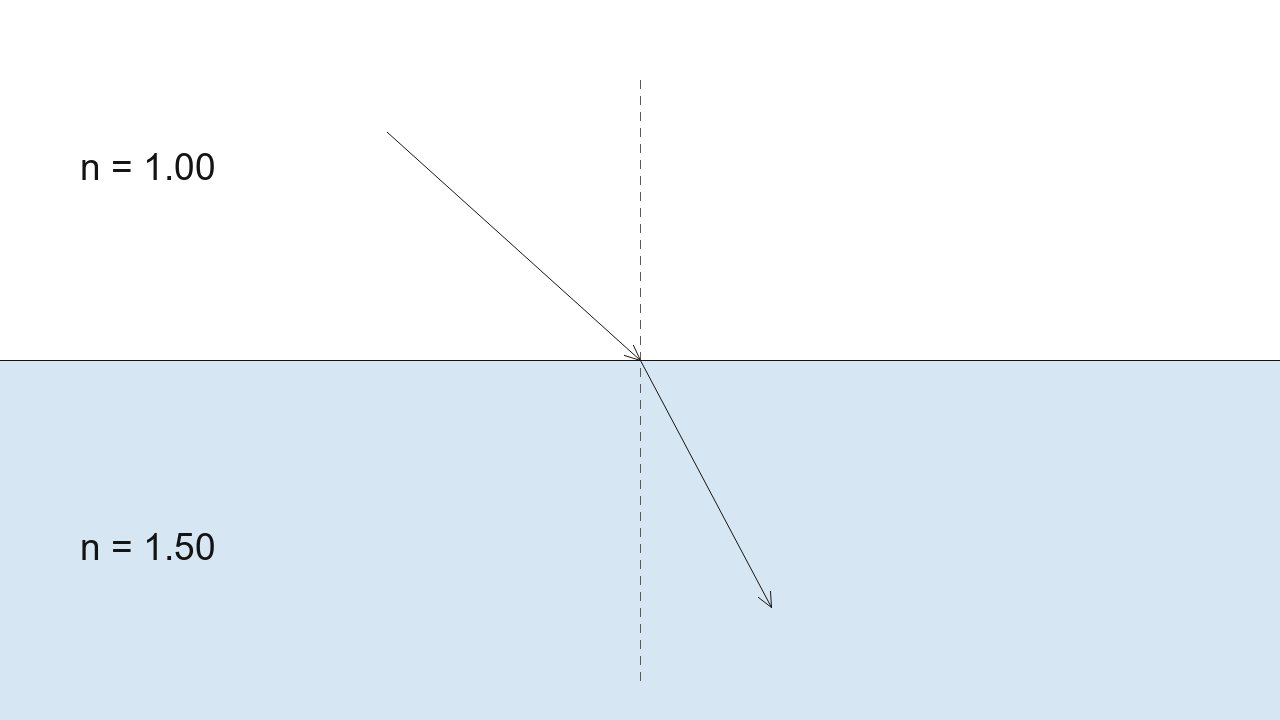
Entering a higher index bends the ray toward the normal. Leaving a higher index bends it away.
Snell's law is $n_1\sin\theta_1=n_2\sin\theta_2$, with angles from the normal. From air ($n=1.00$) into glass ($n=1.50$) at $\theta_1=30^\circ$, $$\sin\theta_2=\frac{1.00\sin 30^\circ}{1.50}=\frac{1}{3},$$ so $\theta_2\approx 19.5^\circ$. The ray bends toward the normal. A larger glass index makes $\theta_2$ even smaller. A ray along the normal is not bent, but its speed still changes.
Going from a higher index to a lower index bends the ray away from the normal. The critical angle is the incidence that puts the transmitted ray along the surface, $\theta_2=90^\circ$: $$\sin\theta_c=\frac{n_2}{n_1}.$$ For glass $n=1.50$ into air, $\theta_c=\arcsin(1/1.50)\approx 42^\circ$. A ray at $50^\circ$ in that glass is totally reflected; no transmitted ray enters the air. For water $n=1.33$ into air, $\theta_c\approx 49^\circ$.
Frequency does not change at the boundary. Wavelength shortens in the slower medium because $v=f\lambda$ and $f$ is fixed. Two rays that enter the same glass, one along the normal and one at an angle, travel at the same speed $c/n$ inside the glass.
Key points
- $n=c/v$. Example: $v=1.50\times 10^{8}\,\mathrm{m/s}$ gives $n=2.00$.
- Snell's law: $n_1\sin\theta_1=n_2\sin\theta_2$.
- Air to glass, $30^\circ$ into $n=1.50$: $\theta_2\approx 19.5^\circ$, toward the normal.
- Higher $n$ to lower $n$: the ray bends away from the normal.
- Critical angle: $\sin\theta_c=n_2/n_1$. Glass to air is about $42^\circ$.
- Incidence beyond $\theta_c$ gives total internal reflection.
- Frequency is unchanged at the boundary. Wavelength changes with speed.
Total internal reflection requires the ray to start in the higher-index medium. A ray arriving from air into glass always has a transmitted ray.