TOPIC 13.4 · STUDY
Images Formed by Lenses
A converging lens can form a real inverted image or a virtual upright image. A diverging lens forms an upright reduced virtual image for a real object. The thin-lens equation uses the same sign rules as the mirror equation.
13.4.A
Images formed by thin lenses
For a thin lens, $s>0$ for a real object, $s'>0$ for a real image on the transmitted side, and $f>0$ for a converging lens. A diverging lens has $f<0$. The thin-lens equation and magnification are $$\frac{1}{s}+\frac{1}{s'}=\frac{1}{f},\qquad M=-\frac{s'}{s}.$$ A real image is where transmitted rays actually meet.
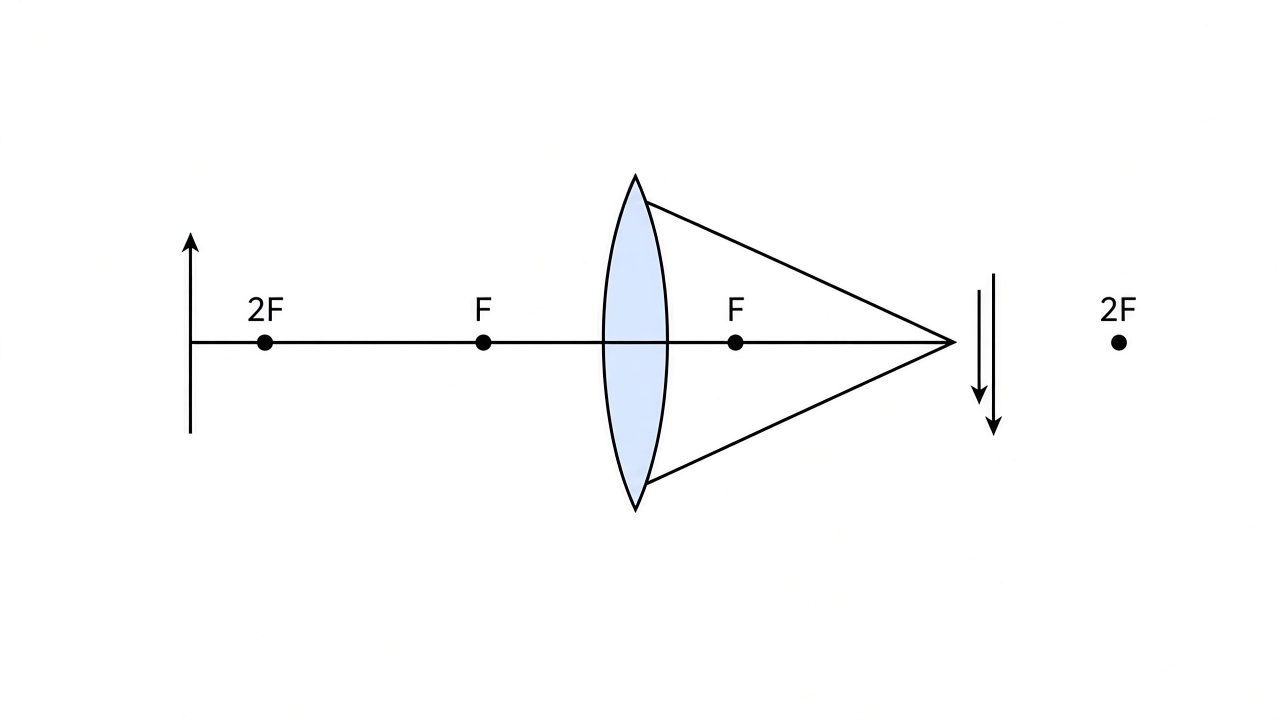
An object beyond 2F produces an inverted real image between F and 2F on the far side.
Three principal rays: a ray parallel to the axis bends through the far focal point; a ray through the center continues approximately straight; a ray through the near focal point leaves parallel to the axis.
Example: $f=+20\,\mathrm{cm}$ and $s=60\,\mathrm{cm}$, which is beyond $2F$. Then $$\frac{1}{s'}=\frac{1}{20}-\frac{1}{60}=\frac{1}{30},$$ so $s'=+30\,\mathrm{cm}$ and $M=-0.50$. The image is real, inverted, and between F and 2F. A $6.0\,\mathrm{cm}$ object has $h'=-3.0\,\mathrm{cm}$. When $s=2f$, the image is also at $2f$ and $M=-1$. For $f=+20\,\mathrm{cm}$ and $s=40\,\mathrm{cm}$, $s'=+40\,\mathrm{cm}$.
An object inside the focal length of a converging lens gives a virtual, upright, enlarged image. For $f=+10\,\mathrm{cm}$ and $s=+6\,\mathrm{cm}$, $s'=-15\,\mathrm{cm}$ and $M=+2.5$. A simple magnifier uses that placement. Positive $f$ does not guarantee a real image.
Parallel rays on a diverging lens spread as if they came from F on the incident side. For $f=-15\,\mathrm{cm}$ and $s=15\,\mathrm{cm}$, $s'=-7.5\,\mathrm{cm}$ and $M=+0.50$. The image is virtual, upright, and reduced. Rays on the far side are diverging, so they do not meet on a screen.
Key points
- Thin lens: $1/s+1/s'=1/f$ and $M=-s'/s$. Converging $f>0$. Diverging $f<0$.
- Object beyond 2F: inverted real image between F and 2F.
- Example $f=+20\,\mathrm{cm}$, $s=60\,\mathrm{cm}$: $s'=+30\,\mathrm{cm}$, $M=-0.50$.
- At $s=2f$, $s'=2f$ and $M=-1$.
- Inside F: virtual, upright, enlarged. Example $s'=-15\,\mathrm{cm}$, $M=+2.5$.
- Diverging example $f=-15\,\mathrm{cm}$, $s=15\,\mathrm{cm}$: $s'=-7.5\,\mathrm{cm}$, $M=+0.50$.
- A real lens image is on the transmitted side, where rays meet.
A diverging lens with a real object does not form a real image. The outgoing rays diverge.