TOPIC 14.1 · STUDY
Properties of Wave Pulses and Waves
A wave pulse carries energy through a medium without carrying the medium along with it. Pulse speed on a string depends on tension and linear density. Transverse and longitudinal waves differ in the direction of the disturbance.
14.1.A
Pulses, speed, and wave type
A wave pulse is a single disturbance. A periodic wave is a repeating disturbance. The pulse transfers energy. The pieces of the medium oscillate about equilibrium and do not travel from the source to the receiver with the pulse.
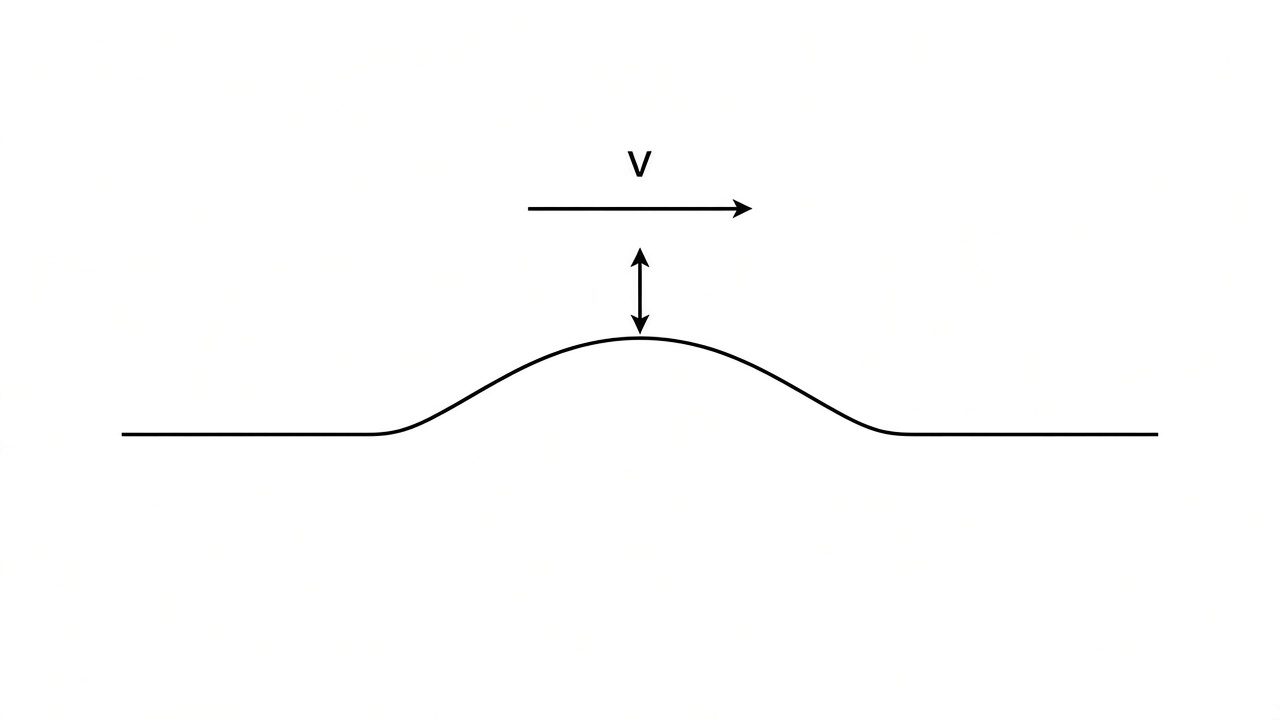
The pulse travels along the string. The displacement of the string is perpendicular to that direction.
On a string, the pulse speed is $v=\sqrt{F_T/\mu}$, where $F_T$ is the tension and $\mu$ is the linear mass density. For $F_T=64\,\mathrm{N}$ and $\mu=0.040\,\mathrm{kg/m}$, $$v=\sqrt{64/0.040}=\sqrt{1600}=40\,\mathrm{m/s}.$$ Doubling both tension and linear density leaves $v$ unchanged, because the ratio $F_T/\mu$ is the same. Speed does not depend on the amplitude or on the total length of a uniform string.
In a transverse wave the disturbance is perpendicular to the travel direction, as on the string in the figure. At a crest the displacement is maximum, so the transverse velocity of that small piece is instantaneously zero. In a longitudinal wave the disturbance is parallel to the travel direction. Sound in air is longitudinal: compressions are high-pressure regions and rarefactions are low-pressure regions. The air does not stream from the speaker to the ear.
For otherwise identical pulses, the energy scales with the square of the amplitude. Doubling the amplitude multiplies the energy by 4. Loudness of a sound increases with pressure amplitude. A mechanical wave needs a medium. An electromagnetic pulse does not, and it can travel in vacuum. In a given gas, the speed of sound increases when the temperature increases.
Key points
- A pulse transfers energy. The medium oscillates locally and is not carried along.
- String speed: $v=\sqrt{F_T/\mu}$. Example: $64\,\mathrm{N}$ and $0.040\,\mathrm{kg/m}$ give $40\,\mathrm{m/s}$.
- Transverse: disturbance perpendicular to travel. Longitudinal: parallel to travel.
- Sound in air is a longitudinal mechanical wave. Compressions are high pressure.
- Energy scales with amplitude squared. Doubling amplitude multiplies energy by 4.
- Electromagnetic pulses need no medium. Mechanical pulses do.
- The speed of sound in a gas increases as temperature increases.
Amplitude does not set the pulse speed on a string. Tension and linear density do.