TOPIC 14.2 · STUDY
Periodic Waves
A periodic wave has a period, a frequency, and a wavelength. Those are related by v = f lambda. Amplitude is independent of period and frequency. Pitch follows frequency, and wave energy increases as frequency increases.
14.2.A
Period, frequency, and wavelength
The period $T$ is the time for one cycle. The frequency is $f=1/T$. The wavelength $\lambda$ is the distance between successive corresponding points, such as adjacent crests. They are related by $$v=f\lambda.$$
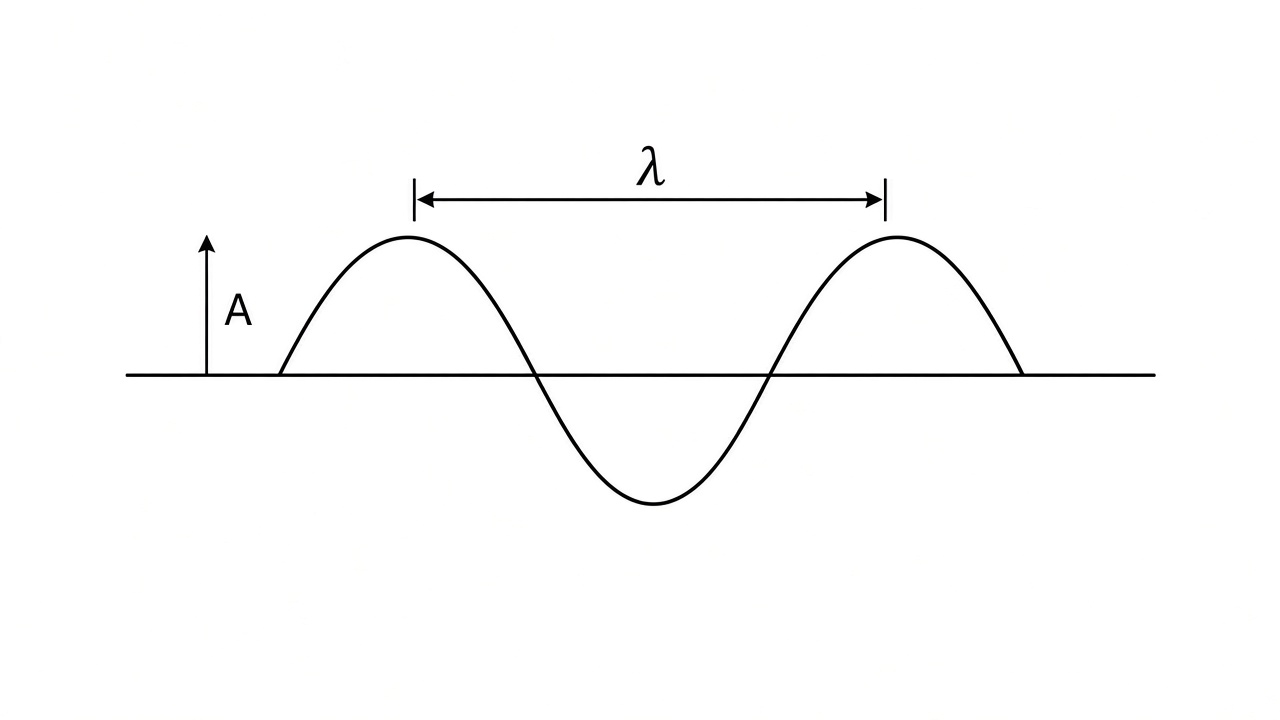
Wavelength is crest to crest. Amplitude is the maximum displacement from equilibrium.
Example: $f=80\,\mathrm{Hz}$ and $\lambda=0.40\,\mathrm{m}$ give $v=(80)(0.40)=32\,\mathrm{m/s}$. A tuning fork at $250\,\mathrm{Hz}$ has period $T=1/250=0.0040\,\mathrm{s}$. In one medium at one speed, doubling the frequency halves the wavelength.
Amplitude is independent of period and frequency. Raising only the amplitude, with tension and frequency fixed, does not change $T$, $f$, or $v$. Pitch is the frequency of a sound. A higher sung note is a higher frequency, and in the same air that means a shorter wavelength. The energy of a periodic wave increases as its frequency increases, even when the amplitude stays the same.
Key points
- $f=1/T$ and $v=f\lambda$.
- Wavelength is the distance between adjacent crests, or any successive corresponding points.
- Example: $80\,\mathrm{Hz}$ and $0.40\,\mathrm{m}$ give $32\,\mathrm{m/s}$.
- $250\,\mathrm{Hz}$ has period $0.0040\,\mathrm{s}$.
- At fixed speed, doubling frequency halves wavelength.
- Amplitude does not determine period or frequency.
- Pitch follows frequency. Wave energy increases as frequency increases.
Matching pitch does not require the amplitude to equal the wavelength. Amplitude and wavelength are independent.