TOPIC 14.3 · STUDY
Boundary Behavior of Waves and Polarization
At a boundary a wave can reflect, transmit, or both. The reflected pulse inverts when the transmitted wave enters a slower medium. Frequency stays the same. Only transverse waves can be polarized.
14.3.A
Boundaries and polarization
A boundary can reflect part of a wave and transmit part of it. The frequency is the same for the incident, reflected, and transmitted waves. The wavelength changes with the speed, because $\lambda=v/f$ and $f$ is fixed.
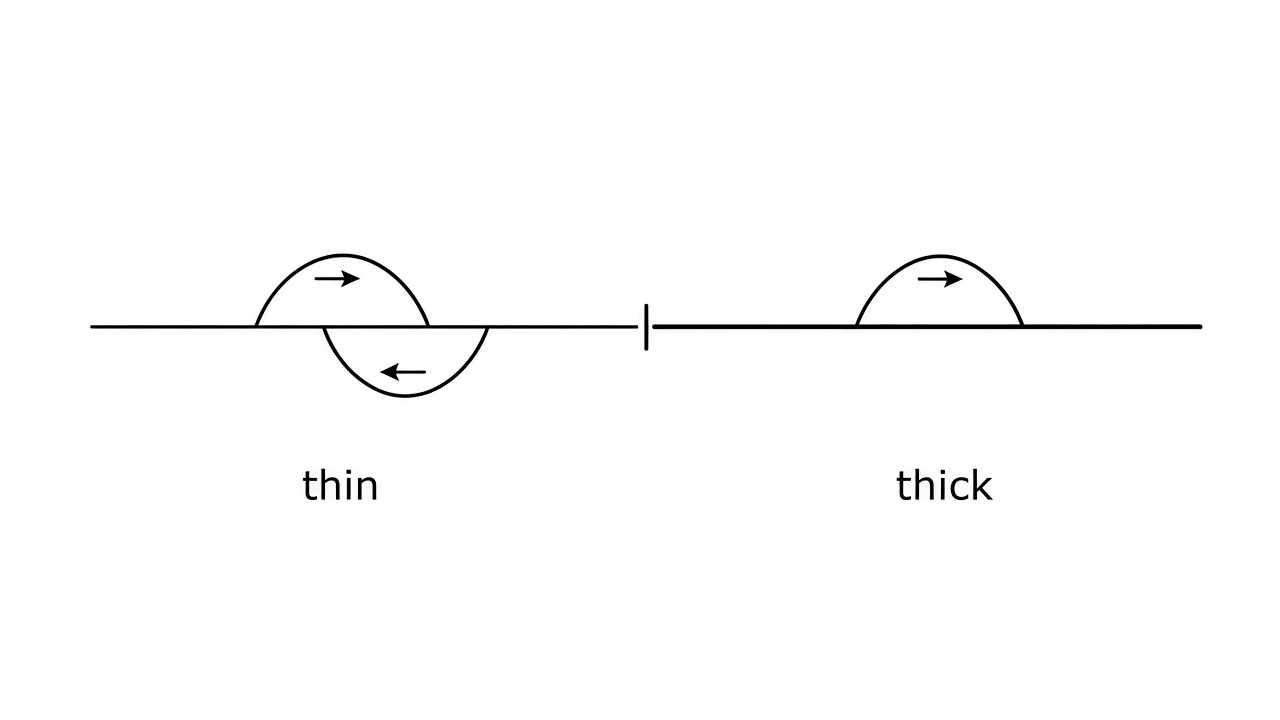
The transmitted wave enters the slower thick string, so the reflected pulse on the thin string is inverted.
If the transmitted wave enters a slower medium, the reflected wave is inverted. If it enters a faster medium, the reflected wave is not inverted. A heavier string under the same tension has a larger $\mu$ and a smaller $v=\sqrt{F_T/\mu}$, so a pulse going from thin to thick reflects inverted. The return trip, thick to thin, reflects without inversion.
Example: $v_1=30\,\mathrm{m/s}$, $v_2=15\,\mathrm{m/s}$, and $f=50\,\mathrm{Hz}$. Then $\lambda_1=v_1/f=0.60\,\mathrm{m}$ and $\lambda_2=0.30\,\mathrm{m}$. The frequency in both media is $50\,\mathrm{Hz}$. Because the speed drops, the reflection back into medium 1 is inverted.
Intensity is the average power per unit area over one period. Transverse waves, including waves on a string and electromagnetic waves, can be polarized. Longitudinal sound cannot, because the disturbance is already along the travel direction. An ideal polarizer transmits half the intensity of unpolarized light, $I_0/2$. A second polarizer aligned with the first still transmits $I_0/2$. Crossed polarizers, with transmission axes perpendicular, transmit approximately zero.
Key points
- A boundary can reflect and transmit. Frequency does not change. Wavelength follows the speed.
- Speed decreases into the next medium: reflected wave inverted.
- Speed increases into the next medium: reflected wave not inverted.
- Example: $30\,\mathrm{m/s}$ to $15\,\mathrm{m/s}$ at $50\,\mathrm{Hz}$ gives wavelengths $0.60\,\mathrm{m}$ and $0.30\,\mathrm{m}$.
- Intensity is average power per unit area over one period.
- Only transverse waves can be polarized.
- Unpolarized light through one ideal polarizer: $I_0/2$. Crossed polarizers: about zero.
Inversion is decided by whether the transmitted speed is smaller or larger, not by which string the student calls the starting string.