Boundary Behavior of Waves and Polarization FRQ Practice

Responses receive AI feedback against a rubric after submission. Scores are practice estimates.

Question 1 of 5

A pulse on string 1 ($v_1=25\,\mathrm{m/s}$) approaches a junction with string 2 ($v_2=50\,\mathrm{m/s}$). (a) State whether the reflected pulse is inverted. (b) Compare frequencies of incident, reflected, and transmitted pulses. (c) Compare $\lambda_2$ to $\lambda_1$ for the periodic train that follows.
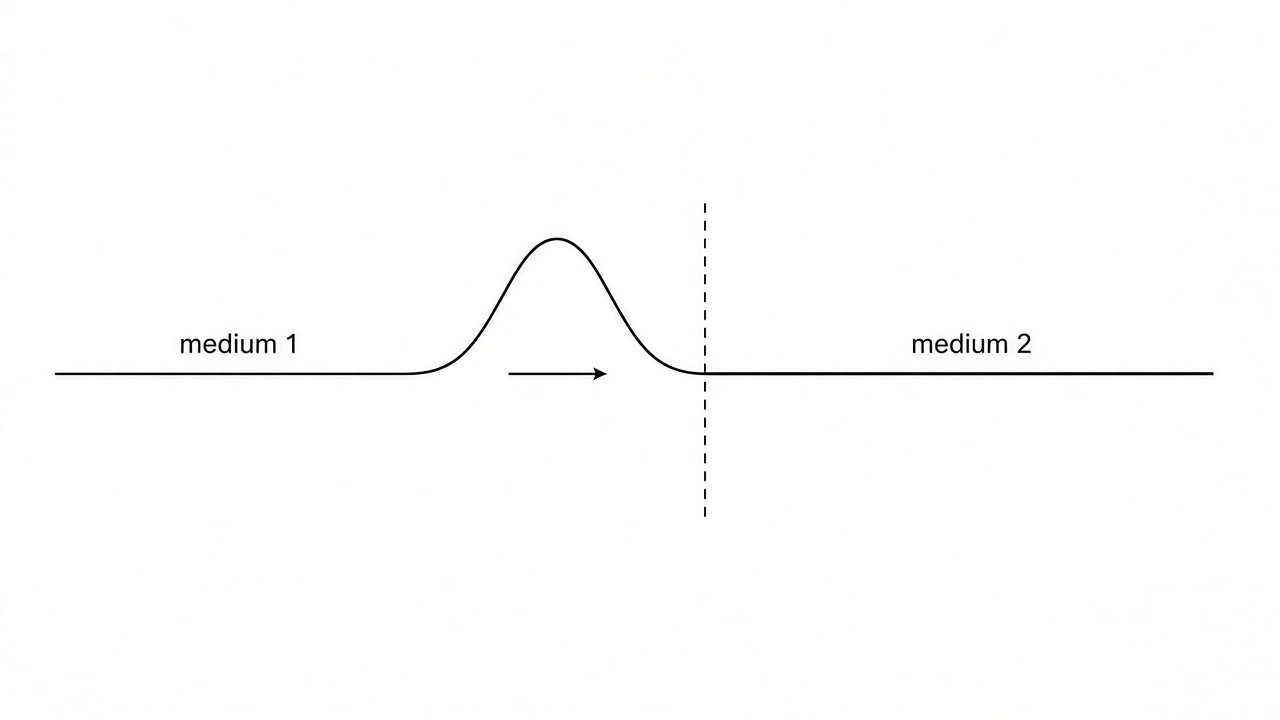
String junction between medium 1 and medium 2.

Question 2 of 5

(a) Explain why sound waves in air cannot be polarized with Polaroid filters. (b) Explain why transverse EM waves can. (c) Relate polarization to a possible reduction in intensity.

Question 3 of 5

A $150\,\mathrm{Hz}$ wave goes from medium A ($v_A=30\,\mathrm{m/s}$) into medium B ($v_B=20\,\mathrm{m/s}$). (a) Find $\lambda_A$ and $\lambda_B$. (b) State whether the reflected wave (back into A) is inverted. (c) Define intensity for the transmitted wave.

Question 4 of 5

A demo uses two strings joined end to end. Students observe an inverted reflected pulse when pulses go from the light string to the heavy string. (a) Connect this observation to wave speeds. (b) Predict the upright/inverted nature for a pulse starting on the heavy string. (c) Explain why frequency matching still holds for a continuous driven wave at the junction.

Question 5 of 5

Unpolarized light intensity $I_0$ hits polarizer P1, then P2 aligned with P1. Ideal case: (a) intensity after P1; (b) intensity after P2; (c) if P2 is rotated $90^\circ$ relative to P1, intensity after P2.