Boundary Behavior of Waves and Polarization MCQ Practice

Question 1 of 10

A transverse pulse on a light string travels toward a junction with a heavier string, where the wave speed decreases. The reflected pulse on the light string is
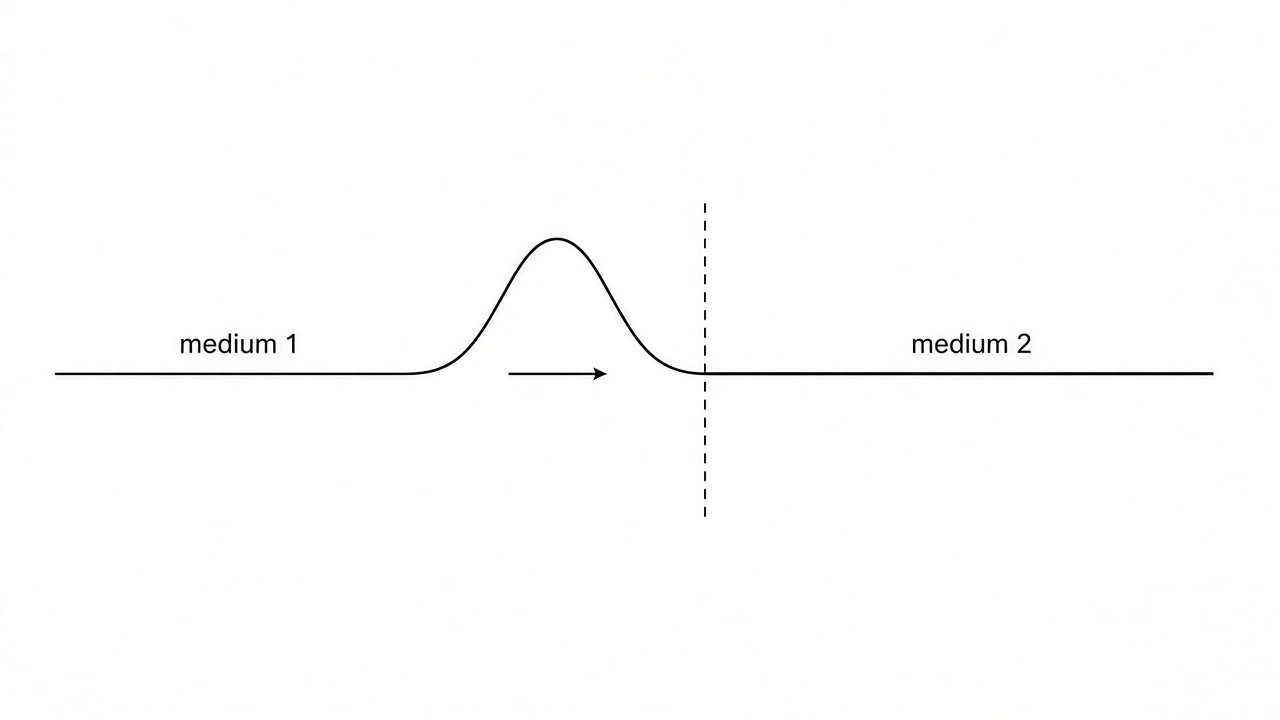
Junction between a light string (medium 1) and a heavier string (medium 2).
  1. A. inverted
  2. B. upright (not inverted)
  3. C. neither reflected nor transmitted
  4. D. transmitted only, with no reflection

Question 2 of 10

A pulse travels from a heavy rope onto a lighter rope where wave speed increases. The reflected pulse on the heavy rope is

  1. A. inverted
  2. B. not inverted
  3. C. stopped completely
  4. D. longitudinal only

Question 3 of 10

A periodic wave crosses from medium 1 into medium 2. Frequency in medium 1 is $200\,\mathrm{Hz}$. In medium 2 the speed is half that in medium 1. The frequency in medium 2 is

  1. A. $100\,\mathrm{Hz}$
  2. B. $200\,\mathrm{Hz}$
  3. C. $400\,\mathrm{Hz}$
  4. D. $50\,\mathrm{Hz}$

Question 4 of 10

Which type of wave can be polarized?

  1. A. Sound in air
  2. B. A longitudinal compression wave in a spring
  3. C. A transverse wave on a string or electromagnetic wave
  4. D. Any wave, because polarization means reflection

Question 5 of 10

Unpolarized light of intensity $I_0$ passes through an ideal polarizer. The transmitted intensity is closest to

  1. A. $I_0$
  2. B. $I_0/2$
  3. C. $0$
  4. D. $2I_0$

Question 6 of 10

At a string junction, $v_1=40\,\mathrm{m/s}$ and $v_2=20\,\mathrm{m/s}$. A $100\,\mathrm{Hz}$ wave in medium 1 has wavelength

  1. A. $0.40\,\mathrm{m}$ in both media
  2. B. $0.40\,\mathrm{m}$ in medium 1 and $0.20\,\mathrm{m}$ in medium 2
  3. C. $0.20\,\mathrm{m}$ in medium 1 and $0.40\,\mathrm{m}$ in medium 2
  4. D. undefined because frequency changes

Question 7 of 10

Intensity of a wave is

  1. A. energy per unit time only
  2. B. average power per unit area over one period
  3. C. amplitude divided by frequency
  4. D. wavelength times speed

Question 8 of 10

A wave pulse partially reflects and partially transmits at a boundary. Which statement is always true?

  1. A. The reflected pulse has higher frequency than the incident pulse.
  2. B. Both reflected and transmitted pulses can occur depending on boundary properties.
  3. C. The transmitted pulse must be inverted whenever reflection occurs.
  4. D. No energy reaches the second medium.

Question 9 of 10

Two polarizing filters are stacked. The first creates vertically polarized light. The second has its transmission axis horizontal. Ideal filters transmit approximately

  1. A. the full incident intensity after the second filter
  2. B. zero intensity after the second filter
  3. C. half the intensity after the second filter regardless of orientation
  4. D. twice the intensity because two filters amplify

Question 10 of 10

The table lists wave speed before and after a boundary for three cases. In which case is the reflected wave inverted?

Case $v$ before (m/s) $v$ after (m/s)
1 30 50
2 50 30
3 40 40
  1. A. Case 1 only
  2. B. Case 2 only
  3. C. Case 3 only
  4. D. Cases 1 and 3