Electromagnetic Induction and Faraday's Law FRQ Practice

Responses receive AI feedback against a rubric after submission. Scores are practice estimates.

Question 1 of 5

A rectangular loop of area $0.050\,\mathrm{m}^2$ has its area vector out of the page. A uniform field $B=0.60\,\mathrm{T}$ into the page (so $\theta=180^\circ$ relative to $\vec{A}$) decreases to zero in $0.20\,\mathrm{s}$ at a constant rate. (a) Calculate the initial flux. (b) Calculate $|\mathcal{E}|$. (c) Using Lenz's law in words, state the direction of the induced current as viewed by you (clockwise or counterclockwise), and justify.
Question 2 of 5

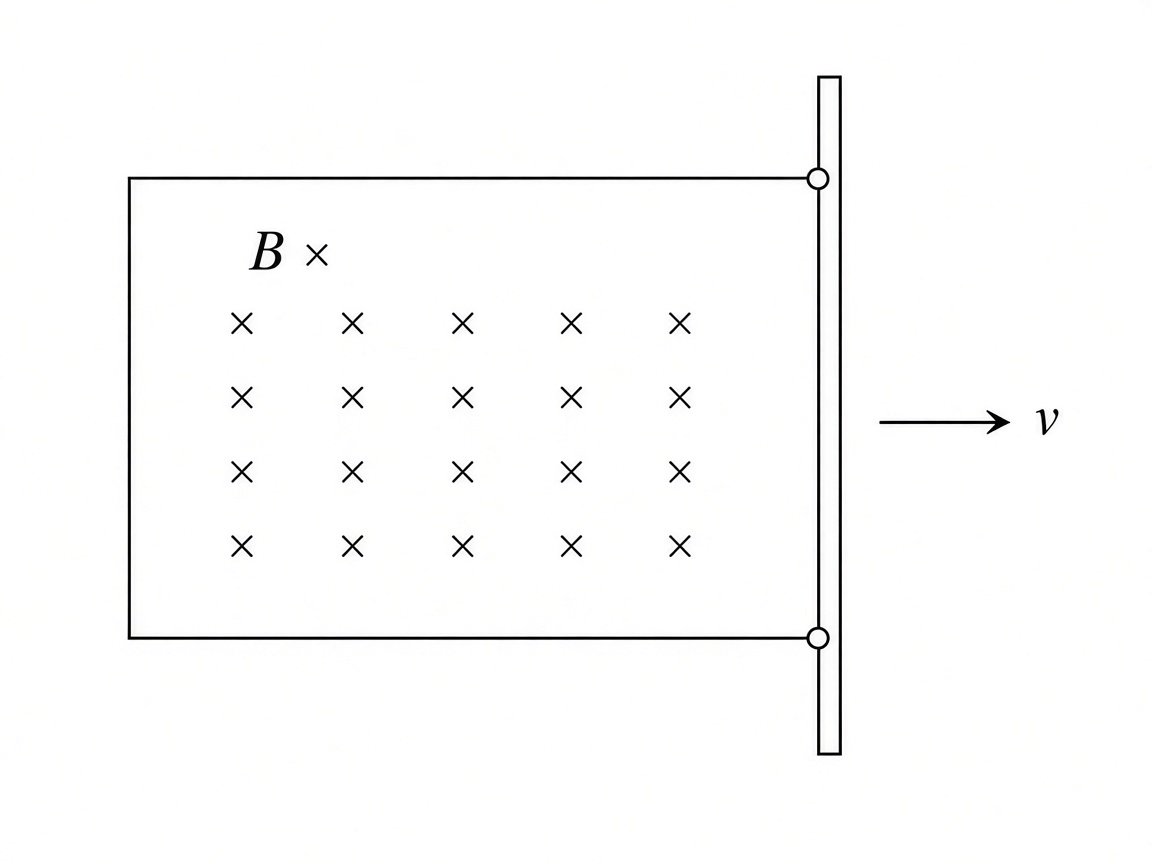
A conducting rod on rails has $\ell=0.40\,\mathrm{m}$, $B=0.50\,\mathrm{T}$ into the page, and slides right at $v=3.0\,\mathrm{m/s}$. (a) Calculate $\mathcal{E}=B\ell v$. (b) Explain why flux through the loop increases as the rod moves right. (c) State the direction of the induced current around the loop using Lenz's law.

Rod on rails in a field into the page.

Question 3 of 5

A north pole of a magnet is pulled away from a closed loop along the axis. (a) While the magnet is moving away, is the into-loop flux from the magnet increasing or decreasing? (b) What direction must the induced field have to oppose that change? (c) Does the loop attract or repel the receding magnet? Justify with Lenz's law.

Question 4 of 5

The table gives flux through a loop at three times.

$t$ (s) $\Phi$ (Wb)
0 0.12
0.10 0.12
0.25 0.04

(a) Find $|\mathcal{E}|$ from $0$ to $0.10\,\mathrm{s}$. (b) Find $|\mathcal{E}|$ from $0.10$ to $0.25\,\mathrm{s}$. (c) Sketch a qualitative $\Phi$-vs-$t$ graph and mark which interval has the larger $|\mathcal{E}|$.

Question 5 of 5

A loop's area is fixed. Its flux is $\Phi=BA\cos\theta$. (a) List the three quantities that can change to induce an emf. (b) If $B$ and $A$ are fixed and $\theta$ changes from $0^\circ$ to $90^\circ$ in time $\Delta t$, express $|\mathcal{E}|$ in terms of $B$, $A$, and $\Delta t$. (c) Explain why a generator can produce emf even in a constant-magnitude field.