Electromagnetic Induction and Faraday's Law FRQ Practice

Responses receive AI feedback against a rubric after submission. Scores are practice estimates.

Question 1 of 5

Flux through a loop goes from $+0.050\,\mathrm{Wb}$ to $-0.010\,\mathrm{Wb}$ in $0.040\,\mathrm{s}$. (a) Calculate $\Delta\Phi$. (b) Calculate $|\mathcal{E}|$. (c) Explain why the sign of $\Phi$ matters for direction but the absolute-value form of Faraday's law still gives the emf magnitude.
Question 2 of 5

A loop lies in the plane of the page. $\vec{B}$ into the page is increasing. (a) State whether into-page flux is increasing or decreasing. (b) State the needed induced-field direction. (c) Using the right-hand rule (thumb along induced $\vec{B}$, fingers give induced current), state clockwise or counterclockwise as viewed by you.

Question 3 of 5

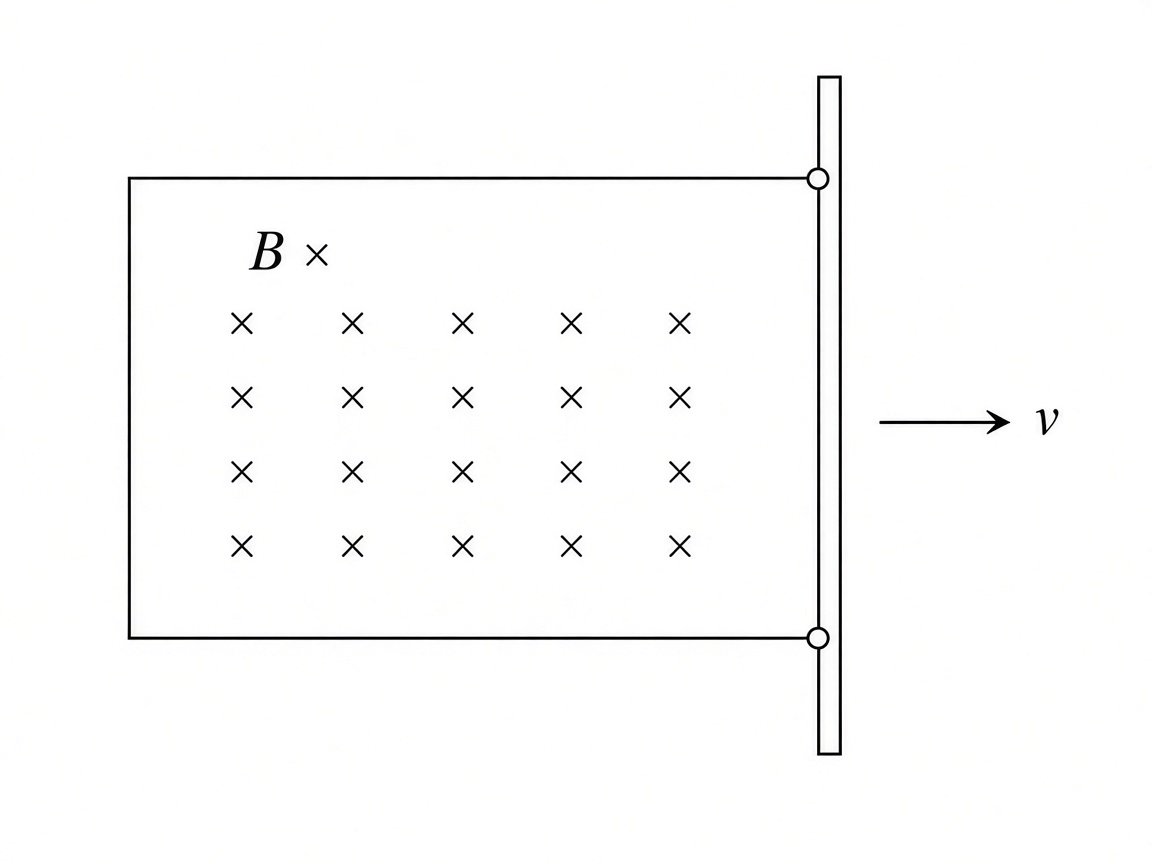
A rod on rails has $\ell=0.20\,\mathrm{m}$ and moves at $5.0\,\mathrm{m/s}$ in $B=0.40\,\mathrm{T}$. (a) Find $\mathcal{E}$. (b) If the circuit resistance is $2.0\,\Omega$, find the induced current magnitude. (c) Explain why a magnetic force opposes the rod's motion (qualitative energy argument).

Rod on rails.
Rod on rails.

Question 4 of 5

A square loop of side $L$ is pulled out of a uniform field region of width $L$ at constant speed $v$, with $\vec{B}$ perpendicular to the loop. While the loop is partially exiting, the enclosed field area decreases. (a) Express $|\mathcal{E}|$ in terms of $B$, $L$, and $v$ during exit. (b) What is $\mathcal{E}$ after the loop has completely left the field? (c) If $v$ doubles, what happens to $|\mathcal{E}|$ during exit?

Question 5 of 5

Compare two situations for the same loop: (1) a strong constant $B$ through the loop; (2) a weak $B$ that is rapidly reversed. (a) Which situation can produce a larger $|\mathcal{E}|$? Justify with Faraday's law. (b) State Lenz's law in one sentence. (c) Explain why "the induced field always points opposite the applied field" is an incorrect summary of Lenz's law.