Magnetism and Current-Carrying Wires FRQ Practice

Responses receive AI feedback against a rubric after submission. Scores are practice estimates.

Question 1 of 5

Wire 1 carries $I_1=10\,\mathrm{A}$ and wire 2 carries $I_2=5.0\,\mathrm{A}$, both to the right, separated by $6.0\,\mathrm{cm}$. Use $\mu_0=4\pi\times 10^{-7}\,\mathrm{T\cdot m/A}$. (a) Find the net $B$ at the midpoint between the wires (magnitude and into/out direction if the page has currents to the right with wire 1 above wire 2). (b) Explain why the fields oppose. (c) Where between the wires would $B$ be zero if the currents were unequal as given?
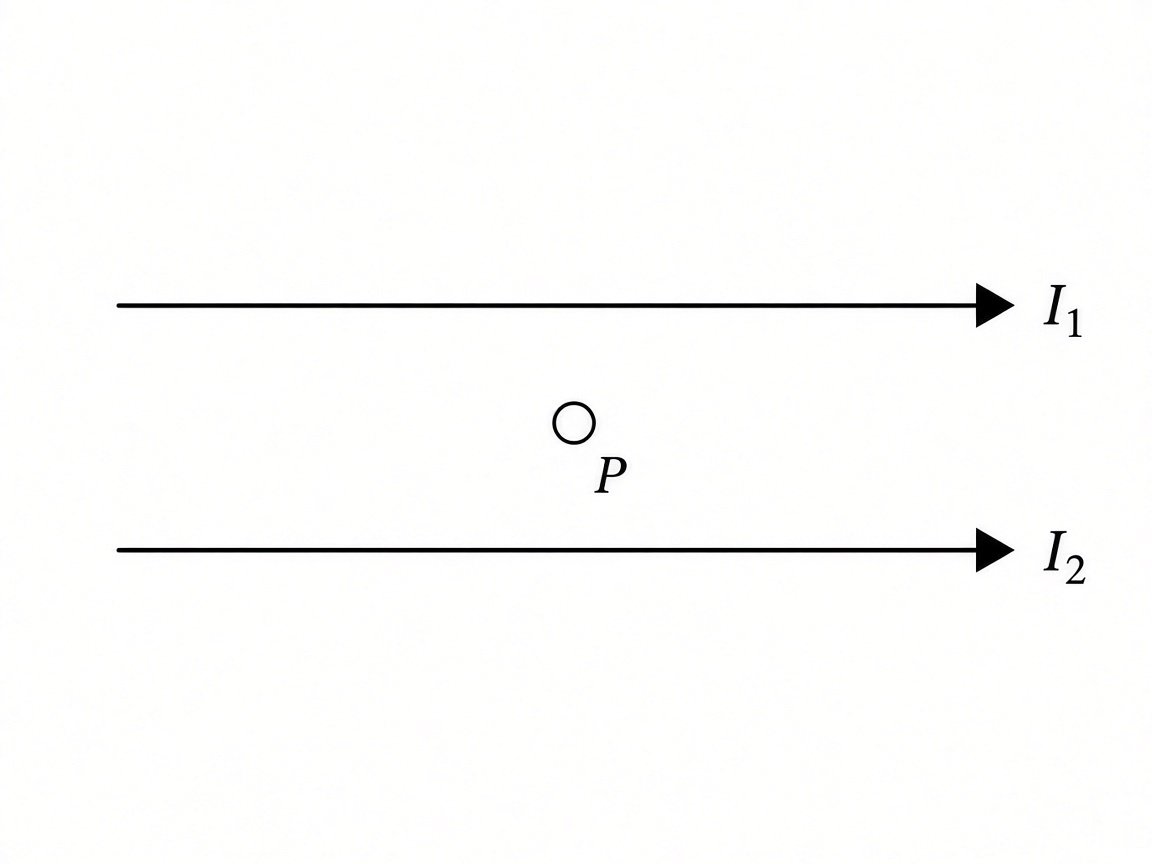
Two parallel wires and midpoint P.

Question 2 of 5

Students claim the field of a long wire falls as $1/r^2$ like Coulomb's law. (a) Write the CED equation for $B$ of a long wire and identify the distance dependence. (b) Describe a graph of $B$ vs $1/r$ that would refute the $1/r^2$ claim. (c) Explain physically why a long wire is not expected to match a point-source inverse-square law.

Question 3 of 5

A $15\,\mathrm{cm}$ wire segment carries $6.0\,\mathrm{A}$ perpendicular to $0.50\,\mathrm{T}$. (a) Find $F$. (b) If only $5.0\,\mathrm{cm}$ of a longer wire is inside the same field with the same $I\perp B$, find $F$. (c) Explain the difference.

Question 4 of 5

A horizontal wire carries current to the east in a region where Earth's magnetic field has a northward horizontal component. (a) Using fingers along $\vec{I}$ (east), curl toward $\vec{B}$ (north), determine whether the force is upward or downward. (b) Explain why a sufficiently large current could make a light wire appear to lose weight. (c) What happens to the force if the current is reversed to the west?

Question 5 of 5

The table lists three wire segments in the same $B$, all with $I\perp B$.

Segment $I$ (A) $\ell$ in field (m)
1 2.0 0.10
2 4.0 0.10
3 2.0 0.20

(a) Rank $F_1$, $F_2$, $F_3$ if $B$ is the same. (b) Compute $F_2/F_1$. (c) Explain why segment 3 matches segment 2's force.