Spring Forces MCQ Practice

Question 1 of 10

An ideal spring of constant $800\,\mathrm{N/m}$ and relaxed length $0.30\,\mathrm{m}$ is squeezed to a length of $0.24\,\mathrm{m}$. The magnitude of the force it exerts is

  1. A. $48\,\mathrm{N}$
  2. B. $192\,\mathrm{N}$
  3. C. $240\,\mathrm{N}$
  4. D. $8.0\,\mathrm{N}$

Question 2 of 10

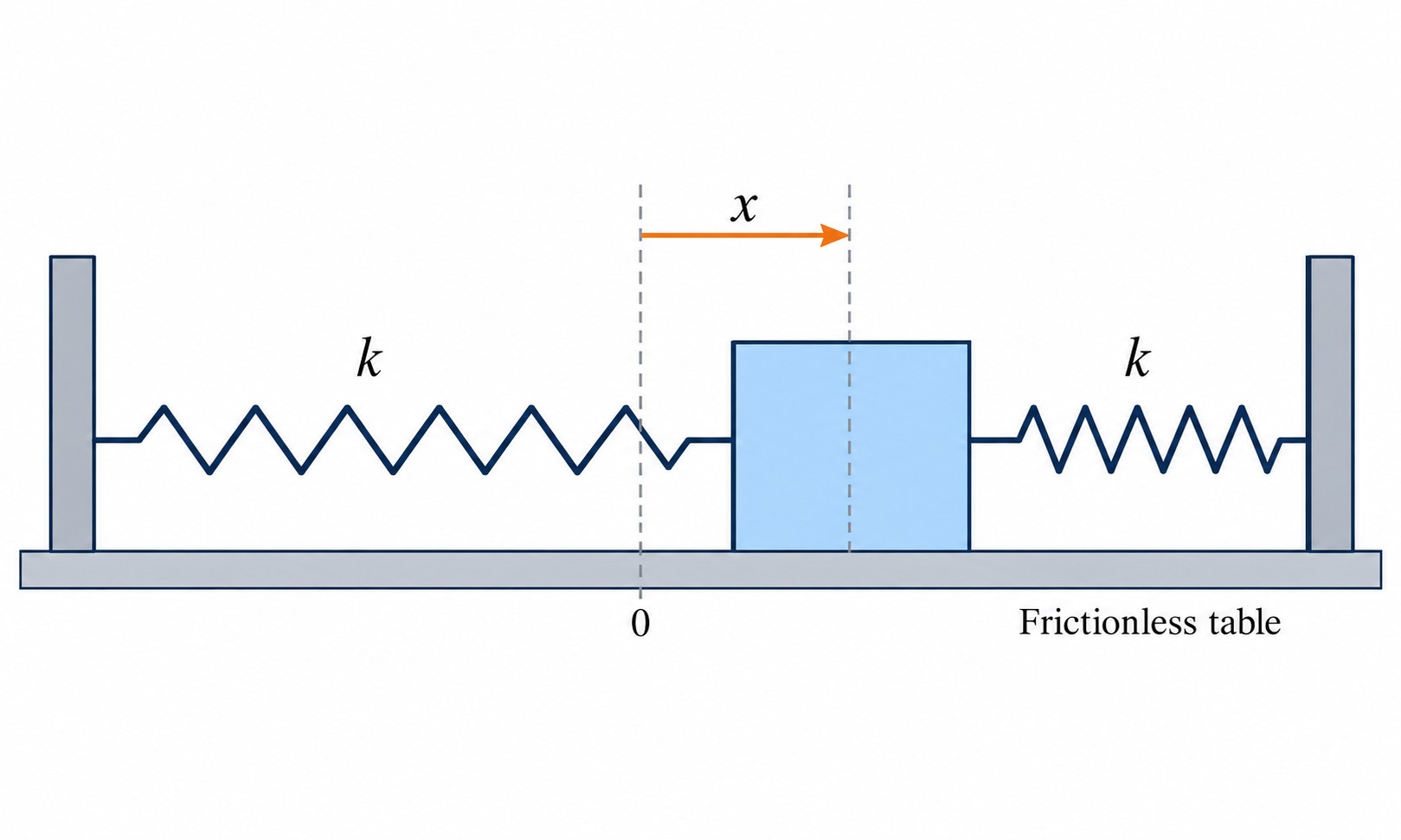
A block on a frictionless table is attached to two identical ideal springs of constant $k$, one on each side, both relaxed when the block sits at $x=0$. The block is then displaced a small distance $x$ to the right. The magnitude of the net spring force on it is

A block between two horizontal springs is displaced to the right of center.
  1. A. $kx$, because the two spring forces point in opposite directions and partly cancel
  2. B. $2kx$, because both spring forces point back toward $x=0$
  3. C. $0$, because the springs are identical and symmetric
  4. D. $kx/2$, because the two springs share the displacement

Question 3 of 10

Spring $R$ stretches $0.15\,\mathrm{m}$ under a $9.0\,\mathrm{N}$ load, and spring $S$ stretches $0.050\,\mathrm{m}$ under the same load. Which statement is correct?

  1. A. $S$ is three times as stiff as $R$, and $k_S=180\,\mathrm{N/m}$.
  2. B. $R$ is three times as stiff as $S$, and $k_R=180\,\mathrm{N/m}$.
  3. C. They are equally stiff, because the applied load is the same.
  4. D. $k_S=0.0056\,\mathrm{m/N}$, the ratio of stretch to force.

Question 4 of 10

A $12\,\mathrm{kg}$ sign hangs level from two vertical springs mounted side by side, one of constant $300\,\mathrm{N/m}$ and one of constant $500\,\mathrm{N/m}$, both of the same relaxed length. Using $g=10\,\mathrm{m/s^2}$, which statement is correct?

  1. A. Each spring stretches $0.15\,\mathrm{m}$, and the stiffer one carries $75\,\mathrm{N}$.
  2. B. Each spring stretches $0.15\,\mathrm{m}$, and each carries $60\,\mathrm{N}$.
  3. C. They stretch $0.40\,\mathrm{m}$ and $0.24\,\mathrm{m}$ respectively, since each carries half the weight.
  4. D. Each spring stretches $0.075\,\mathrm{m}$, since springs in parallel double the stretch.

Question 5 of 10

A block hung from a single ideal spring stretches it $0.080\,\mathrm{m}$. The same block is then hung from two of those identical springs joined end to end. The total stretch is now

  1. A. $0.040\,\mathrm{m}$
  2. B. $0.080\,\mathrm{m}$
  3. C. $0.16\,\mathrm{m}$
  4. D. $0.32\,\mathrm{m}$

Question 6 of 10

In the relation $F_s=-kx$, where $x$ is measured from the relaxed position, the negative sign indicates that

  1. A. the spring force always points in the $-x$ direction
  2. B. the spring force points opposite the displacement from the relaxed position, back toward it
  3. C. the spring constant must be taken as negative when the spring is compressed
  4. D. the spring force decreases as the displacement increases

Question 7 of 10

Blocks of mass $1.0\,\mathrm{kg}$ and $3.0\,\mathrm{kg}$ rest on a frictionless table, joined by an ideal spring of constant $200\,\mathrm{N/m}$. A horizontal force of $8.0\,\mathrm{N}$ pulls the $1.0\,\mathrm{kg}$ block directly away from the other. At an instant when both blocks have the same acceleration, the spring’s stretch is

  1. A. $0.010\,\mathrm{m}$
  2. B. $0.030\,\mathrm{m}$
  3. C. $0.040\,\mathrm{m}$
  4. D. $0.015\,\mathrm{m}$

Question 8 of 10

A block of mass $m$ hangs at rest from a spring of constant $k$ inside an elevator that accelerates downward with magnitude $a$, where $a<g$. The spring’s stretch is

  1. A. $\dfrac{mg}{k}$
  2. B. $\dfrac{m(g-a)}{k}$
  3. C. $\dfrac{m(g+a)}{k}$
  4. D. $\dfrac{ma}{k}$

Question 9 of 10

Four setups each use springs of constant $200\,\mathrm{N/m}$, as described in the table. Which setup produces the greatest total stretch of the spring assembly?

Setup Load (N) Spring arrangement
$T$ 24 one spring
$U$ 24 two springs end to end (series)
$V$ 24 two springs side by side (parallel)
$W$ 48 two springs side by side (parallel)
  1. A. Setup $T$, with a total stretch of $0.12\,\mathrm{m}$
  2. B. Setup $U$, with a total stretch of $0.24\,\mathrm{m}$
  3. C. Setup $V$, with a total stretch of $0.060\,\mathrm{m}$
  4. D. Setup $W$, with a total stretch of $0.12\,\mathrm{m}$

Question 10 of 10

Two ideal springs with $k_1\gg k_2$ are joined end to end and stretched by a load. Which statement is correct?

  1. A. Nearly all of the total stretch occurs in the soft spring, and $k_{\mathrm{eff}}$ is slightly less than $k_2$.
  2. B. Nearly all of the total stretch occurs in the stiff spring, and $k_{\mathrm{eff}}\approx k_1$.
  3. C. Both springs stretch equally, because they carry the same force.
  4. D. $k_{\mathrm{eff}}$ is the average of $k_1$ and $k_2$.