Circular Motion MCQ Practice

Question 1 of 10

A stone on a string moves in a horizontal circle of radius $0.50\,\mathrm{m}$, completing $4.0$ revolutions every second. Its centripetal acceleration is closest to

  1. A. $32\,\mathrm{m/s^2}$
  2. B. $79\,\mathrm{m/s^2}$
  3. C. $316\,\mathrm{m/s^2}$
  4. D. $1260\,\mathrm{m/s^2}$

Question 2 of 10

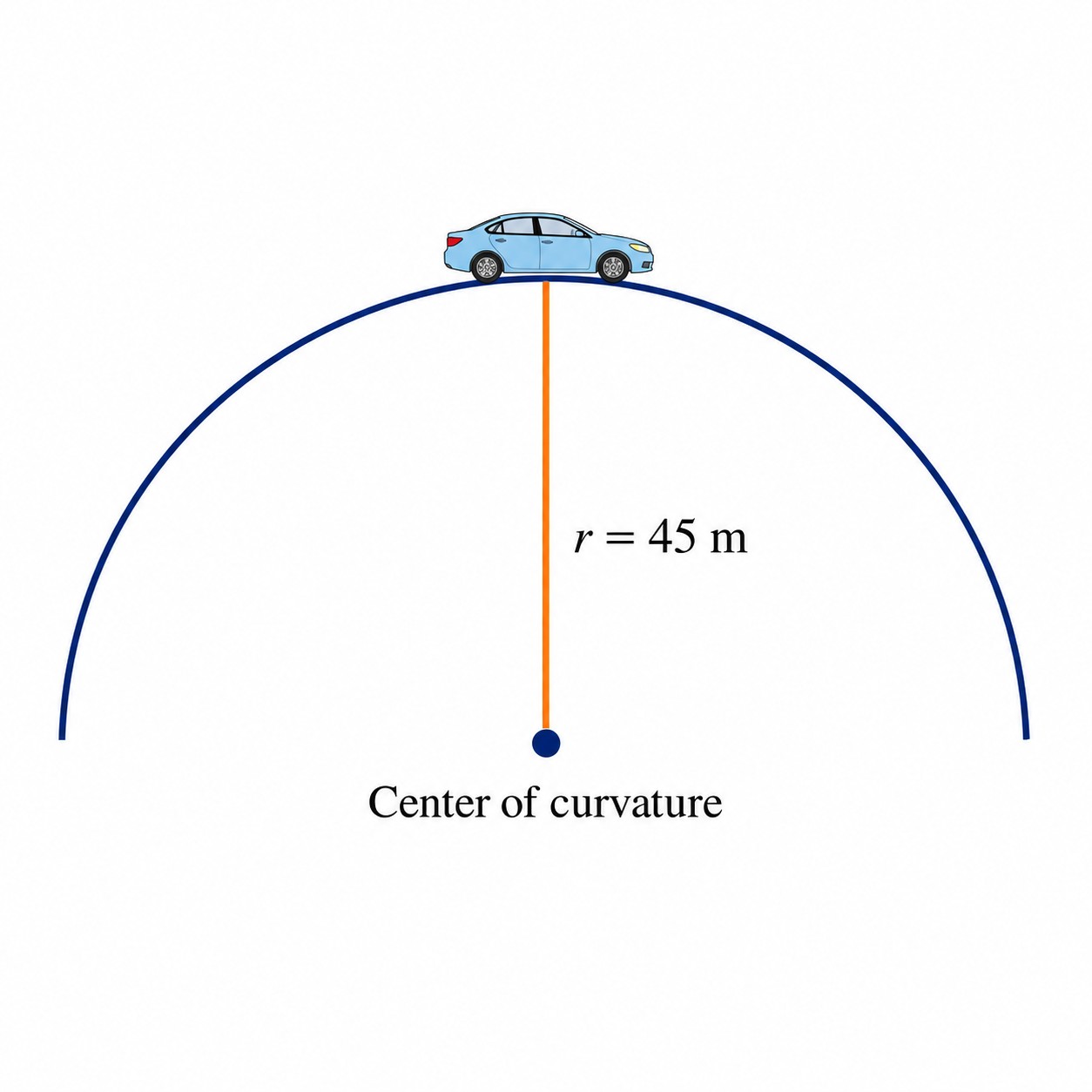
A car drives over the rounded crest of a hill whose top is an arc of a circle of radius $45\,\mathrm{m}$. Using $g=10\,\mathrm{m/s^2}$, the greatest speed at which the road still pushes up on the car at the crest is

A car is at the crest of a rounded hill with a 45-meter radius of curvature.
  1. A. $15\,\mathrm{m/s}$
  2. B. $21\,\mathrm{m/s}$
  3. C. $30\,\mathrm{m/s}$
  4. D. $450\,\mathrm{m/s}$

Question 3 of 10

A $1000\,\mathrm{kg}$ car rounds a flat, unbanked curve of radius $60\,\mathrm{m}$ at $18\,\mathrm{m/s}$ without slipping. Using $g=10\,\mathrm{m/s^2}$, the smallest coefficient of static friction that makes this possible is

  1. A. $0.30$
  2. B. $0.54$
  3. C. $0.94$
  4. D. $5.4$

Question 4 of 10

A ball on the end of a string is swung in a vertical circle at a speed that varies around the loop. At the lowest point of the circle, which statement about the forces on the ball is correct?

  1. A. The tension exceeds the ball’s weight, because the net force there must point upward toward the center.
  2. B. The tension equals the ball’s weight, because the radius of the circle is constant.
  3. C. The tension is less than the weight, because gravity helps supply the centripetal force.
  4. D. The net force is zero, because the ball is momentarily moving horizontally.

Question 5 of 10

A curve of radius $r$ is banked at angle $\theta$ and the road is frictionless. The one speed at which a car can round it is

  1. A. $\sqrt{rg\tan\theta}$
  2. B. $\sqrt{rg\sin\theta}$
  3. C. $\sqrt{\dfrac{rg}{\tan\theta}}$
  4. D. $rg\tan\theta$

Question 6 of 10

Four objects move in uniform circular motion with the masses, speeds, and radii listed in the table. Rank the magnitude of the net force required, greatest first.

Object Mass (kg) Speed (m/s) Radius (m)
$E$ 2.0 4.0 2.0
$F$ 1.0 8.0 4.0
$G$ 4.0 3.0 1.5
$H$ 3.0 2.0 1.0
  1. A. $G>E=F>H$
  2. B. $G>F>E>H$
  3. C. $F>G>E>H$
  4. D. $E>F>G>H$

Question 7 of 10

A puck of mass $m$ slides in a circle on a frictionless horizontal table, held by a horizontal string of length $L$ attached to a pin at the center. If the string tension is $T$, the puck’s speed is

  1. A. $\sqrt{\dfrac{TL}{m}}$
  2. B. $\dfrac{TL}{m}$
  3. C. $\sqrt{\dfrac{T}{mL}}$
  4. D. $\sqrt{\dfrac{mL}{T}}$

Question 8 of 10

A $0.60\,\mathrm{kg}$ ball on a string of length $0.80\,\mathrm{m}$ swings in a vertical circle. At the instant the string is horizontal the ball is moving at $4.0\,\mathrm{m/s}$. Using $g=10\,\mathrm{m/s^2}$, the string tension and the magnitude of the ball’s total acceleration at that instant are

  1. A. $12\,\mathrm{N}$ and $20\,\mathrm{m/s^2}$
  2. B. $12\,\mathrm{N}$ and $22\,\mathrm{m/s^2}$
  3. C. $18\,\mathrm{N}$ and $22\,\mathrm{m/s^2}$
  4. D. $6.0\,\mathrm{N}$ and $30\,\mathrm{m/s^2}$

Question 9 of 10

Object $P$ moves with speed $v$ in a circle of radius $r$. Object $Q$ moves with speed $3v$ in a circle of radius $2r$. The ratio of their centripetal accelerations $a_Q/a_P$ is

  1. A. $3/2$
  2. B. $3$
  3. C. $9/2$
  4. D. $9$

Question 10 of 10

At the top of a vertical circular loop of radius $2.0\,\mathrm{m}$, the track pushes on a $0.40\,\mathrm{kg}$ ball riding along the inside with a normal force of $6.0\,\mathrm{N}$. Using $g=10\,\mathrm{m/s^2}$, the ball’s speed there is

  1. A. $5.5\,\mathrm{m/s}$
  2. B. $7.1\,\mathrm{m/s}$
  3. C. $3.2\,\mathrm{m/s}$
  4. D. $10\,\mathrm{m/s}$