Circular Motion FRQ Practice

Responses receive AI feedback against a rubric after submission. Scores are practice estimates.

Question 1 of 5

A car of mass $m$ rounds a flat, unbanked curve of radius $r$ at constant speed $v$ without slipping. (a) Identify the force that provides the centripetal force and derive an expression for the minimum coefficient of static friction required. (b) Explain why the answer to part (a) does not depend on $m$. (c) A curve safe at $v$ on dry pavement is taken at the same speed on a wet road with half the coefficient of friction. Determine the largest speed that is now safe, in terms of $v$, and state what happens if the driver keeps the original speed.
Question 2 of 5

A $0.80\,\mathrm{kg}$ ball on a string of length $0.60\,\mathrm{m}$ is whirled in a vertical circle. Use $g=10\,\mathrm{m/s^2}$. (a) At the top its speed is $4.0\,\mathrm{m/s}$; calculate the string tension there. (b) At the bottom its speed is $7.0\,\mathrm{m/s}$; calculate the tension there. (c) Calculate the minimum speed at the top for the string to remain taut. (d) Explain why the string is most likely to break at the bottom of the circle.

Question 3 of 5

A student whirls an object of fixed mass at a fixed speed on strings of different lengths and measures the net force required, obtaining the table. (a) Show that the data are consistent with $F_{\mathrm{net}}=mv^2/r$. (b) The object’s mass is $0.40\,\mathrm{kg}$; determine its speed. (c) State what the student should graph to obtain a straight line through the origin, and state what the slope of that line represents.

Radius (m) Net force (N)
0.50 72
0.75 48
1.00 36
1.50 24

Question 4 of 5

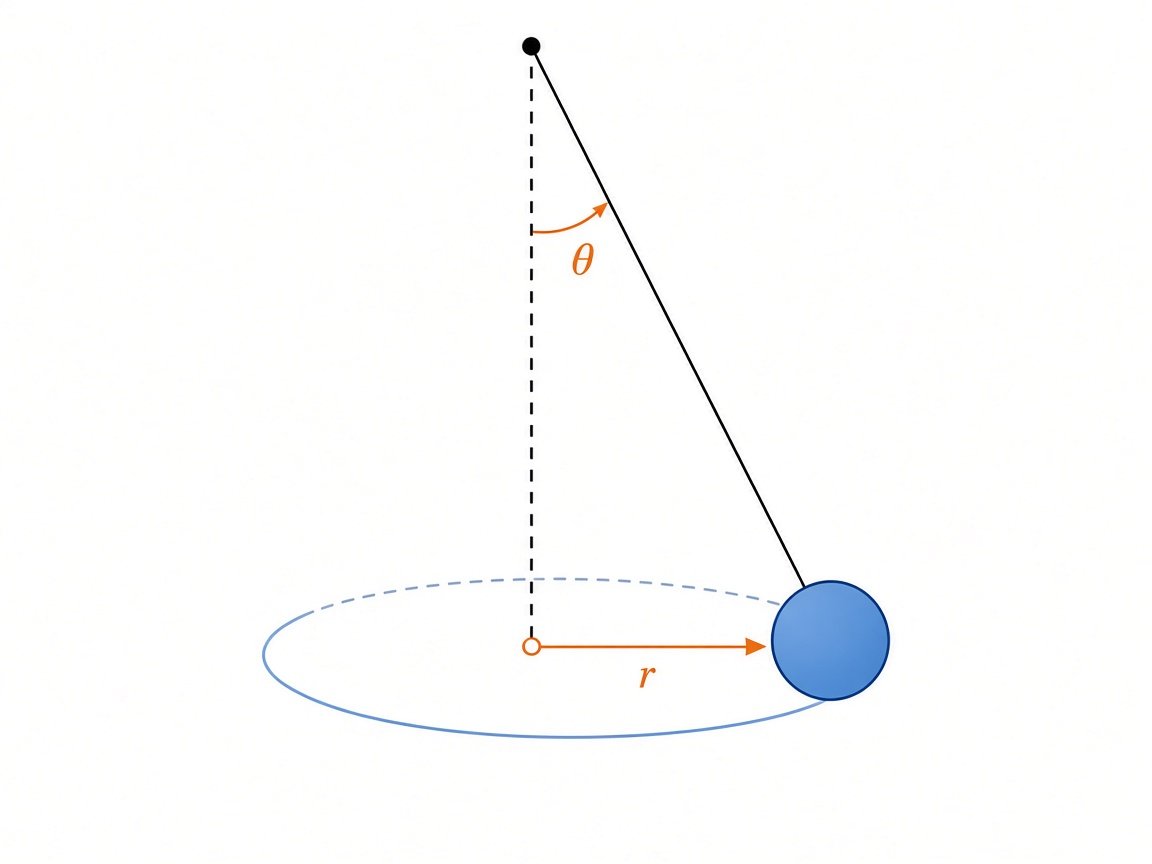
A ball of mass $m$ hangs from a string of length $L$ attached to a fixed point and moves in a horizontal circle with the string at a constant angle $\theta$ from the vertical. (a) Write the vertical and radial equations for the ball. (b) Derive an expression for the ball’s speed in terms of $L$, $\theta$, and $g$. (c) Derive an expression for the period of the motion and state how the period changes as $\theta$ increases toward $90^\circ$.

A conical pendulum shows string length, tilt angle, and circular radius.

Question 5 of 5

A runner starts from rest on a circular track of constant radius and speeds up at a steady rate. (a) Describe the direction of the runner’s acceleration just after starting, and justify it. (b) Describe the direction much later, when the runner is moving quickly, and justify it. (c) Explain why the acceleration is never exactly directed toward the center while the runner continues to speed up.