Circular Motion MCQ Practice

Question 1 of 10

A ball moves at a constant $6.0\,\mathrm{m/s}$ around a horizontal circle of radius $4.0\,\mathrm{m}$. If its speed is doubled and the radius of its circle is tripled, its centripetal acceleration becomes

  1. A. $6.0\,\mathrm{m/s^2}$
  2. B. $12\,\mathrm{m/s^2}$
  3. C. $9.0\,\mathrm{m/s^2}$
  4. D. $27\,\mathrm{m/s^2}$

Question 2 of 10

A small block slides on the inside of a vertical circular track of radius $0.80\,\mathrm{m}$ and barely maintains contact with the track at the very top. Using $g=10\,\mathrm{m/s^2}$, its speed at that point is

  1. A. $2.8\,\mathrm{m/s}$
  2. B. $4.0\,\mathrm{m/s}$
  3. C. $8.0\,\mathrm{m/s}$
  4. D. $0$

Question 3 of 10

A $0.50\,\mathrm{kg}$ cart passes the lowest point of a vertical circular loop of radius $1.2\,\mathrm{m}$ at $6.0\,\mathrm{m/s}$. Using $g=10\,\mathrm{m/s^2}$, the magnitude of the normal force the track exerts on it there is

  1. A. $5.0\,\mathrm{N}$
  2. B. $15\,\mathrm{N}$
  3. C. $20\,\mathrm{N}$
  4. D. $10\,\mathrm{N}$

Question 4 of 10

A curve of radius $80\,\mathrm{m}$ is banked at exactly the angle that lets a car round it at $20\,\mathrm{m/s}$ with no friction needed. Using $g=10\,\mathrm{m/s^2}$, that bank angle is closest to

  1. A. $14^\circ$
  2. B. $27^\circ$
  3. C. $30^\circ$
  4. D. $63^\circ$

Question 5 of 10

A car rounds a banked curve at a speed greater than the design speed of a frictionless bank of that angle and radius. For the car to stay on its circular path, the friction force the road exerts on the tires must

  1. A. point down the slope, so that it adds an inward horizontal component
  2. B. point up the slope, because friction always opposes the car’s motion
  3. C. be zero, because the bank angle by itself fixes the turn
  4. D. point horizontally outward, to balance the centripetal force

Question 6 of 10

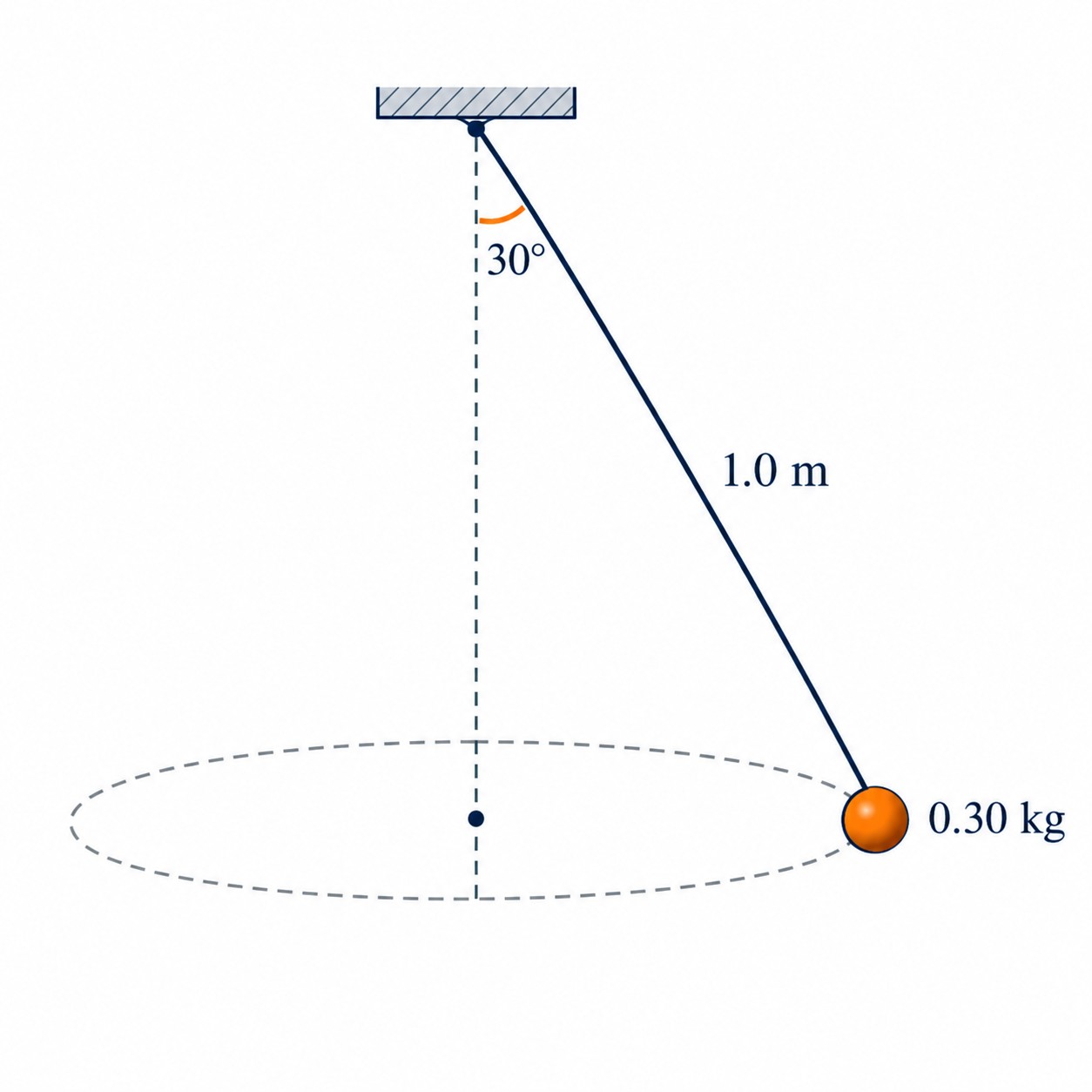
A $0.30\,\mathrm{kg}$ ball on a $1.0\,\mathrm{m}$ string swings in a horizontal circle with the string making a constant $30^\circ$ with the vertical. Using $g=10\,\mathrm{m/s^2}$ and $\cos30^\circ=0.87$, the string tension is closest to

A conical pendulum has a string angled 30 degrees from vertical.
  1. A. $2.6\,\mathrm{N}$
  2. B. $3.0\,\mathrm{N}$
  3. C. $3.5\,\mathrm{N}$
  4. D. $1.5\,\mathrm{N}$

Question 7 of 10

Object $X$ moves with constant speed in a circle of radius $r$ and period $T$. Object $Y$ moves with constant speed in a circle of radius $2r$ and period $T/2$. The ratio of their centripetal accelerations $a_Y/a_X$ is

  1. A. $1/2$
  2. B. $2$
  3. C. $4$
  4. D. $8$

Question 8 of 10

A car speeds up steadily as it rounds a circular curve of constant radius. At any instant during the turn, its total acceleration vector points

  1. A. exactly toward the center of the curve
  2. B. exactly along its velocity, in the direction of motion
  3. C. between the center and the forward direction, because it has both a centripetal and a tangential component
  4. D. away from the center, since the car tends to slide outward

Question 9 of 10

An object moves in a circle of radius $r$ with period $T$. Its centripetal acceleration is

  1. A. $\dfrac{2\pi r}{T}$
  2. B. $\dfrac{4\pi^2 r}{T^2}$
  3. C. $\dfrac{2\pi r}{T^2}$
  4. D. $\dfrac{4\pi^2 r^2}{T^2}$

Question 10 of 10

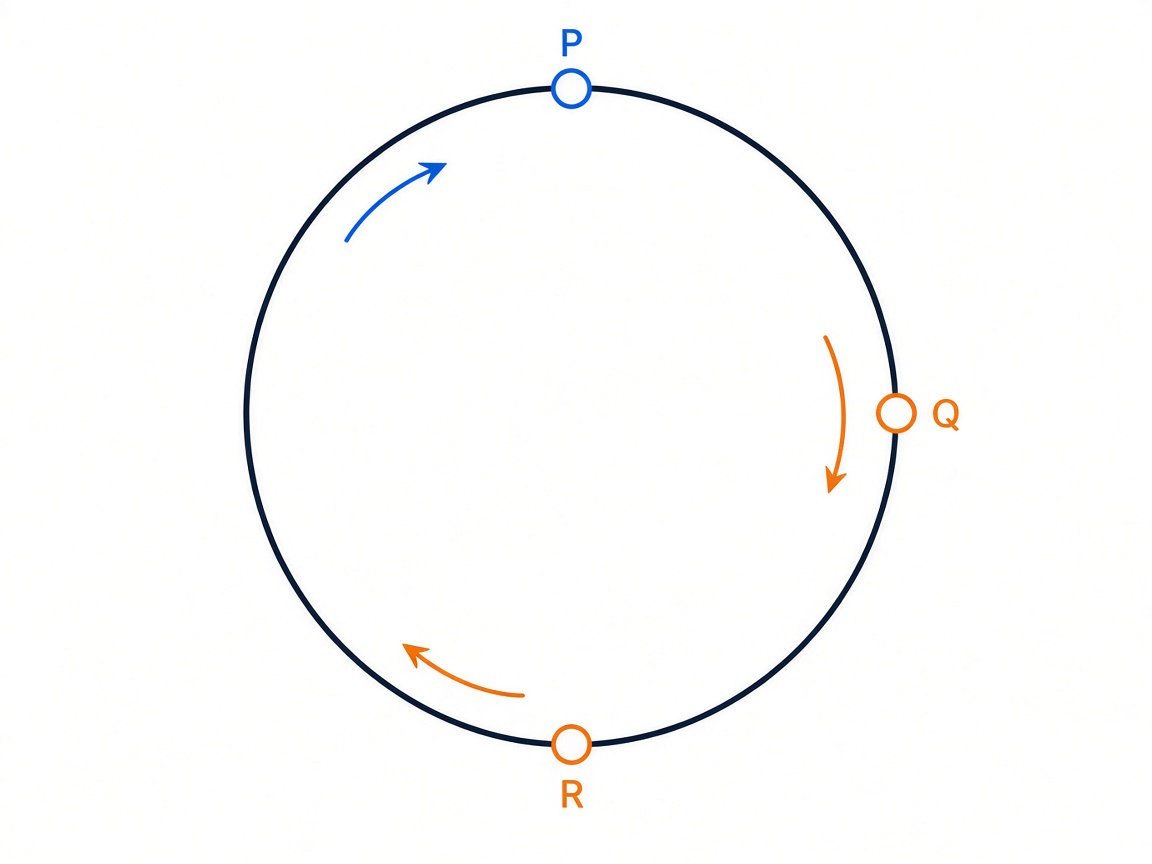
A bead slides along the inside of the vertical circular track shown, passing through the three marked points. It moves fastest at the lowest point of the track and slowest at the highest point. Rank the magnitude of the normal force the track exerts on the bead at $P$, $Q$, and $R$, greatest first.

A bead moves inside a vertical circular track with points at the top, side, and bottom.
  1. A. $R>Q>P$
  2. B. $P>Q>R$
  3. C. $Q>R>P$
  4. D. $P=Q=R$, because the radius is the same at all three points