Question 1 of 10
Scenario A. A cart's mass and speed are listed in the table. What is its translational kinetic energy?
| Mass (kg) | Speed (m/s) |
|---|---|
| 2 | 3 |
- A. 6 J
- B. 18 J
- C. 9 J
- D. 3 J
Scenario A. A cart's mass and speed are listed in the table. What is its translational kinetic energy?
| Mass (kg) | Speed (m/s) |
|---|---|
| 2 | 3 |
Scenario A. The speed of an object is multiplied by 2 while its mass is unchanged. Its translational kinetic energy is multiplied by
Scenario A. Cart P has mass $m$ and speed $2v$. Cart Q has mass $4m$ and speed $v$. Which comparison is correct?
Scenario A. A 1 kg cart speeds up from 6 m/s to 8 m/s. What is the change in its translational kinetic energy?
Scenario A. The net work on a puck is $+12\,\mathrm{J}$. Which statement must be true?
Scenario A. Two objects have equal nonzero translational kinetic energy. Object X has four times the mass of object Y. The ratio $v_X/v_Y$ is
Scenario A. Which graph best represents translational kinetic energy $K$ as a function of signed velocity $v$ for an object of fixed mass?
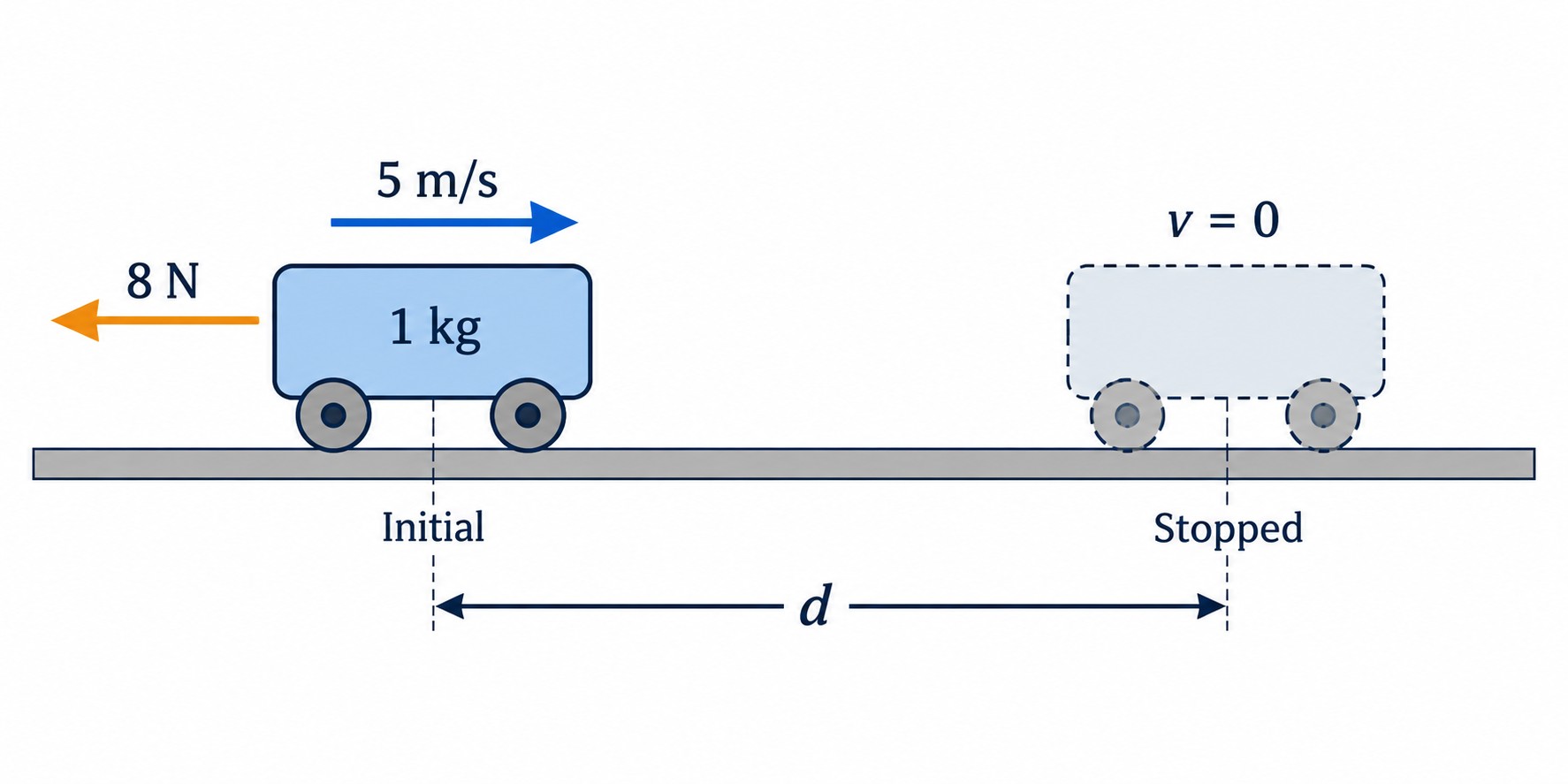
Scenario A. A 1 kg cart moving at 5 m/s is stopped by a constant net force of magnitude 8 N opposite its motion. Its stopping distance is
Scenario A. A student standing beside a track and a rider moving alongside a cart assign different translational kinetic energies to the cart. Which statement resolves the apparent disagreement?
Scenario A. A student claims that doubling both mass and speed doubles an object’s kinetic energy. Which evaluation is correct?