Work MCQ Practice

Question 1 of 10

A horizontal force is constant within each trial and parallel to the listed displacement. Using the table, for which trial is the work by the force greatest?

Trial Force (N) Displacement (m)
1 6 2
2 9 2
3 4 2
  1. A. Trial 1
  2. B. Trial 2
  3. C. Trial 3
  4. D. The work is equal in all trials.

Question 2 of 10

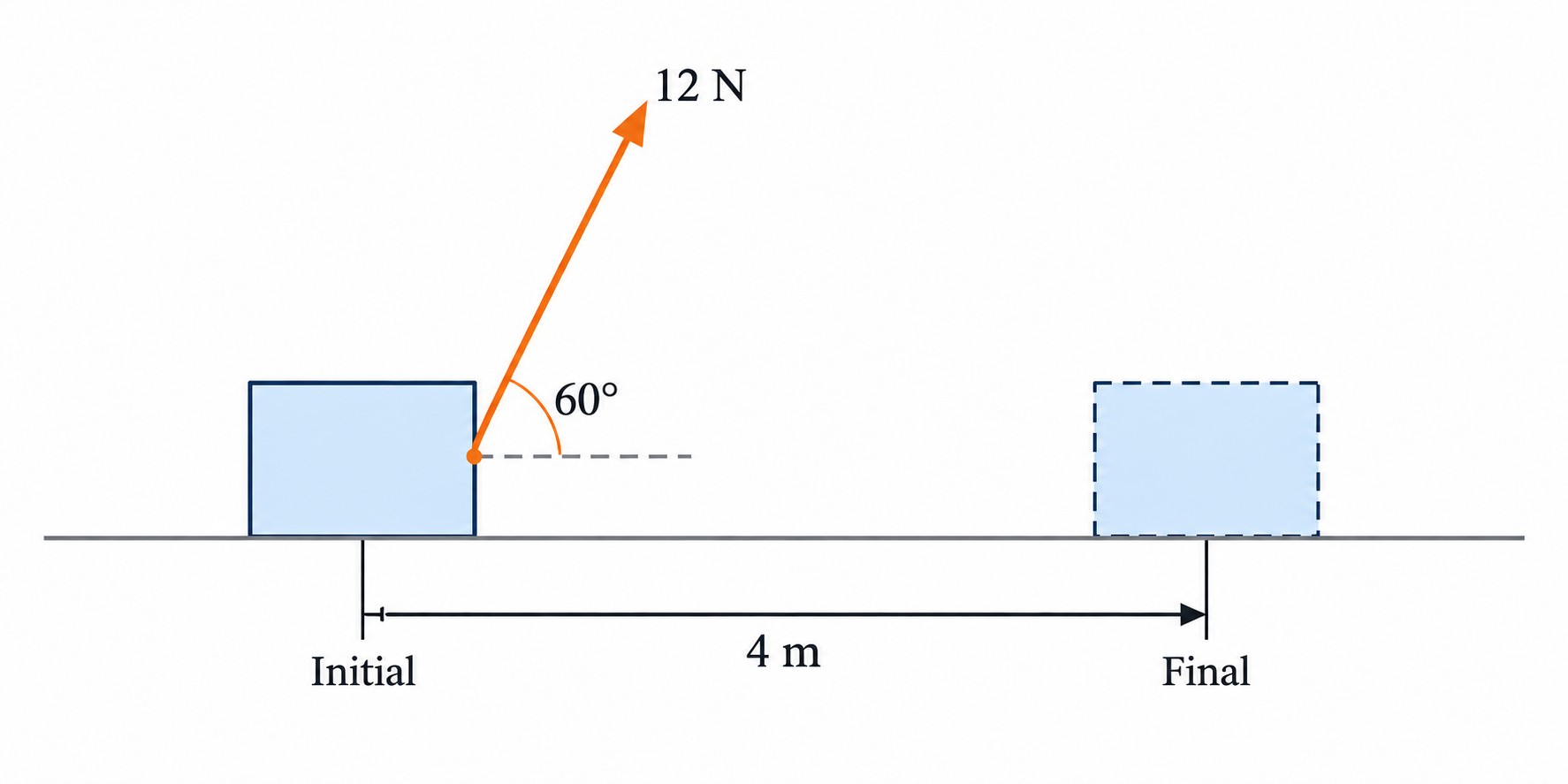
Scenario A. A 12 N force pulls a box through 4 m at $60^\circ$ above the displacement. The work done by the force is

A rope pulls a box through horizontal distance d at 60 degrees above horizontal.
  1. A. 24 J
  2. B. 48 J
  3. C. 41.57 J
  4. D. 0 J

Question 3 of 10

Scenario A. A box slides to the right while kinetic friction acts to the left. The work done by friction on the box is

  1. A. positive because friction changes the speed
  2. B. zero because friction is internal
  3. C. negative because force and displacement are opposite
  4. D. positive if the box is slowing

Question 4 of 10

Scenario A. A waiter carries a tray horizontally at constant height and constant speed. Relative to Earth, the upward normal force by the waiter does how much work on the tray?

  1. A. Positive work
  2. B. Negative work
  3. C. Work equal to the tray’s weight times distance
  4. D. Zero work

Question 5 of 10

Scenario A. A force–position graph is a triangle from $(0,0)$ to $(4,10)$ and back to $(8,0)$. The work is

Force versus position: a triangular pulse above the axis.
  1. A. 20 J
  2. B. 40 J
  3. C. 80 J
  4. D. 0 J

Question 6 of 10

Scenario A. A block travels between the same two points by two paths while only gravity and a normal force act. Which statement about the work by gravity is correct?

  1. A. It is the same on both paths because gravity is conservative.
  2. B. It is greater on the longer path.
  3. C. It depends on the block’s speed.
  4. D. It is zero on both paths because the normal force does zero work.

Question 7 of 10

Scenario A. A spring pushes a block as the spring moves from a compressed position toward its natural length. During that interval, the work done by the spring on the block is

  1. A. negative because the spring force decreases
  2. B. positive because force and displacement have the same direction
  3. C. zero because the force is variable
  4. D. equal to $kx$

Question 8 of 10

Scenario A. Net work on an object is zero over an interval. Which conclusion is required?

  1. A. No forces acted.
  2. B. Every force did zero work.
  3. C. The object was at rest throughout.
  4. D. Its final speed equals its initial speed.

Question 9 of 10

A person lowers a box at constant speed. Only gravity and the person exert forces on the box. During the lowering, the work done by the person on the box is

  1. A. positive and greater than gravity’s work
  2. B. zero
  3. C. negative and equal in magnitude to gravity’s positive work
  4. D. negative and greater in magnitude than gravity’s work

Question 10 of 10

Scenario A. A constant force produces positive work on an object, but the object’s kinetic energy decreases. This is possible only if

  1. A. other forces do a larger amount of negative work
  2. B. the force is perpendicular to displacement
  3. C. the object’s mass decreases
  4. D. positive work never changes kinetic energy