Work FRQ Practice

Responses receive AI feedback against a rubric after submission. Scores are practice estimates.

Question 1 of 5

Scenario B. A rescue worker pulls a sled through three consecutive horizontal segments. The tension magnitude and angle are constant within each segment as tabulated. (a) Calculate the work done by tension on each segment and in total. (b) If friction does $-90\,J$ of work and the sled starts from rest, determine its final kinetic energy. (c) Explain why the vertical component of tension does no work on the sled. The sled remains on the floor and reaches the end of all three segments; weight and normal do no work.

Segment Distance (m) Tension (N) Angle above horizontal
1 2 50 $0^\circ$
2 3 40 $60^\circ$
3 1 30 $90^\circ$

Question 2 of 5

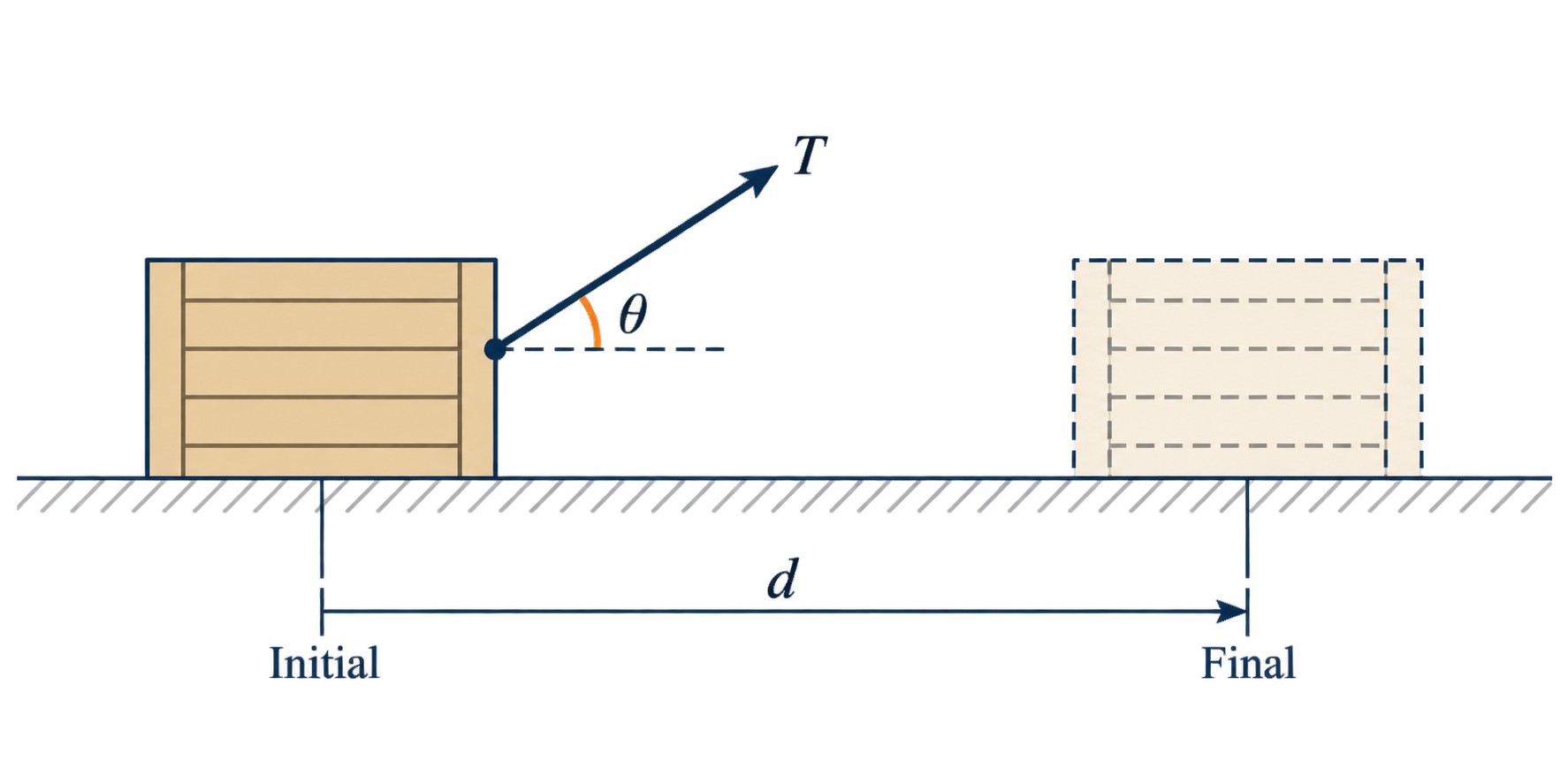
Scenario B. The pictured rope pulls a crate at angle $\theta$ through the horizontal displacement $d$ shown. Design an experiment to test the work–energy theorem for this motion. (a) Identify measurements that independently determine the crate's kinetic-energy change and the work done by the rope. (b) Describe how to account for friction, weight, and the normal force in the net-work comparison. (c) Explain how repeated trials and measurement uncertainties would be used to evaluate agreement.

A rope pulls a crate across a rough floor at angle theta.

Question 3 of 5

Scenario B. A 2.0 kg cart passes $x=0$ at $1.0\,\mathrm{m/s}$. Its measured net horizontal force is $0$, $4$, $4$, and $0\,N$ at positions $x=0$, $1$, $2$, and $3\,m$, respectively, with force changing linearly between measurements. (a) Sketch the force–position graph. (b) Use geometric areas to determine the net work from 0 to 3 m. (c) Predict the cart's speed at 3 m and state one assumption required.

Question 4 of 5

Scenario B. Design an experiment to test whether gravitational work is path independent. A cart can descend between the same two heights on two tracks of different shape. Specify measurements, controls, the calculated work or energy change, and a comparison that would support the conservative-force model. Include one method for reducing random uncertainty.

Question 5 of 5

Scenario B. A bead moves at speed $v$ on a smooth circular wire of radius $R$ in a vertical plane. At one instant the wire's normal force is perpendicular to the bead's velocity. (a) Determine the instantaneous power delivered by the normal force. (b) Explain how that force can still change the bead's momentum. (c) Identify which force changes the bead's kinetic energy as it moves vertically. The wire is fixed in the laboratory, and air resistance is negligible.