Spring Forces FRQ Practice

Responses receive AI feedback against a rubric after submission. Scores are practice estimates.

Question 1 of 5

Two ideal springs with constants $k_1$ and $k_2$ hang side by side from a ceiling, both of the same relaxed length, and a rigid bar of negligible mass is attached across their lower ends. A load of magnitude $F$ hangs from the middle of the bar, and the bar stays horizontal. (a) Explain why the two springs must stretch by the same amount. (b) Derive an expression for $k_{\mathrm{eff}}$ of the pair. (c) Explain how the force is divided between the springs and check that your division is consistent with the total load.
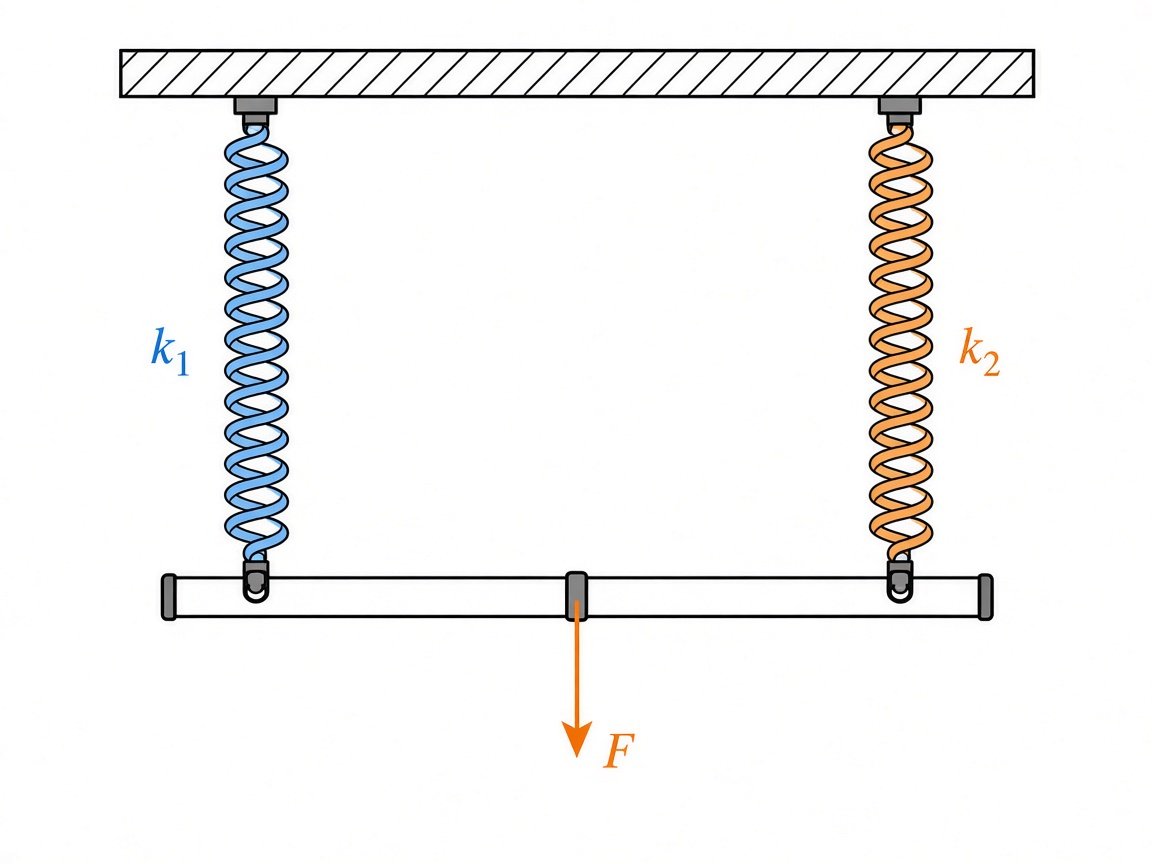
Two side-by-side springs support a rigid bar with a load at its center.

Question 2 of 5

A $0.60\,\mathrm{kg}$ ball rests on top of a vertical ideal spring of constant $240\,\mathrm{N/m}$. Use $g=10\,\mathrm{m/s^2}$. (a) Calculate the spring’s compression when the ball sits at rest. (b) The spring is pushed down an extra $0.050\,\mathrm{m}$ and held. Calculate the magnitude and direction of the net force on the ball. (c) Calculate the ball’s acceleration the instant it is released.

Question 3 of 5

A student loads a spring and records the stretch, obtaining the table. (a) Determine the spring constant over the range where the spring obeys Hooke’s law, and state that range. (b) Explain how the data show where Hooke’s law stops describing this spring. (c) A classmate computes $k$ from the last row alone. State the value that gives and explain why it is misleading.

Load (N) Stretch (m)
2.0 0.010
4.0 0.020
6.0 0.030
8.0 0.046
10.0 0.075

Question 4 of 5

Blocks of mass $m$ and $M$ sit on a frictionless table joined by an ideal spring of constant $k$. A constant horizontal force $F$ is applied to the block of mass $m$, pulling it directly away from $M$. At an instant when both blocks have the same acceleration, the spring has stretch $x$. (a) Determine that common acceleration. (b) Derive an expression for $x$. (c) The force $F$ is instead applied to the block of mass $M$, pulling it away from $m$. At an instant when the blocks again have the same acceleration, determine the spring’s stretch and state the condition under which it is smaller than your answer to part (b).

Question 5 of 5

A student claims, “A stiffer spring always exerts a larger force.” (a) Describe a circumstance in which the claim is correct and a circumstance in which it is wrong. (b) A spring with $k=100\,\mathrm{N/m}$ and one with $k=400\,\mathrm{N/m}$ each exert $20\,\mathrm{N}$; calculate each stretch. (c) State the quantity that must be held fixed for the student’s claim to be a correct statement.