Spring Forces MCQ Practice

Question 1 of 10

An ideal spring hangs vertically with a relaxed length of $0.25\,\mathrm{m}$. When a $2.0\,\mathrm{kg}$ block hangs at rest from its lower end, the spring’s length is $0.45\,\mathrm{m}$. Using $g=10\,\mathrm{m/s^2}$, the spring constant is

  1. A. $44\,\mathrm{N/m}$
  2. B. $80\,\mathrm{N/m}$
  3. C. $100\,\mathrm{N/m}$
  4. D. $200\,\mathrm{N/m}$

Question 2 of 10

The graph shows the magnitude of the force each of two ideal springs exerts versus its stretch from its relaxed length. Which statement is correct?

Force versus stretch for two springs: line P from the origin to (0.20 m, 30 N) and line Q from the origin to (0.20 m, 10 N).
  1. A. $P$ is three times as stiff as $Q$, and $k_P=150\,\mathrm{N/m}$.
  2. B. $Q$ is three times as stiff as $P$, and $k_Q=150\,\mathrm{N/m}$.
  3. C. The springs have equal stiffness, because both lines pass through the origin.
  4. D. $k_P=30\,\mathrm{N/m}$, read directly from the highest point on line $P$.

Question 3 of 10

A block on a frictionless horizontal surface is attached to an ideal spring of constant $k$ whose relaxed position places the block at $x=0$. The block is pulled to $x=+A$ and released. When the block is at $x=-A/2$, the spring force on it is

  1. A. in the $+x$ direction, with magnitude $kA/2$
  2. B. in the $-x$ direction, with magnitude $kA/2$
  3. C. in the $-x$ direction, with magnitude $kA$
  4. D. in the $+x$ direction, with magnitude $kA$

Question 4 of 10

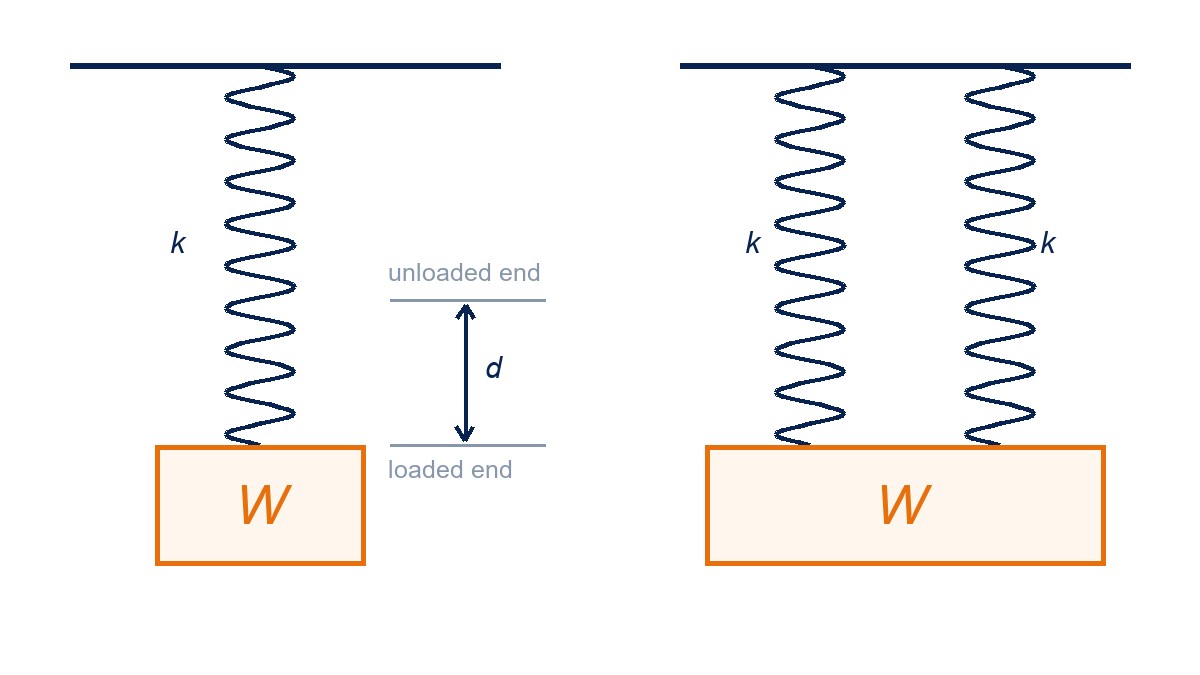
A load of weight $W$ hung from a single ideal spring of constant $k$ stretches it a distance $d$. The same load is then hung from two identical springs of constant $k$ mounted side by side, sharing the load equally. Each spring now stretches

The same load hangs first from one spring and then from two parallel springs.
  1. A. $d/2$, and the pair behaves like one spring of constant $2k$
  2. B. $d$, because each spring still has its own constant $k$
  3. C. $2d$, and the pair behaves like one spring of constant $k/2$
  4. D. $d/4$, and the pair behaves like one spring of constant $4k$

Question 5 of 10

An ideal spring of constant $k$ is cut exactly in half. One of the halves is then stretched by a force of magnitude $F$. Compared with the whole spring under that same force $F$, the half stretches

  1. A. half as much, so each half has constant $2k$
  2. B. twice as much, so each half has constant $k/2$
  3. C. the same amount, because cutting does not change the material
  4. D. one quarter as much, so each half has constant $4k$

Question 6 of 10

Four springs are each loaded with the same $6.0\,\mathrm{N}$ force. Using the table, rank the spring constants from greatest to least.

Spring Relaxed length (m) Length under $6.0\,\mathrm{N}$ (m)
$J$ 0.30 0.42
$K$ 0.50 0.56
$L$ 0.20 0.35
$M$ 0.40 0.48
  1. A. $K>M>J>L$
  2. B. $K>L>M>J$
  3. C. $L>J>M>K$
  4. D. $K>J>M>L$

Question 7 of 10

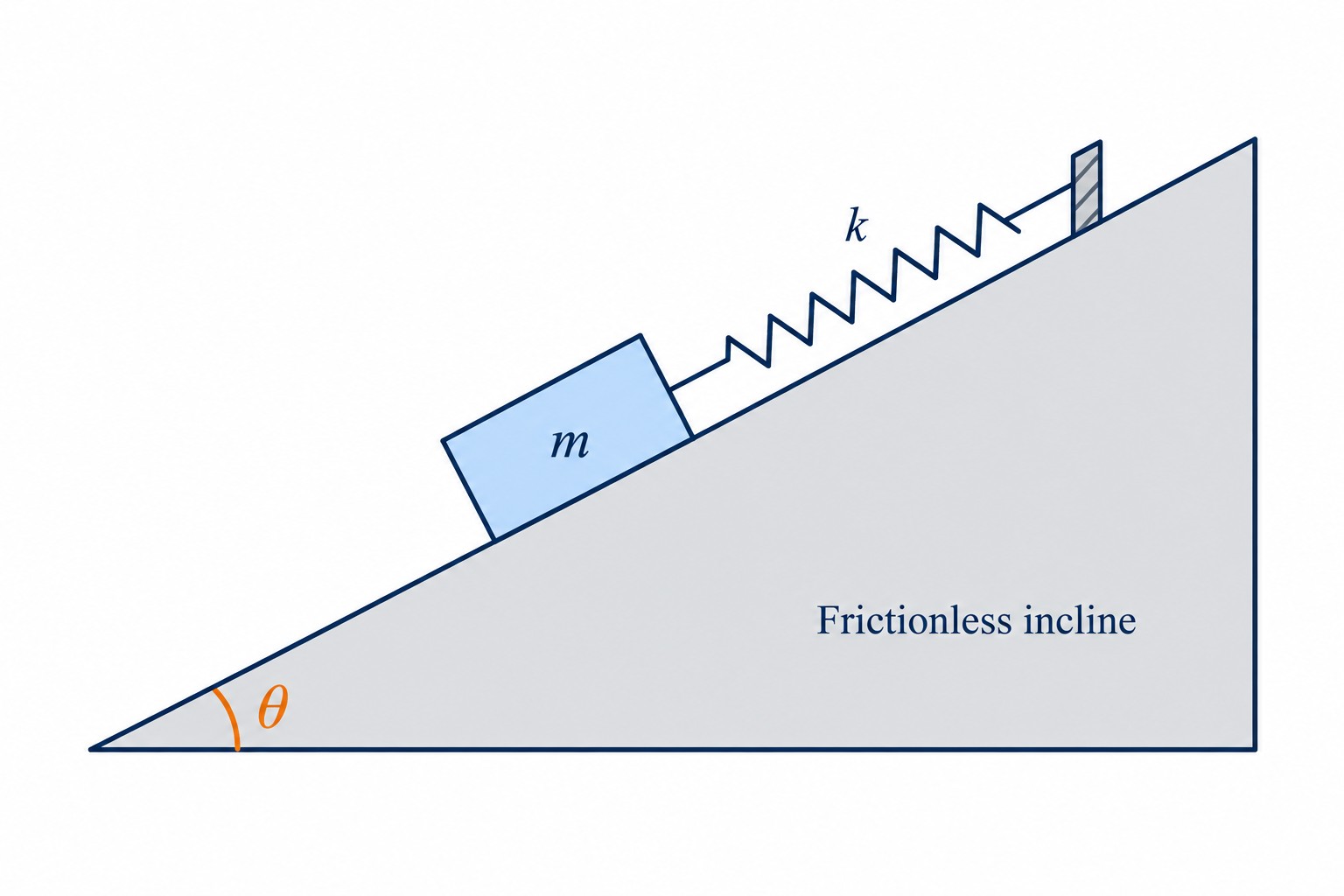
A block of mass $m$ rests at equilibrium on a frictionless incline of angle $\theta$, held by an ideal spring of constant $k$ that runs parallel to the incline surface. The spring’s stretch is

A block on an incline is held by a spring parallel to the slope.
  1. A. $\dfrac{mg}{k}$
  2. B. $\dfrac{mg\sin\theta}{k}$
  3. C. $\dfrac{mg\cos\theta}{k}$
  4. D. $\dfrac{mg\tan\theta}{k}$

Question 8 of 10

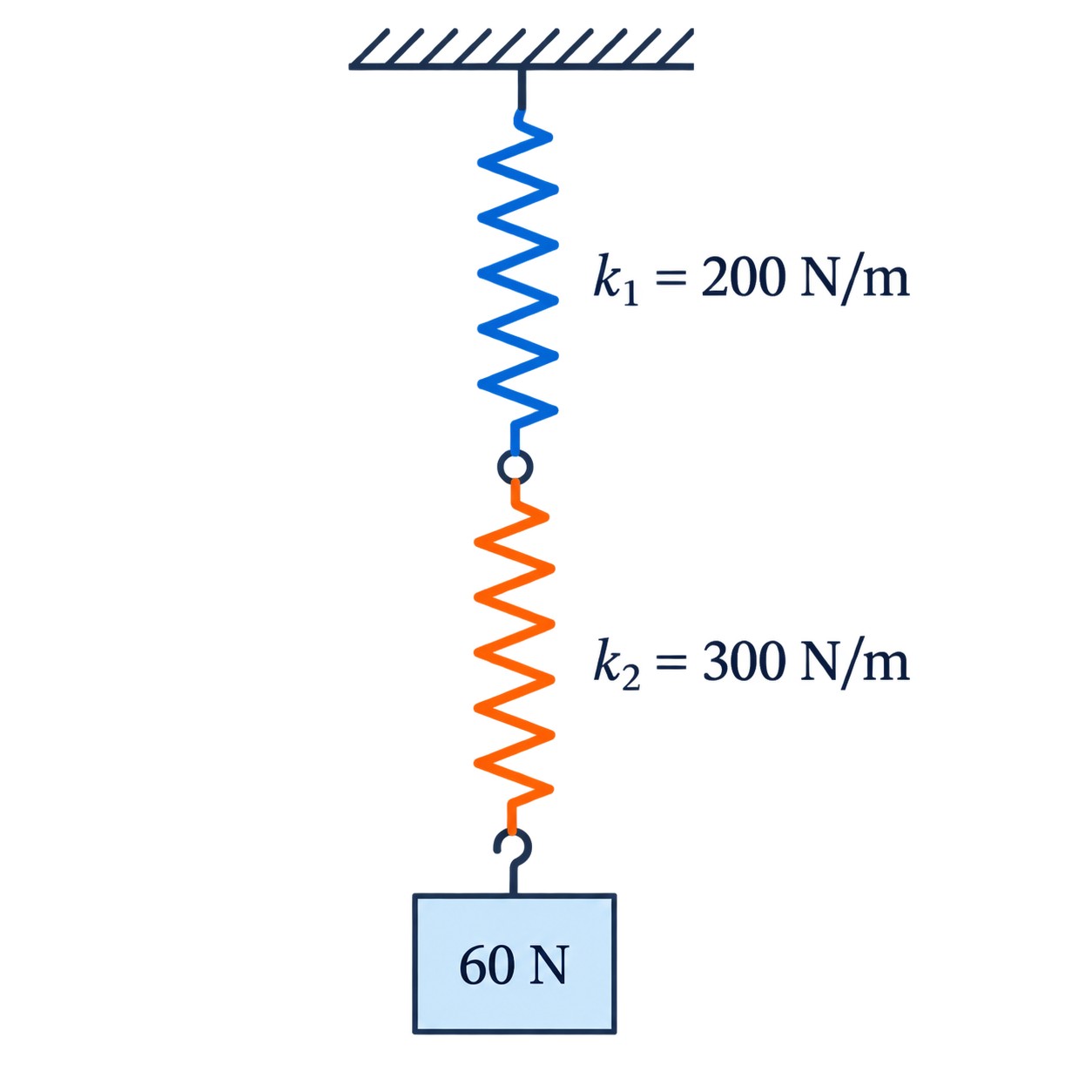
Two ideal springs, $k_1=200\,\mathrm{N/m}$ and $k_2=300\,\mathrm{N/m}$, are joined end to end and a $60\,\mathrm{N}$ load hangs from the bottom of the pair. The total stretch of the combination is

Two vertical springs are connected end to end with a load below.
  1. A. $0.12\,\mathrm{m}$
  2. B. $0.20\,\mathrm{m}$
  3. C. $0.30\,\mathrm{m}$
  4. D. $0.50\,\mathrm{m}$

Question 9 of 10

A $2.0\,\mathrm{kg}$ block hangs from a spring of constant $400\,\mathrm{N/m}$ fixed to the ceiling of an elevator. The elevator accelerates upward at $2.0\,\mathrm{m/s^2}$. Using $g=10\,\mathrm{m/s^2}$, the spring’s stretch is

  1. A. $0.040\,\mathrm{m}$
  2. B. $0.050\,\mathrm{m}$
  3. C. $0.060\,\mathrm{m}$
  4. D. $0.010\,\mathrm{m}$

Question 10 of 10

The graph shows the force a real spring exerts versus its stretch. Which statement is best supported by the graph?

Force versus stretch for a real spring: a straight line from the origin to (0.040 m, 20 N), then a shallower line to (0.080 m, 26 N).
  1. A. The spring obeys Hooke’s law for stretches up to about $0.040\,\mathrm{m}$, where $k=500\,\mathrm{N/m}$.
  2. B. The spring obeys Hooke’s law over the whole range shown, with $k=325\,\mathrm{N/m}$.
  3. C. Beyond $0.040\,\mathrm{m}$ the spring grows stiffer, so $k$ increases.
  4. D. The spring never obeys Hooke’s law, because the graph is not one straight line.