Reference Frames and Relative Motion MCQ Practice

Question 1 of 10

An airport walkway moves at $0.80\,\mathrm{m/s}$ relative to the ground. A traveler steps on and walks in the direction of motion at $1.4\,\mathrm{m/s}$ relative to the walkway for $12\,\mathrm{s}$, then turns around and walks at $1.4\,\mathrm{m/s}$ relative to the walkway in the opposite direction for $8.0\,\mathrm{s}$. What is the traveler’s displacement relative to the ground?

  1. A. $5.6\,\mathrm{m}$ forward
  2. B. $21.6\,\mathrm{m}$ forward
  3. C. $8.8\,\mathrm{m}$ forward
  4. D. $31.2\,\mathrm{m}$ forward

Question 2 of 10

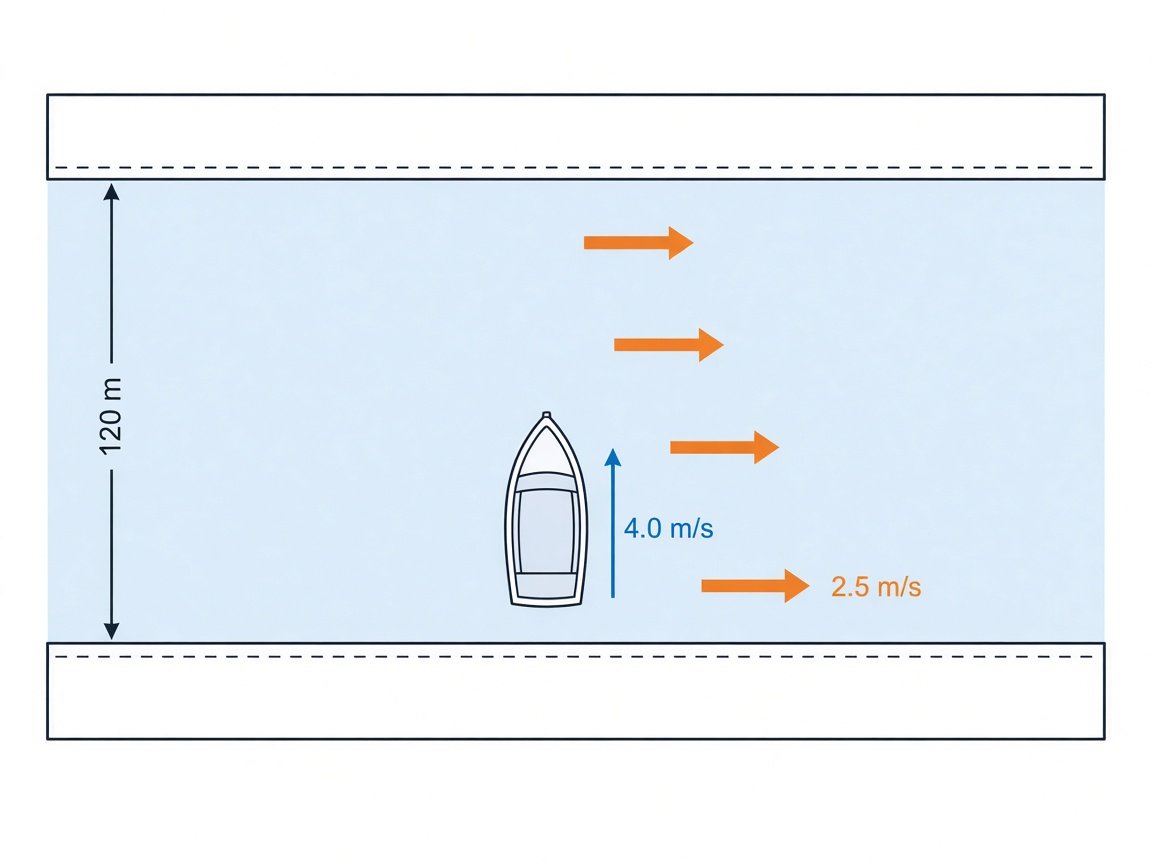
A river $120\,\mathrm{m}$ wide flows east at $2.5\,\mathrm{m/s}$. A boat whose speed relative to the water is $4.0\,\mathrm{m/s}$ points its bow due north (straight across) for the entire crossing. How far downstream of its starting point does the boat reach the far bank?

A boat points straight across a 120-meter river while the current flows east.
  1. A. $0\,\mathrm{m}$, because the current acts perpendicular to the crossing
  2. B. $64\,\mathrm{m}$
  3. C. $75\,\mathrm{m}$
  4. D. $96\,\mathrm{m}$

Question 3 of 10

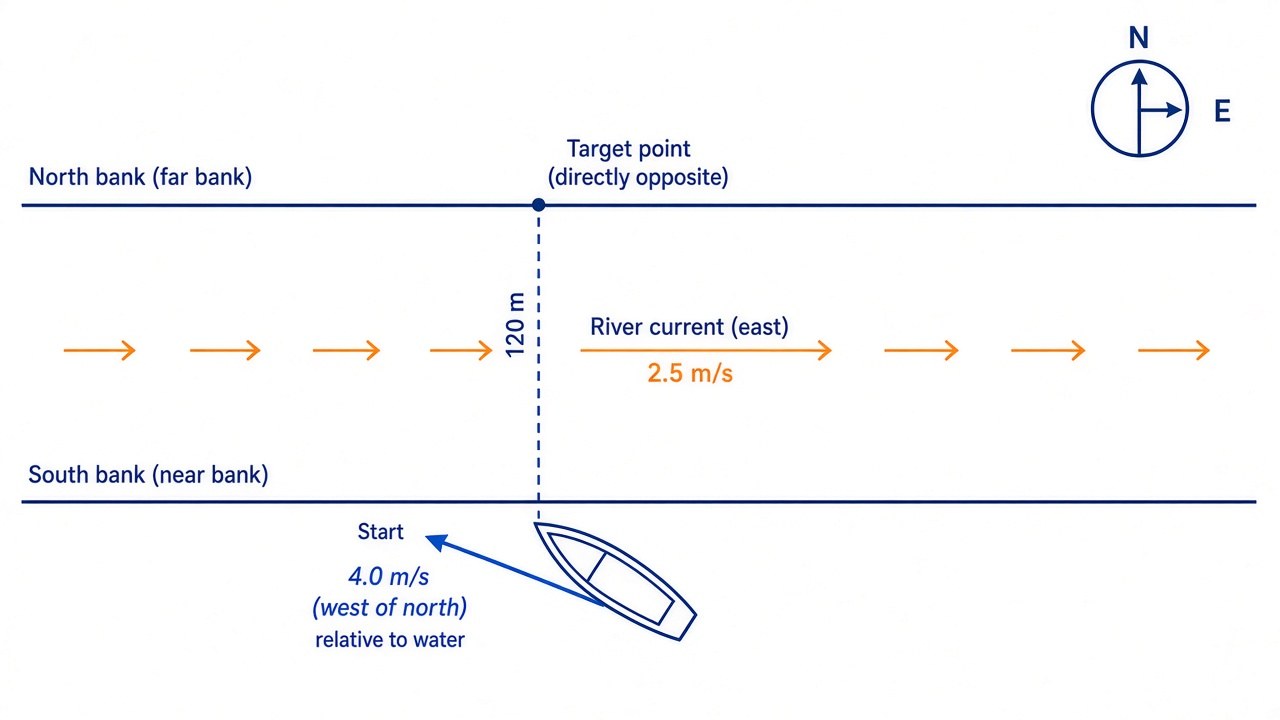
The same $120\,\mathrm{m}$ river flows east at $2.5\,\mathrm{m/s}$ and the boat still moves at $4.0\,\mathrm{m/s}$ relative to the water, but now the pilot angles the bow upstream so the boat lands directly across from its starting point. How long does this crossing take?

A boat points upstream across an east-flowing river toward a point directly opposite its start.
  1. A. $25\,\mathrm{s}$
  2. B. $30\,\mathrm{s}$
  3. C. $48\,\mathrm{s}$
  4. D. $38\,\mathrm{s}$

Question 4 of 10

A pilot needs to travel $300\,\mathrm{km}$ due north over the ground. The plane’s airspeed is $130\,\mathrm{km/h}$ and a steady wind blows at $50\,\mathrm{km/h}$ due east. If the pilot holds the heading that keeps the ground track due north, how long does the trip take?

  1. A. $2.5\,\mathrm{h}$
  2. B. $2.3\,\mathrm{h}$
  3. C. $1.7\,\mathrm{h}$
  4. D. $3.8\,\mathrm{h}$

Question 5 of 10

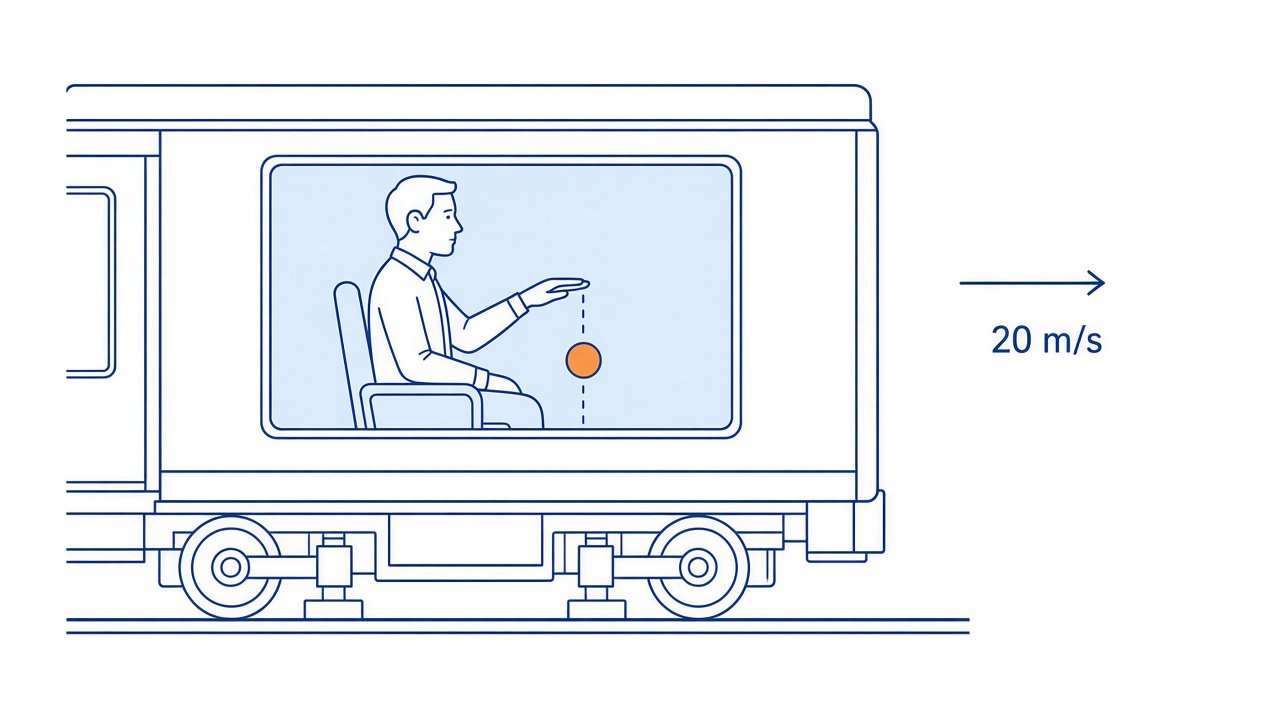
A train moves along a straight track at a constant $20\,\mathrm{m/s}$. A passenger releases a ball from rest relative to the train. Take $g=10\,\mathrm{m/s^2}$ and ignore air resistance. Which comparison of the passenger’s frame and the ground frame is correct?

A passenger releases a ball straight down inside a train moving right at 20 meters per second.
  1. A. The ball’s acceleration is larger in the ground frame because the ball also moves horizontally there.
  2. B. The acceleration is $10\,\mathrm{m/s^2}$ downward in both frames, but the path is straight down in the train frame and a parabola in the ground frame.
  3. C. The ball lands behind the release point in the train frame because the train moves forward while the ball falls.
  4. D. The fall takes longer in the ground frame because the ball travels a longer path there.

Question 6 of 10

The table lists velocity components of three drones measured in the ground frame, with $+x$ east and $+y$ north. What is the magnitude of the velocity of drone $P$ relative to drone $Q$?

Drone $v_x$ (m/s) $v_y$ (m/s)
P +9.0 +2.0
Q +3.0 -6.0
R -5.0 +2.0
  1. A. $10\,\mathrm{m/s}$
  2. B. $12.6\,\mathrm{m/s}$
  3. C. $2.5\,\mathrm{m/s}$
  4. D. $15.9\,\mathrm{m/s}$

Question 7 of 10

Walking up a moving escalator takes a student $20\,\mathrm{s}$. Standing still on that same moving escalator takes $30\,\mathrm{s}$. How long would the student need to walk up the escalator if it were switched off?

  1. A. $10\,\mathrm{s}$
  2. B. $12\,\mathrm{s}$
  3. C. $50\,\mathrm{s}$
  4. D. $60\,\mathrm{s}$

Question 8 of 10

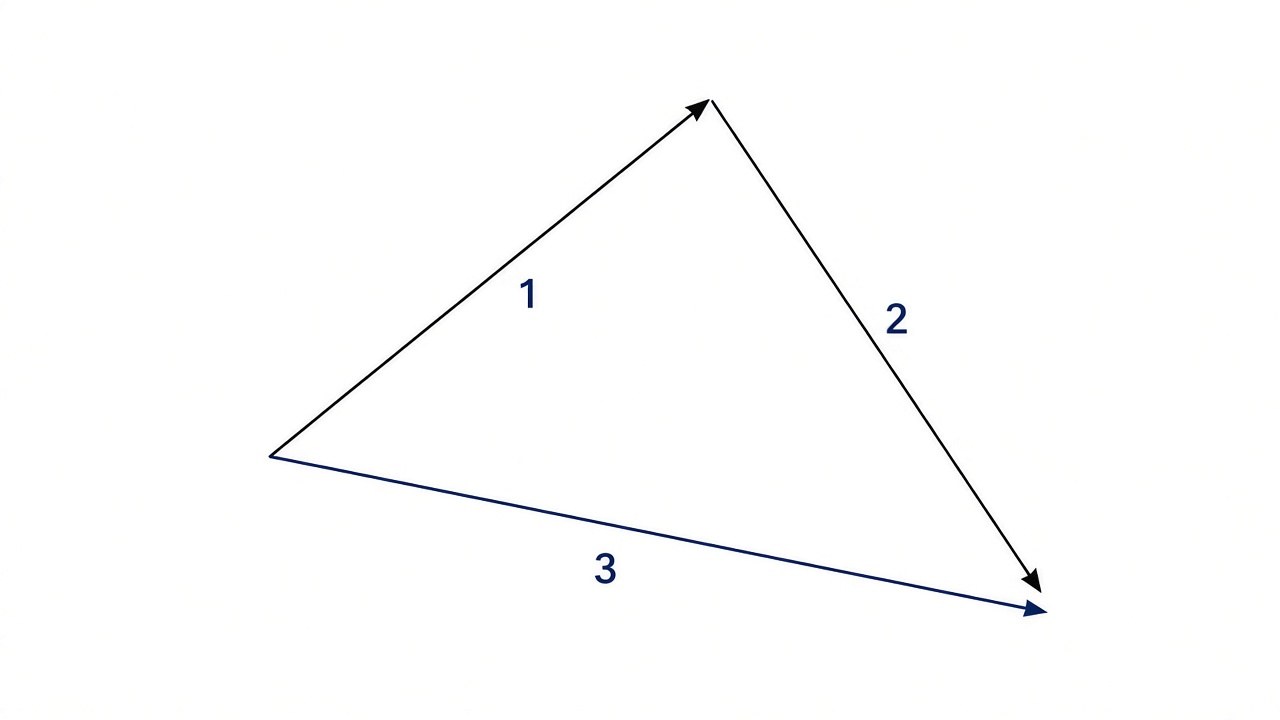
In the vector sketch, arrow 1 is a plane’s velocity relative to the air and arrow 2 is the air’s velocity relative to the ground. Which statement about arrow 3 is correct?

Vector triangle: arrow 1 from the origin up and to the right, arrow 2 continuing from its head down and to the right, and arrow 3 drawn from the tail of arrow 1 to the head of arrow 2.
  1. A. Arrow 3 is the plane’s velocity relative to the air, since it points toward the destination.
  2. B. Arrow 3 is the wind’s velocity measured by the pilot.
  3. C. Arrow 3 is the plane’s velocity relative to the ground, because it runs from the tail of arrow 1 to the head of arrow 2.
  4. D. Arrow 3 has a magnitude equal to the sum of the magnitudes of arrows 1 and 2.

Question 9 of 10

A train $120\,\mathrm{m}$ long travels east at a constant $15\,\mathrm{m/s}$. A passenger starts at the front and walks to the rear at $3.0\,\mathrm{m/s}$ relative to the train. What is the magnitude of the passenger’s displacement relative to the ground during that walk?

  1. A. $120\,\mathrm{m}$
  2. B. $480\,\mathrm{m}$
  3. C. $600\,\mathrm{m}$
  4. D. $720\,\mathrm{m}$

Question 10 of 10

In the ground frame a cart’s velocity increases uniformly from $+2.0\,\mathrm{m/s}$ at $t=0$ to $+10.0\,\mathrm{m/s}$ at $t=4.0\,\mathrm{s}$. A second observer glides past at a constant $+6.0\,\mathrm{m/s}$. In the observer’s frame, when is the cart momentarily at rest, and what is its acceleration?

  1. A. At $t=2.0\,\mathrm{s}$, with acceleration $2.0\,\mathrm{m/s^2}$
  2. B. At $t=2.0\,\mathrm{s}$, with acceleration $0$
  3. C. At $t=3.0\,\mathrm{s}$, with acceleration $8.0\,\mathrm{m/s^2}$
  4. D. Never, because the cart always moves forward