Reference Frames and Relative Motion MCQ Practice

Question 1 of 10

The table gives velocities of three vehicles on a straight highway, with east positive. What is the velocity of vehicle $Z$ relative to vehicle $Y$?

Vehicle Velocity (m/s)
X +32
Y +25
Z -18
  1. A. $43\,\mathrm{m/s}$ east
  2. B. $7.0\,\mathrm{m/s}$ east
  3. C. $43\,\mathrm{m/s}$ west
  4. D. $50\,\mathrm{m/s}$ west

Question 2 of 10

A moving walkway travels at $1.0\,\mathrm{m/s}$. A traveler walking at $1.5\,\mathrm{m/s}$ relative to the walkway, in its direction of motion, covers the full length in $24\,\mathrm{s}$. How long would a traveler who simply stands on the walkway take to cover that same length?

  1. A. $24\,\mathrm{s}$
  2. B. $40\,\mathrm{s}$
  3. C. $96\,\mathrm{s}$
  4. D. $60\,\mathrm{s}$

Question 3 of 10

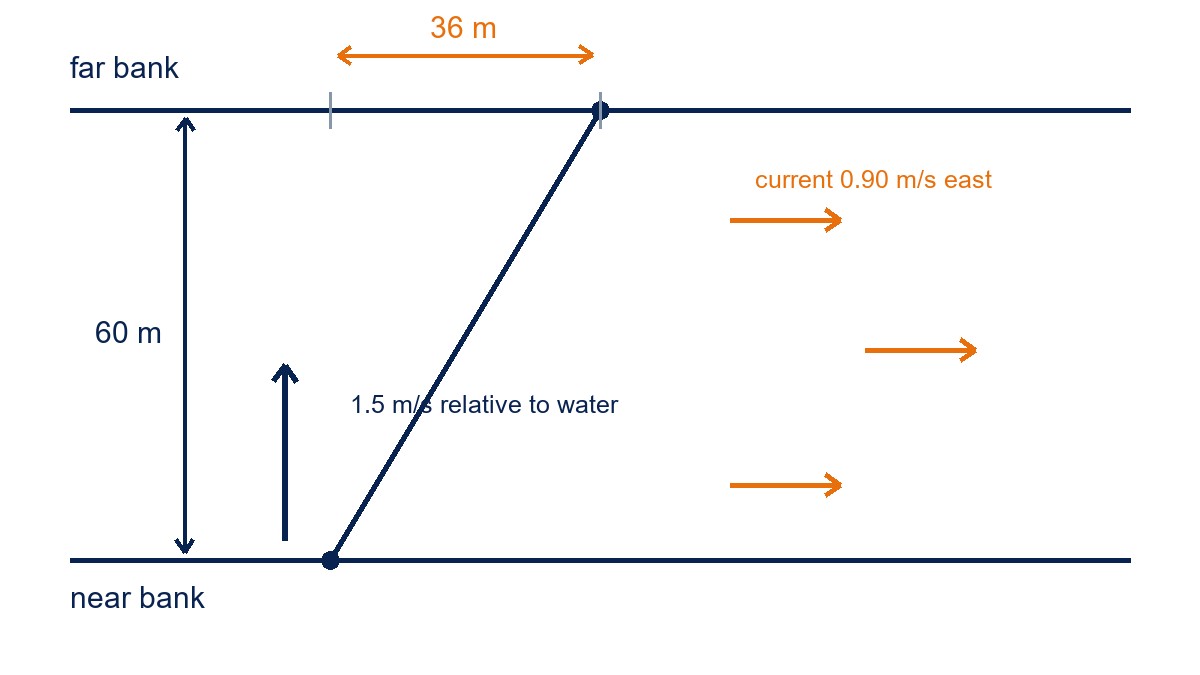
A swimmer heads straight across a $60\,\mathrm{m}$ river at $1.5\,\mathrm{m/s}$ relative to the water while the current flows at $0.90\,\mathrm{m/s}$. What is the length of the path the swimmer actually traces over the ground?

A swimmer heads across a 60-meter river while the current carries the swimmer downstream.
  1. A. $60\,\mathrm{m}$
  2. B. $70\,\mathrm{m}$
  3. C. $96\,\mathrm{m}$
  4. D. $48\,\mathrm{m}$

Question 4 of 10

A plane points due west with an airspeed of $80\,\mathrm{m/s}$ while a steady wind blows at $60\,\mathrm{m/s}$ due north. The pilot holds that heading for $10$ minutes. How far north of its starting latitude is the plane at the end of that time?

  1. A. $36\,\mathrm{km}$
  2. B. $48\,\mathrm{km}$
  3. C. $60\,\mathrm{km}$
  4. D. $0\,\mathrm{km}$, because the plane is pointed west

Question 5 of 10

An elevator rises at a constant $3.0\,\mathrm{m/s}$. A rider releases a key from rest relative to the elevator. Take $g=10\,\mathrm{m/s^2}$ and ignore air resistance. What is the key’s velocity in the ground frame $0.50\,\mathrm{s}$ after release?

  1. A. $5.0\,\mathrm{m/s}$ downward
  2. B. $8.0\,\mathrm{m/s}$ downward
  3. C. $2.0\,\mathrm{m/s}$ downward
  4. D. $2.0\,\mathrm{m/s}$ upward

Question 6 of 10

Walking down a switched-off escalator takes a person $40\,\mathrm{s}$. Standing on that escalator while it runs upward carries the person from bottom to top in $60\,\mathrm{s}$. If the person walks down at the same walking rate while the escalator runs upward, how long does it take to reach the bottom?

  1. A. $20\,\mathrm{s}$
  2. B. $24\,\mathrm{s}$
  3. C. $100\,\mathrm{s}$
  4. D. $120\,\mathrm{s}$

Question 7 of 10

Car $A$ travels due north at $12\,\mathrm{m/s}$ and car $B$ travels due east at $16\,\mathrm{m/s}$. What is the magnitude of the velocity of car $A$ relative to car $B$?

  1. A. $20\,\mathrm{m/s}$
  2. B. $28\,\mathrm{m/s}$
  3. C. $14\,\mathrm{m/s}$
  4. D. $4.0\,\mathrm{m/s}$

Question 8 of 10

Two cyclists ride east on a straight path. Cyclist 1 moves at $8.0\,\mathrm{m/s}$ and cyclist 2, who is $45\,\mathrm{m}$ ahead, moves at $5.0\,\mathrm{m/s}$. How far does cyclist 1 travel over the ground before catching cyclist 2?

  1. A. $45\,\mathrm{m}$
  2. B. $75\,\mathrm{m}$
  3. C. $120\,\mathrm{m}$
  4. D. $105\,\mathrm{m}$

Question 9 of 10

The table lists a glider’s velocity in the ground frame, with east positive. An observer rides past in a cart moving east at a constant $5.0\,\mathrm{m/s}$. Which statement describes the glider as measured by that observer?

$t$ (s) $v$ (m/s)
0 1.0
2.0 4.0
4.0 7.0
6.0 10.0
  1. A. Its acceleration is $1.5\,\mathrm{m/s^2}$ smaller than in the ground frame, and it is never at rest.
  2. B. Its acceleration is still $1.5\,\mathrm{m/s^2}$ east, and it is momentarily at rest at about $t=2.7\,\mathrm{s}$.
  3. C. Its acceleration is $5.0\,\mathrm{m/s^2}$ east, and it is momentarily at rest at $t=5.0\,\mathrm{s}$.
  4. D. Its acceleration is zero, because the cart and the glider move in the same direction.

Question 10 of 10

An object moves along a straight line. Several observers each travel at their own constant velocity along that line. Which quantity do all of these observers measure to be the same for a given time interval?

  1. A. The object’s velocity at the start of the interval
  2. B. The object’s change in velocity during the interval
  3. C. The object’s displacement during the interval
  4. D. Whether the object is at rest at the middle of the interval