Reference Frames and Relative Motion FRQ Practice

Responses receive AI feedback against a rubric after submission. Scores are practice estimates.

Question 1 of 5

A river $90\,\mathrm{m}$ wide flows at $1.2\,\mathrm{m/s}$. A boat moves at $2.0\,\mathrm{m/s}$ relative to the water. (a) The pilot points the bow straight across. Determine the crossing time and the downstream drift. (b) Instead the pilot wants to land directly opposite the start. Determine the angle of the bow relative to the straight-across direction. (c) Determine the crossing time for the trip in part (b). (d) Explain why the trip in (b) takes longer even though the boat’s speed through the water is unchanged.
Question 2 of 5

An airport walkway is $60\,\mathrm{m}$ long and moves at $0.75\,\mathrm{m/s}$. (a) Determine the time for a traveler who stands still on the walkway to reach the far end. (b) Determine the time for a traveler who walks at $1.25\,\mathrm{m/s}$ relative to the walkway, in the direction of its motion. (c) Determine the time for a traveler who walks at $1.25\,\mathrm{m/s}$ relative to the ground on the fixed floor beside the walkway, covering the same $60\,\mathrm{m}$. (d) Identify which frame each given speed is measured in, and explain why the speeds in (b) may be added.

Question 3 of 5

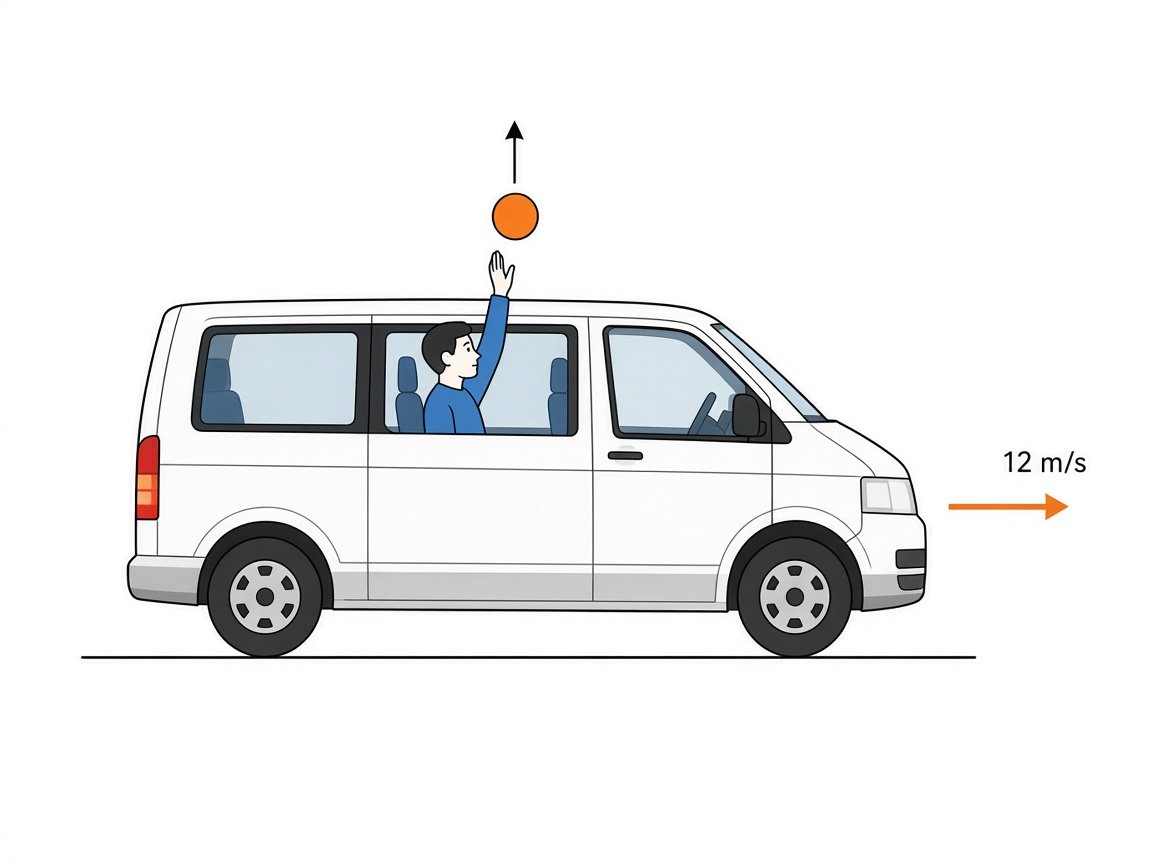
A van travels along a straight, level road at a constant $12\,\mathrm{m/s}$. A passenger tosses a ball straight up relative to the van and catches it again. Take $g=10\,\mathrm{m/s^2}$ and ignore air resistance. (a) Describe the ball’s path as seen by the passenger and as seen by an observer standing on the road. (b) State the ball’s acceleration in each frame and justify your answer. (c) Explain why the ball returns to the passenger’s hand rather than landing behind it. (d) State what changes about (c) if the van speeds up while the ball is in the air.

A passenger tosses a ball upward inside a van moving right at 12 meters per second.

Question 4 of 5

Two boats travel on a river whose water moves east at $2.0\,\mathrm{m/s}$ relative to the ground. The table gives each boat’s velocity components relative to the water, with $+x$ east and $+y$ north. (a) Determine each boat’s velocity components relative to the ground. (b) Determine the components of the velocity of boat 1 relative to boat 2. (c) Determine the magnitude of that relative velocity. (d) Explain why the current does not appear in your answer to (b).

Boat $v_x$ relative to water (m/s) $v_y$ relative to water (m/s)
1 +3.0 +4.0
2 +6.0 -2.0

Question 5 of 5

A plane must fly $540\,\mathrm{km}$ due east to a city. The plane’s airspeed is $180\,\mathrm{km/h}$ and a steady wind blows at $60\,\mathrm{km/h}$ toward the north. (a) Determine the angle, relative to due east, at which the pilot must point the plane. (b) Determine the plane’s ground speed on that heading. (c) Determine the flight time.